
By re-immersing figures such as Chuttimukhan, Kakkathamburan and Nagamukhi in an environment in which city families congregate, the folkloric experiment in a mall reconnects the past and present.
Onam in Kerala is always more than a calendar-marked festival. It is the season of memories, rituals, food, colours, and tales that go back centuries into tradition. Each home reeks of banana leaves and sambar, each courtyard is filled with flower carpets, and each cultural space is filled with stories of Mahabali and the golden age of equality. This year's festivities in Kerala have a new friend in Kochi as well, where Lulu Mall has decided to tell a story in a different way.
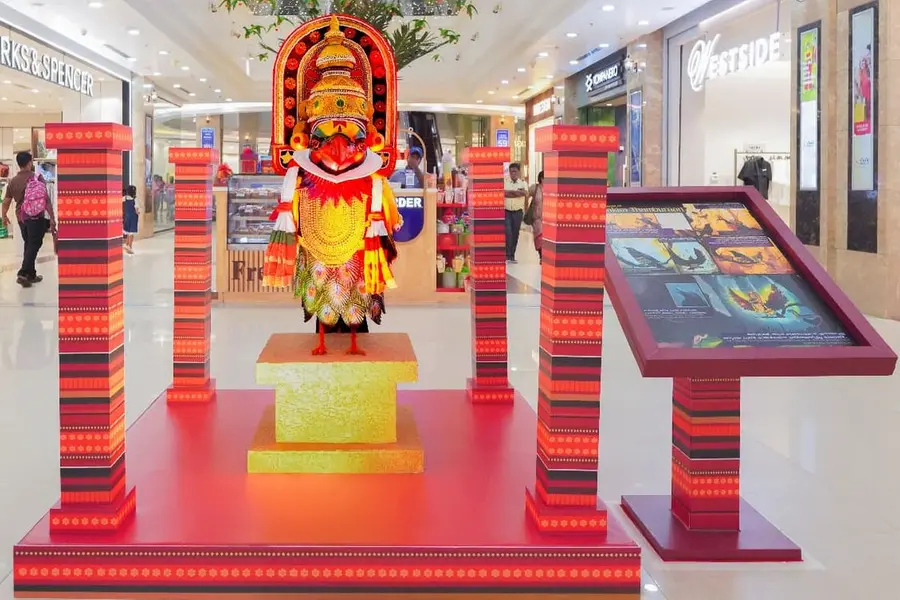
Rather than simply festooning its large interior with floral designs and festive flags, the mall has built an entire world based on folklore named Onappuraanam, where everyone is welcome to greet three friends from Kerala's legend and remembrance -- Chuttimukhan, Kakkathamburan and Nagamukhi.
The first glimpse is set even before one enters the mall, with a 20-foot-high installation of Chuttimukhan waiting to be seen. Its towering height ensures that one cannot help but notice. Kids pause to look, families take photos before entering, and soon, word of mouth does the rest. This is no ordinary decoration changing with every festival; this one is alive -- drawn from something much greater. The remaining two characters, Kakkathamburan and Nagamukhi, are deliberately located in the mall area, making a shopping trip a form of folklore journey.
The concept is plain but powerful: to provide Onam with a living story in an area where thousands congregate daily. The enormity, colour, and creativity make it at once a visual experience and an act of cultural narration.
"This Onam, our vision was to revive the lost art of storytelling by celebrating Kerala’s folklore, vibrant tapestry, and traditional art forms. To craft such a mythological universe, we drew inspiration from Kerala’s roots. At a time when most campaigns look alike, we wanted to create an experience with endless possibilities. One that makes people fall in love with grandma’s tales and our culture all over again. Lulu’s Onapuraanam is not just a campaign; it is a love letter to all who cherish art and stories, a journey back to a time before AI and social media, when people and even mythical beings could have lived as one," said Aiswarya Babu, GM - Marketing, LuLu Malls India.
The campaign has been carefully designed with collaborations that speak to Kerala's increasing passion for art and public storytelling. It is headed by Lulu Malls India Marketing Head Aiswarya Babu, in association with Vith Art Room, Lulu Events Team and Zook Studio. Together they have tried something almost unseen in commercial spaces during a festival -- a storytelling campaign that transcends visual adornment.
This year’s Lulu Onam decor was conceptualised and designed by Vith Art Room, led by Manu and Bindu, who also designed three original characters and created the storyline around them. The comic stories of these characters were illustrated by Balendu T.P. and Abhinand M. The story was then adapted into Malayalam by Sudheesh Kottembram.
Zook App, headed by Shanub, is a creative advertising agency that has been the driving force behind LuLu Mall Kochi’s campaigns for the past nine years. Renowned for its ability to merge creativity with cultural essence, the agency crafted ‘Onapuranam’ campaign, bringing folklore to life in a modern storytelling format.
As part of this campaign, Zook App along with his team Lekshmi, Ananthan and Afsal collaborated with Vith for developing a folklore comic story illustrated with iconic characters Chuttimukhan, Nagamukhi, and Kakkathamburan, making the tradition of Onam more relatable to today’s audiences. In addition, the agency produced the main Onam campaign video for LuLu Mall Kochi, beautifully connecting the folklore theme with contemporary festive celebrations.
With the inclusion of Vith Art Room, another level to the project is added. Established in 2019 by Manu Mohan Pallivathukkal, with co-founders Bindu Anirudhan, a playback singer, and Silna George, Studio Manager, Vith Art Room has been dedicated to the vision of developing the creative abilities of children and communities.
According to their philosophy, art is not limited to individuals who are exceptionally talented; all children possess creativity that can be developed. They explain their mission as nurturing a seed -- watering it, sheltering it, and urging it along until it matures into a sapling that can stand in the sun. From the first time a child can grip a crayon, they feel their creativity needs to be recognised and mentored.
In the last five years, Vith Art Room has pursued this mission through workshops, collaborations, and community projects. They have organised activities such as ‘Handmade’ at Lulu Mall, ‘The Nature of Art’ at Government UPS, Paipra in Muvattupuzha, and ‘Colours of Nature’ at the Creative Learning Academy. Each of these activities aimed to incorporate art into daily life, to remind others that creativity is not a luxury but a fundamental aspect of human expression.
It is against this backdrop that their activity with Lulu Mall during Onam is more significant. It's not simply a matter of creating beautiful installations but of putting art into a public environment where thousands view it with no barrier of galleries, admission fees, or classroom walls.
Public art, indeed, has a singular power. It addresses passing strangers who might never have otherwise looked for it. It engages curiosity in children who might otherwise have been caught up in shopping diversions. It makes individuals stop, glance, and share an alliance that is cultural and personal.
Designing public space has gained more significance in India post-COVID-19 pandemic. When individuals returned to common spaces after months of restrictions and lockdowns, there was a renewed awareness of how essential well-designed public spaces are to the fabric of communities.
Malls, which had previously been viewed only as hubs of commerce, are now also sites of cultural interaction. Parks, metro stops, and public squares are being repurposed with installations, performances, and art inviting interactivity. Lulu Mall's 'Onappuraanam' is also a part of this since it shows how a mall space can be converted into a cultural centre, at least on a temporary basis, during a festival.
For Kerala, this folkloric experiment in a mall has a deeper meaning too. State folklore has long existed in temples, theatres, and word of mouth, but in contemporary times, it will be lost to city families.
By re-immersing figures such as Chuttimukhan, Kakkathamburan and Nagamukhi in an environment in which city families congregate, the campaign reconnects the past and present. Parents and grandparents are left having to clarify these characters to kids, reading them a tale which they may have heard during their own childhood. In a sense, mall installations are as much about spectacle as they are about oral culture being rekindled in new locations.
Guests at Lulu Mall during Onam have termed the installations as surprising and refreshing. For some, the magnitude of Chuttimukhan towering over the entrance was a reminder of how tradition can even amaze us when reimagined.
Children saw the characters as more or less stepping into a world of comics, inspiring imagination beyond the shopping lists held by their families. The synergy between the authors of the stories, illustrators, artists, and marketers made sure the installations were not just fancy add-ons but also an extension of the story that included a comic series that took the experience to the next level, beyond buildings.
The timing of all this is important as well. Onam itself is a narrative-based festival -- of King Mahabali, of equality, of return, and of celebration. There is a story associated with every ritual in Onam, whether it is the floral carpets that represent welcome, the onathappan figure kept at home, or the boat race that reminds one of community spirit.
Lulu Mall's campaign did not try to supplant such traditions but supplemented them, demonstrating how tales can be transformed and new forms of expression in modern society. The characters from folklore are a part of Kerala's rich reservoir of imagination, and by introducing them within a contemporary public space, the campaign has ensured their preservation.
This mix of tradition and modernity is a representation of Kerala's overall cultural ethos as well. The state has never been one where commerce and modern infrastructure coexisted with literature, folklore, cinema, and art. To have such a mall that brings in the folklore into its precincts during Onam is to have it as a microcosm of that cultural synthesis. It is no wonder, therefore, that the installations have been a point of conversation among visitors, social media enthusiasts, and even cultural critics who perceive in it an omen of how festivals can be reimagined for new generations.
Ultimately, the success of Lulu Mall's Onappuraanam campaign resides not just in its visual appeal but in the conversation it has provoked. Festivals are not remembered for what we wear or eat, but for the stories that we share and the emotions that we bear.
By inventing a make-believe world based on folklore, the mall has made shopping during Onam an act of cultural participation. It has made people realise that festivals are not rigid things -- they evolve, modify, and change mediums. Whether it is a village courtyard or a giant shopping complex, the essence of Onam remains the same: community, storytelling, and the joy of togetherness.
This year, as Kerala celebrated its beloved festival with pookkalams, onasadya, and boat races, Kochi's Lulu Mall added another chapter to the evolving story of Onam. With the installations glowing, before the eyes of Chuttimukhan, amidst the colourful radiance of Kakkathamburan and Nagamukhi, tourists became a part of a story that was both old and new. And maybe that is the true magic of Onam -- that it is always finding new ways to unite people, year by year, story by story.
Published: 07 Sept 2025, 10:23 am IST
Related Topics
Disclaimer: Kindly avoid objectionable, derogatory, unlawful and lewd comments, while responding to reports. Such comments are punishable under cyber laws. Please keep away from personal attacks. The opinions expressed here are the personal opinions of readers and not that of Mathrubhumi.
