
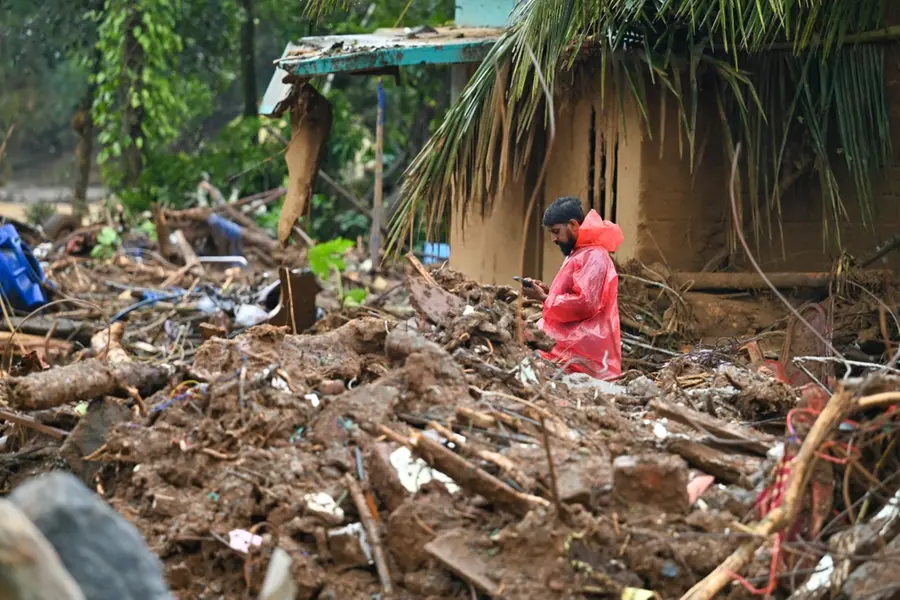
In the wake of the tragic landslides that occurred in Wayanad, the state police media centre has issued a stern warning to the public to avoid travelling to the affected areas.
The police have shared a poster on social media cautioning against disaster tourism or dark tourism. They have also stated that strict action will be taken against anyone obstructing rescue operations or workers.
Chief Minister Pinarayi Vijayan has advised against unnecessary travel to the disaster zones in Wayanad. Emphasising the severity of the tragedy and the ongoing rescue efforts, he urged the public to refrain from gathering as spectators, which could hinder rescue operations. He also stressed the importance of cooperating and recognizing this as a collective societal responsibility.
The phenomenon of disaster tourism, also known as dark tourism, is actually not new. Throughout history, people have been drawn to places where tragic events have occurred.
For instance, even before the end of the Battle of Gettysburg in 1863 during the American Civil War, visitors were drawn to the area. Timothy H. O. Sullivan's famous photograph, "The Harvest of Death," depicted the battlefield strewn with corpses. The site, where almost a lakh of corpses remained scattered later became the famous Gettysburg National Cemetery. Abraham Lincoln delivered his historic Gettysburg Address on the day of this monument’s inauguration.
The Colosseum in Rome, where gladiators fought to death in 80 CE, is often considered a prototype of dark tourism. Similarly, the Italian city of Pompeii, destroyed by a volcanic eruption in 79 CE, has attracted tourists since the early 1800s.
Human curiosity about tragedy and disaster is natural, and this interest drives many to visit such sites. The curiosity to know more about tragedies faced by other people is something that attracts people to these places. However, dark tourism has faced significant criticism and debate regarding its appropriateness.
What is dark tourism?
Dark tourism generally involves visiting places associated with death, tragedy, violence, torture, and war, which hold historical significance.This includes both long-past events and recent or ongoing disasters. It is also known as black tourism and grief tourism.
Descendants of massacre victims often visit these sites to understand their ancestors' suffering, and such visits are considered a form of dark tourism. They are called dark tourists.
A person hiking to a dormant volcano for geological study and to know more about its history is also engaged in dark tourism, though the purpose is educational rather than morbid.
Published: 01 Aug 2024, 05:16 pm IST
Related Topics
Disclaimer: Kindly avoid objectionable, derogatory, unlawful and lewd comments, while responding to reports. Such comments are punishable under cyber laws. Please keep away from personal attacks. The opinions expressed here are the personal opinions of readers and not that of Mathrubhumi.
