
Lockheed Martin's JAGM Quad Launcher (JQL) fires missiles straight up, transforming drone defense on land and sea. Tested on a "Mothership" vehicle, this flexible system offers 360° coverage without repositioning -- cheaper and smarter than rivals.
Lockheed Martin, one of America's biggest defence companies, is working on a brand new missile system that launches straight up into the sky, almost like a rocket. According to a report by Interesting Engineering, this new technology could completely change the way US forces stop enemy drones on land and at sea.
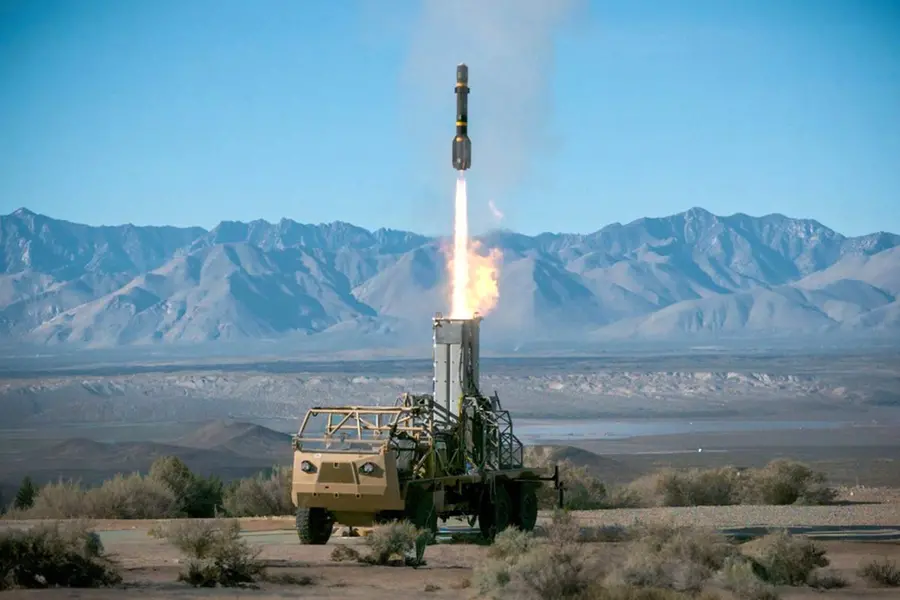
In a recent live test, the company successfully fired its JAGM Quad Launcher (JQL) at a perfect 90-degree angle, proving that it works without needing the usual front-facing launch position.
Why vertical launch is a game changer
Most missile systems fire at a slanted angle, which means the launcher must be turned or pointed in the direction of the target before firing. But this new vertical launch system fires the missile straight up, and then the missile turns mid-air toward the target.
Also Read: How Asteria-DGCA bribery scandal clouds India's drone boom
This is a huge advantage because operators can fire from very tight spaces without moving or adjusting position. This feature is extremely useful on small ship decks, moving army vehicles, and front-line bases, where space is limited and every second matters.
Smart engineering behind the system
Lockheed Martin built the JQL using what they call a modular, open-architecture design. In simple words, it means the system is flexible, like building blocks.
Engineers can easily upgrade it, connect it with other military systems, or add new sensors without rebuilding the whole thing. This is very important because in today's world, threats change quickly, and weapons must also adapt fast.
The system connects with existing combat networks through its Launcher Management Assembly, allowing soldiers to control it from nearby or even from a far distance.
Also Read: 96 drones in 5 minutes: China’s Atlas swarm is a wake-up call India cannot ignore
As Felipe Benvegnu, Director of Mission Systems & Weapons at Lockheed Martin, rightly pointed out, staying ahead of enemies in today's fast-changing world needs flexibility and the ability to adapt easily.
The launcher also has a smart pivot system, which means it can tilt and fire either at an angle or straight up. Engineers have built it tough enough to handle harsh sea conditions, so it can be used on warships and naval vessels.
Another clever feature is the built-in gas control system, which safely releases missile exhaust during vertical launches, protecting nearby crew members and equipment from harm. Along with quick reloading, this system keeps the crew working smoothly without long delays.
The brain of the system: JAGM missile
The Joint Air-to-Ground Missile, or JAGM, is the main weapon used in this system. What makes it special is its dual-mode seeker, which is a fancy way of saying it has two different ways of finding its target.
The first is a laser guide, where a laser beam points at the target and the missile follows that beam. The second is radar, which sends out signals and tracks the target by how those signals bounce back.
By combining both methods, the missile can spot and follow even small, fast-moving drones, no matter if it is dark, foggy, cloudy, or smoky. The missile is so advanced that it can even be fired before fully locking on to its target, and then guided in mid-flight using sensors. This is very helpful in modern war, where situations change every second.
Cheaper than special anti-drone weapons
According to Casey Walsh, JAGM can destroy targets just like special anti-drone systems, but at a much lower cost per shot. This makes it a smart choice for layered defence, where different weapons work together.
Also Read: HAL's golden ticket: Forging Russia's Sukhoi-57 Felon stealth fighter at home
For example, electronic warfare can jam enemy signals, lasers can burn small drones, and if both fail, the JAGM missile can physically destroy the target. It is like having multiple safety nets to catch any threat.
The 'mothership' on wheels
In a January test, the system was mounted on a 6×6 ground vehicle built by Richard Childress Racing, the famous American motorsport company. This special vehicle, called the "Mothership," can carry both missiles and unmanned systems together, working like a moving launch platform.
Engineers fitted the JQL on top, and the test proved that the system can fire in all directions, giving full 360-degree coverage without moving the vehicle. This makes it faster and deadlier in action.
It is interesting to note that Richard Childress Racing, originally famous for race cars, has used its speed, precision, and engineering skills to step into the defence world. Their factories now build very accurate parts for aircraft and military equipment.
Coming soon to the seas
Lockheed Martin is also expanding this technology for use at sea. The company plans more tests with Saildrone, a firm that makes unmanned boats which travel on water by themselves using wind, solar power, and sensors.
These boats are mainly used for sea surveillance and data collection. Fitting vertical-launch missiles on such boats will combine protection, monitoring, and attack power into one single system.
As drone threats keep growing, the world is moving towards flexible weapons that can be used anywhere quickly, and Lockheed's vertical launch system promises exactly that.
The author is a Defence, Aerospace & Geopolitical Analyst.
Published: 25 Apr 2026, 01:56 pm IST
Related Topics
Disclaimer: Kindly avoid objectionable, derogatory, unlawful and lewd comments, while responding to reports. Such comments are punishable under cyber laws. Please keep away from personal attacks. The opinions expressed here are the personal opinions of readers and not that of Mathrubhumi.
