
The Jaguar has served India well, but its time is running out.
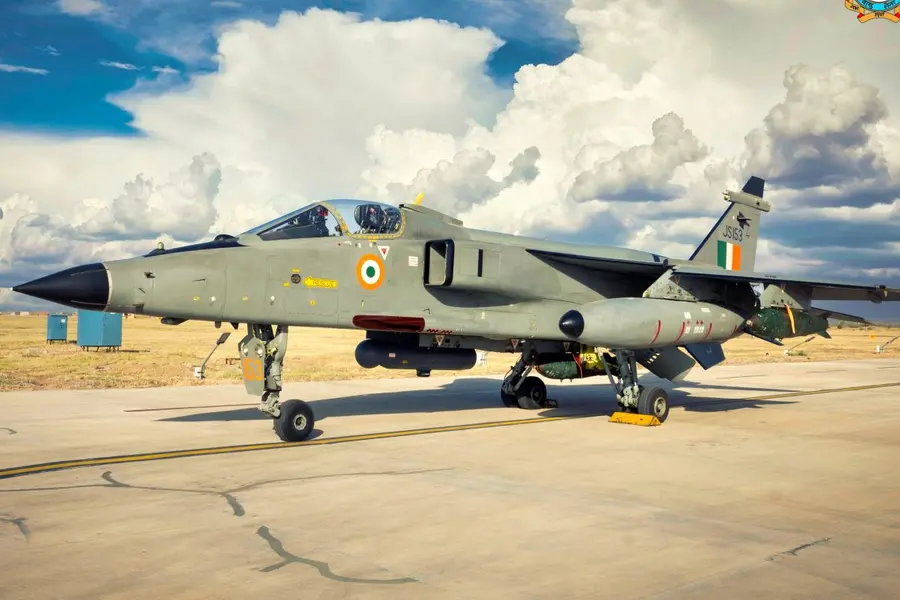
The Indian Air Force (IAF) lost another SEPECAT Jaguar jet on July 9, 2025, when a twin-seater trainer crashed in Rajasthan's Churu district, killing both pilots. This was the third Jaguar crash this year, following incidents in Ambala in March and Jamnagar in April. Over the past decade, at least 12 Jaguars have gone down, and since their induction in 1979, the fleet has seen over 50 accidents, with 65 of the original 140 aircraft lost by 2015. Despite these alarming numbers, the IAF plans to keep these 1960s-era jets in service until around 2040. Why does India cling to these ageing warbirds, and why do they crash so often? Let's break it down.
The SEPECAT Jaguar, fondly called 'Shamsher' (Sword of Justice), is a British-French supersonic jet designed for ground attack and nuclear strike roles. It joined the IAF in 1979 and has been a workhorse, playing key roles in the 1999 Kargil War for reconnaissance and precision strikes, and more recently in Operation Sindoor in 2025, where it struck Pakistani air bases.
With around 115–120 jets across six squadrons, the IAF is the world's only air force still flying Jaguars, as countries like Britain, France, and Oman have long retired theirs. But India's Jaguars are no museum pieces -- they remain critical to our nuclear strategy and deep-strike missions, filling a gap no other aircraft in the IAF can fully replace yet.
Why do Jaguars crash so often?
The biggest culprit is their underpowered Rolls-Royce Turbomeca Adour Mk811 engines. These engines lack the thrust needed for modern demands, especially in India's tough conditions -- hot weather, high-altitude airfields, and dusty environments. This leads to frequent flameouts, compressor stalls, and oil pressure failures, leaving pilots with little time to react.
The jets, some over 45 years old, also suffer from ageing airframes and worn-out systems. Spare parts are hard to come by, forcing the IAF to cannibalize retired Jaguars to keep others flying. A plan to upgrade the engines with modern Honeywell F125IN turbofans was scrapped in 2019 due to high costs -- Rs 190 crore per jet. Add to this the lack of automatic ejection seats, which means pilots must manually eject in split seconds during low-altitude flights, a near-impossible task.
The July 2025 Churu crash, where both pilots died, highlighted this flaw, as one pilot's ejection was too late for the parachute to deploy fully.
Why does India keep flying the Jaguar?
The answer lies in necessity. The IAF is short of fighter squadrons -- only 31 against a needed 42. Newer jets like the HAL Tejas Mk1A and Rafale are delayed, and the Multi-Role Fighter Aircraft (MRFA) program is still in talks.
The Jaguars, despite their age, are versatile. Upgrades like the DARIN-III avionics, Israeli radars, and modern missiles keep them relevant for low-level strikes, where they excel due to their terrain-hugging ability. The Russia-Ukraine conflict showed that low-altitude jets like the Jaguar are safer against modern air defences. Plus, they are cost-effective compared to pricier alternatives. Phasing them out by 2027–28, as planned, would leave the IAF critically short-handed.
Still, the human cost is heavy. Brave pilots like Flight Lieutenant Siddharth Yadav, who died in the April 2025 Jamnagar crash after steering his jet away from homes, remind us of the risks. The IAF has improved its overall safety, with accident rates dropping from 0.93 per 10,000 flying hours in 2000–2005 to 0.20–0.27 in 2020–2024. But the Jaguar's specific issues -- old engines, tired airframes, and part shortages -- push crash rates higher.
Social media posts on X reflect public frustration, with users pointing to 'ageing frames and scrapped upgrades' as reasons for the crashes.
What's the way forward?
The IAF must balance operational needs with pilot safety. Upgrading critical systems like ejection seats could save lives, even if full engine replacements are too costly. Meanwhile, speeding up the induction of modern jets like the Tejas Mk2 is urgent.
The Jaguar has served India well, but its time is running out. Each crash is a stark reminder that we must act fast to protect our pilots and skies.
The author is a defence, aerospace & geopolitical analyst
Published: 10 Jul 2025, 09:40 am IST
Related Topics
Disclaimer: Kindly avoid objectionable, derogatory, unlawful and lewd comments, while responding to reports. Such comments are punishable under cyber laws. Please keep away from personal attacks. The opinions expressed here are the personal opinions of readers and not that of Mathrubhumi.
