
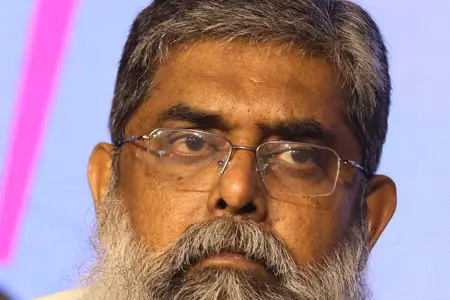
The bureaucratic delay in renewing veteran journalist R Rajagopal's passport reflects a subtler, dangerous trend of using administrative paperwork to muzzle independent press freedom.
There are many ways to muzzle a journalist. While prison may be the crudest of them, democracy that wishes to preserve the appearance of constitutional propriety has far subtler instruments at its disposal. It can bury dissent beneath paperwork, delay it through procedure, exhaust it with litigation and suffocate it under the weight of administrative discretion.
A passport need not be confiscated forever. It only needs to be withheld long enough for every other journalist to understand the message. The controversy surrounding the passport renewal of veteran journalist R Rajagopal deserves to be seen through precisely this lens.
The official explanation, at least so far, is that his passport renewal encountered difficulties because his name had reportedly been deleted from the electoral roll during the ongoing revision of voter lists. That explanation raises more questions than it answers. Since when has inclusion in the electoral roll become a legal prerequisite for obtaining or renewing an Indian passport? The Passports Act contains no such requirement, nor do the Passport Rules.
Applicants establish their identity and address through recognised documents such as Aadhaar, bank records, utility bills and other prescribed proofs, followed by police verification wherever applicable. The law does not say that the absence of one’s name from the voters’ list extinguishes one’s right to a passport.
If electoral status has suddenly become a decisive factor in passport verification, the government owes every Indian an explanation. Not a political explanation, but a legal one. The rule of law cannot coexist with unwritten rules. The immediate issue is Rajagopal’s passport. But the larger issue is whether administrative authorities have quietly begun inventing standards that Parliament itself has never enacted. Rights guaranteed by law cannot be made contingent upon conditions that exist only in bureaucratic imagination.
Ordinarily, one might be inclined to dismiss this as an isolated instance of official overreach. Bureaucracies are not strangers to absurdity. Files are misplaced, rules are misunderstood, and officials occasionally mistake discretion for authority. But context matters, and context is precisely what transforms this episode from a routine administrative dispute into something that demands national attention.
Rajagopal has emerged over the past decade as one of the most credible editorial voices in Indian journalism. While television studios increasingly abandoned reportage in favour of theatrical nationalism and partisan spectacle, he chose the less glamorous task of asking difficult questions and holding those in power accountable. His critics may disagree with his conclusions, but few would seriously accuse him of intellectual dishonesty or reckless sensationalism.
And that is exactly why this episode cannot be viewed in isolation. One remembers Priya Pillai being stopped from boarding a flight to London despite possessing a valid passport, only for the Delhi High Court to later affirm that her constitutional rights had been violated.
One remembers Siddique Kappan spending more than two years in prison after being arrested while travelling to report on a crime that had shocked the country. And one remembers the growing list of journalists and media organisations subjected to criminal investigations, financial inquiries and extraordinary legal provisions for what often amounts to little more than persistent scrutiny of those in office.
No serious observer should claim that these cases are identical. Of course, each arose under different facts and different legal provisions. Yet it requires remarkable intellectual effort to pretend that they are unrelated.
Democracies do not always silence criticism through spectacular acts of censorship. Mature authoritarian impulses rarely announce themselves with dramatic prohibitions. Instead, they operate through accumulation; one investigation here, one travel restriction there, one prolonged verification, and one inexplicable procedural obstacle.
No single incident appears catastrophic, but together they cultivate something far more valuable than obedience. They cultivate hesitation. Journalists begin calculating the personal cost of every story. Editors start wondering whether certain investigations are worth the inevitable consequences.
Institutions gradually internalise caution without anyone ever issuing a formal order. The chilling effect becomes self-sustaining. This is how freedom contracts without a single law formally abolishing it.
India’s declining position in international assessments of press freedom is frequently dismissed by the government as the product of flawed methodology or ideological bias.
There is room for debate about any ranking and no index is infallible. But governments do not rebut criticism merely by questioning those who compile it. They do so by demonstrating through their conduct that independent journalism flourishes without fear of administrative retaliation. That demonstration has become increasingly difficult to make. Perhaps there may be an innocent explanation for Rajagopal’s predicament.
Perhaps an overzealous official mistakenly treated the deletion of a name from the electoral roll as sufficient reason to question passport eligibility. If that is indeed the case, the remedy is simple. Renew the passport, clarify the law publicly and ensure that no citizen is subjected to the same arbitrary interpretation again. If that does not happen, the suspicion that this was more than bureaucratic incompetence will become harder to dismiss.
A confident government has nothing to fear from independent journalism. Only insecure power mistakes scrutiny for subversion. The passport at the centre of this controversy belongs to Rajagopal. The principle at stake belongs to every Indian who still believes that constitutional rights flow from law and not from the goodwill of those temporarily entrusted with power. The day paperwork becomes a weapon against dissent is the day bureaucracy ceases to serve democracy and begins to govern it.
(The author is a National Award winner for Best Narration and an independent political analyst. Views expressed are personal.)
Published: 01 Jul 2026, 05:32 pm IST
Related Topics
Subscribe to our Newsletter
Disclaimer: Kindly avoid objectionable, derogatory, unlawful and lewd comments, while responding to reports. Such comments are punishable under cyber laws. Please keep away from personal attacks. The opinions expressed here are the personal opinions of readers and not that of Mathrubhumi.
