

Kochi-based artist Unnikrishna M Damodaran represented India at Art Blocks Marfa 2025. The visual artist explores how art, AI, and algorithms converge, placing Kerala firmly on the global digital art map.
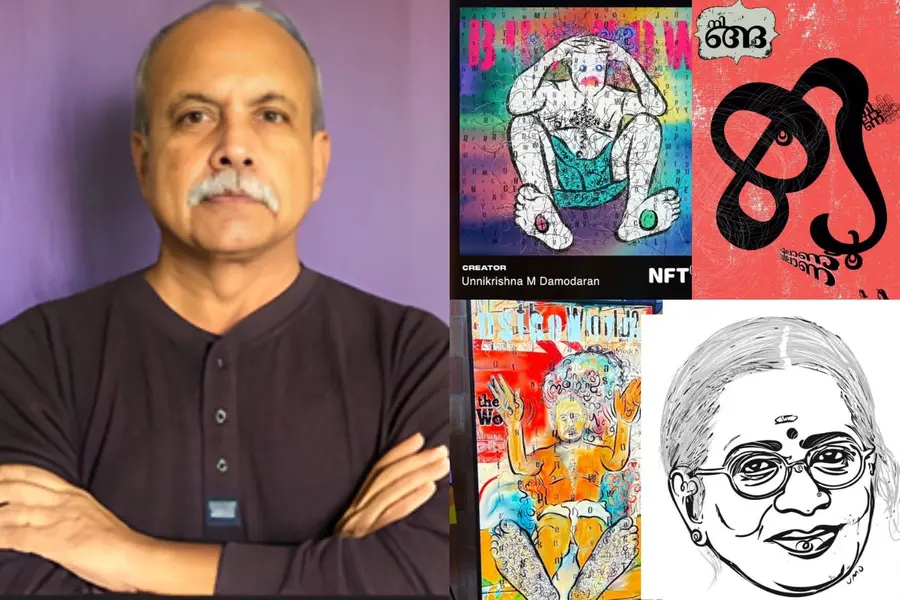
From collecting soap wrappers and packaging covers as a schoolboy to creating art with code, Unnikrishna M Damodaran, a visual artist from Kochi, has always been driven by curiosity and communication. Unnikrishna’s work spans digital art, typography, and generative code-based visuals, along with practising primary media.
This October, he has represented India at the 5th Annual Art Blocks Marfa Weekend (October 16–19, 2025) in Marfa, Texas, USA, one of the world’s most prestigious gatherings for digital and generative art. His inclusion places Kerala and India firmly on the global map of contemporary digital practice.
In this candid conversation with 'Mathrubhumi', Unnikrishna reflects on his artistic journey, his relationship with technology, his views on AI, and the world of generative art and its current scenario.
Tracing the beginnings of a visual journey
Unnikrishna’s artistic journey began during his school days. “I used to collect wrappers from soaps, medicine packets, anything with an interesting design. I didn’t realise it then, but that was the beginning of my fascination with visual language.”, he said with a smile.
With that passion and love for art, he joined to study Applied Arts at the College of Fine Arts, Thiruvananthapuram, which helped him understand how communication and design intertwine. After graduating, he entered the world of advertising, a field that honed his eye for persuasion and structure.
“Advertising taught me clarity,” he says. “You learn to communicate ideas precisely. But outside work, I’d come home and experiment with other media, painting, drawing, typography. I didn’t have a favourite medium for a long time. Now, digital has become my primary one.”
Mixing pixels, code and craft
His foray into digital art began with a first-generation iPad, an unexpected gateway to a new world. “It was magical. I realised I could create anywhere, without limits,” he says.
From there, his tools evolved to Adobe Illustrator and Photoshop, and today, to JavaScript and Processing, a software based on code. “You can actually make images with code. They can be abstract, geometric, or organic. My current practice is about mixing digital and physical forms. The possibilities are endless,” he explains.
For him, the beauty of digital art lies in its openness. “There’s no need for advice,” he laughs. “Everything’s available. You just choose what suits you best and start exploring.”
Representing India at Marfa
At Marfa, Unnikrishna displayed 'Consumer Struggles', a site-specific installation combining physical consumer artefacts with generative visuals displayed on LCD screens. The work examines how capitalist systems and digital communication shape not just our choices but our sense of beauty and pace of living.
“We live in a world that demands speed and clarity. I’m interested in exploring slowness, ambiguity, and partial visibility as strategies of resistance. My practice invites viewers to question systems of clarity, speed, and optimisation, making space for slower, more contemplative engagement with digital images. It invites reflection,” he pointed out.
He is happy and humbled at the same time, seeing his name alongside the names of Beeple, Jack Butcher, Erick Calderon (Snowfro), and Tyler Hobbs, in the event, who have defined the global landscape of generative art. “For me, it’s not about comparison,” he says. “It’s about being part of a wider movement that’s redefining what art can be.”
Viewing AI as an ally, not a threat
He is deeply open-minded about technology. “I take every new tool as an opportunity. “I don’t reject anything, I want to experience it first,” he admits.
He acknowledges the controversies surrounding artificial intelligence in art but sees it pragmatically. “Yes, AI is controlled by a few major companies, but it’s still a technology, another medium. I use it more for gathering information and experimenting rather than creating finished works. The point is to explore, not to fear.”
Art as a discipline
One of his most loved projects is the '100-Day Portrait Series', inspired by a challenge that began at the School of Visual Arts, New York. Participants were asked to create something daily for a hundred days, be it drawing, collecting, or documenting.
“I chose to draw portraits of my friends. It was a huge challenge, working all day and then drawing at night. In the beginning, nobody noticed. But when I started sharing them online, people began to engage," Unnikrishna says.
That project, repeated three times, became a cornerstone of his philosophy. “I don’t believe in waiting for mood or inspiration. Art is like a job; you show up, you do it, you enjoy it. Discipline is what keeps you going,” he said.
Later, he created 'Number Portrait Series in Malayalam' and the 'Malayalam Writers Series', beginning with OV Vijayan, whose name he subtly embedded into the artwork. “Those hidden elements were my way of saying that even within structure, there’s room for play.”
Kerala’s evolving art scene
Having seen Kerala’s art scene evolve over the decades, Unnikrishna is optimistic. “I wouldn’t complain about galleries now,” he says. “After the Biennale, people here understand lighting, display, and presentation. Things have improved dramatically. Even warehouse spaces used for exhibitions handle challenges like heat or humidity well. The professionalism has really grown.”
Speaking up on advertising and brand recall
I’ve always seen advertising as a form of communication, where the main goal is to persuade consumers and make the brand memorable. When I first saw that particular ad of a jewellery brand, I realised I couldn’t even recall which brand it was for. That made me curious, so I asked a few friends working in the advertising industry whether they felt the brand message came through, and most of them said no.
That response really triggered something in me. I felt compelled to speak about it, and that’s what led me to create the reaction video. Since I come from an advertising background myself, though not on the same scale as someone like Prakash Varma sir, I felt I should share a perspective on it.
For me, the primary purpose of an advertisement is to persuade and ensure that the audience remembers the brand. In this case, that aspect seemed to be missing. Of course, one could argue that it’s the first in a series of campaign ads, designed to spark curiosity and make people look forward to the next one, which is also a valid strategy. But when such a large budget is involved, the client’s brief becomes crucial.
https://www.youtube.com/shorts/YMyzQuHlXm0 | WATCH here
In the video, I even mentioned that if the ad met the brief given by the client, then there’s no issue. There are essentially two sides to this discussion, one supporting Lalettan (Mohanlal) and another against. But really, it has nothing to do with Lalettan himself; he’s an extraordinary actor. The real question is whether the creative brief was effectively fulfilled.
Experimentation and the future of digital art
Unnikrishna remains committed to the blend of experimentation and craft that defines his practice. “I want to keep exploring the intersection between digital and physical, where code meets human texture. Generative art, interaction, motion… there’s still so much to learn. Every new medium is an invitation.”
For an artist who began by collecting packaging scraps, the journey to international recognition feels poetic. Yet, Unnikrishna isn’t chasing validation. He’s chasing understanding, of tools, of ideas, of time. “If you keep learning, the art will keep changing with you,” he says.
Art beyond appreciation
Ask him to choose a favourite series, and he refuses. “I can’t pick one. I don’t care for responses. If you chase appreciation, you’ll end up disappointed. Those who truly notice will come and connect,” he said.
His portrait series gained significant recognition at Lokame Tharavadu, curated by Bose Krishnamachari in Alappuzha, which featured over 260 artists. “I printed all 100 portraits on canvas; it was a huge wall of faces,” “I also showed my text-based and animated works there. It was special,” he recalls.
On NFTs and the art economy
When asked about NFTs, his answer is practical. “Basically, Non-fungible tokens (NFTs) are digital assets stored on a blockchain representing content or even physical items. They still exist, but the market fluctuates,” he says. “NFTs are tied to cryptocurrency, and crypto keeps changing. It’s not a guaranteed way to make money through art, but it’s another ecosystem. People can still find their place there.”
Art, politics and the Kochi vandalism controversy
For Unnikrishna, every artwork is inherently political. “If you make art and show it publicly, you should expect reactions,” he says. “Some will like it, some won’t. But vandalism is never acceptable.”
He refers to the recent Kochi art vandalism incident, which sparked debate in Kerala’s cultural circles. “Malayalees were shocked, but many may not know similar or even extreme examples are in the history of art. I think it reflects a lack of curatorial clarity, the absence of a proper curator’s note or institutional intervention. These things could prevent misunderstanding.”
The curator as collaborator, not authority
“Curation was once an alien word for many people in Kerala,” he says. “The Biennale changed that. A curator isn’t someone with power over the artist, but a collaborator, someone who helps shape and contextualise the work. A good exhibition is built on that partnership.”
Position of digital art in Kerala's mainstream
“There’s still resistance in Kerala on digital art,” he admits. “Many traditional artists think digital art isn’t human, that it’s made by machines. But we’ve resisted every new technology before, and we’ve always adapted. Young people here use digital tools brilliantly, but they’re not yet seen as part of the mainstream art world. That will change when digital artists form their own parallel force, a community strong enough to say: this is art too.”
Published: 03 Nov 2025, 12:06 pm IST
ABOUT THE AUTHOR
Disclaimer: Kindly avoid objectionable, derogatory, unlawful and lewd comments, while responding to reports. Such comments are punishable under cyber laws. Please keep away from personal attacks. The opinions expressed here are the personal opinions of readers and not that of Mathrubhumi.