

Meet Dr Kodoth Prabhakaran Nair, a world-renowned soil scientist. Discover his journey, contributions to sustainable agriculture, and insights on protecting our planet`s most vital resource.
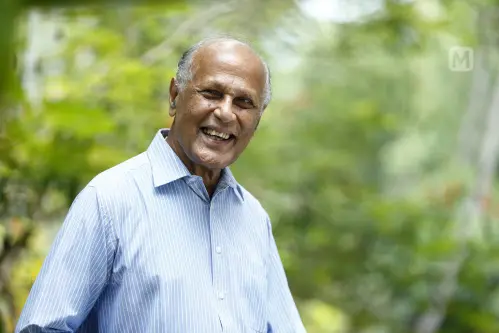
When soil speaks, Dr Kodoth Prabhakaran Nair listens. An internationally renowed agricultural scientist whose journey into soil science began in the 1980s, Nair has turned a lifelong passion for soil science into a globally recognised legacy. He was recently named among the top 2 percent of scientists in the world in Stanford University’s 2024 list.
Once a professor with the National Science Foundation and the Royal Society in Belgium, and a Senior Fellow of the Alexander von Humboldt Foundation in Germany, Nair’s career has spanned continents and decades. The first and only Asian scientist to hold the prestigious National Chair of the Science Foundation, he was the first to launch India’s first scientific e-book. Nair fondly recalls that the late President APJ Abdul Kalam personally flew from New Delhi to Chennai to launch one of his book, a moment he continues to cherish.
Behind his calm demeanour lies a story of quiet resilience. Losing his parents early—his father, a decorated police officer honoured with the King George V Medal for bravery—Nair built his life from around the soil. With his wife, nematologist Dr Pankajam Nair, he chose to return home to Kerala, settling in Kozhikode after years of global research and teaching across Europe and Asia.
In a freewheeling interview with Mathrubhumi, Dr Nair talks about the way the world looks at the earth that feeds us.
From your global perspective, which countries are leading in sustainable agriculture, and what lessons can others learn from them?
From my experience I find Sweden and Switzerland leading in sustainable agriculture. I think the lessons that one must learn from them is first on the centrality of sustaining soil resources and adopting climate resilient sustainable agriculture. My latest book provides a good direction to India. It is titled ‘Climate Resilient Sustainable Agriculture’.
What were the biggest challenges you faced while working across three continents (Europe, Africa, and Asia) in agricultural research?
After finishing my Ph.D in Agronomy (specialisation in soil fertility and plant nutrition) from the Indian Institute of Agricultural Research, New Delhi, in 1965, I was immediately selected for a Post Doctoral Fellowship by the Belgian Ministry of National Education & Culture. I had no difficulty in adapting to the research and societal conditions when I went to Germany in 1980 as a Senior Fellow of the world renowned Aleander von Humboldt Research Foundation. I must frankly state that I faced no professional challenges while working in Europe. There were, of course, few instances of racial discrimination in Germany, but, when a German realises that you are equal or above him/her, in professional competence, they start respecting you. This is in sharp contrast to my earlier work in India, where the all pervading jealousy inhibited one's capabilities. In Africa, I faced no challenges whatsoever. In fact, during my tenure as Senior Professor at University of Fort Hare, Alice, (the Alma Mater of late President Nelson Mandela) —it was Mandela himself who invited me to the country to establish a Faculty of Agriculture at his alma mater.
How can traditional knowledge and modern agricultural technologies be integrated for better results?
As far as agriculture is concerned, there are several examples where one can learn from traditional knowledge. One of the best examples is the use of organic manure, particularly farm yard manure (FYM). In villages, this is very common. The liberal use of FYM helps build up soil carbon, as against the excessive use of synthetic or chemical fertilisers promoted during the so-called Green Revolution, which has led to huge soil carbon loss.
You have written several books on agriculture science. What inspired you to write the book Nutrient Buffer Power Concept, selected as one of the 20 best books on sustainable agriculture, ever written. How did it feel to have your book released by UN Secretary-General Antonio Guterres?
My inspiration to write the book on Nutrient Buffer Power Concept originated from my total disillusion about the so-called ‘green revolution’ and the manner in which it was carried out in India. I realised that the Indian agricultural scientists, especially those working in the area of soil science and plant nutrition, never took the trouble to clearly understand the thermodynamic principles involved in soil nutrient bio availability. The opportunity to develop the concept was realised when I received the world renowned Senior Fellowship of the Alexander von Humboldt Research Foundation in Germany, and a placement at the Institute of Plant Nutrition at Giessen in Germany. I felt very humbled when UN secretary general Antonio Guterres launched my book on global warming in New York, during the global meet for Heads of State that he had organised. Prime minister Modi and US president Donald Trump had attended and both were presented with a copy of the book. Modi was very generous to write a personal letter complimenting me on the book, when he returned to India, while Trump ignored my gesture.
How can developing nations protect biodiversity?
Only when the policy makers realise that the so-called ‘development’ is not at the cost of ruining bio diversity. My book on this theme explains all the principles involved
As the author of the first electronic agriculture book in 2012, what’s your view on the role of digital technology in shaping the future of agriculture?
I strongly believe digital technology has much to offer in disseminating scientific knowledge in agriculture. But, I also realise that the printed word will stay. All of my books (20 in all) are both in the digital and printed form, including the book ADVANCES IN AGRONOMY, the magnum opus of agricultural science or what is called the ‘Bible of agriculture science’, to which I have been invited ten times to contribute chapters.
Do you believe AI, big data, and precision farming can realistically benefit small farmers in developing countries?
Not the first two, in any case, but, precision farming, yes, provided those who impart its knowledge handles the subject very objectively and intelligently. The best example comes from my experience when Kansas State University in the US took as a benchmark, my book ‘The Nutrient Buffer Power Concept’ for its ambitious multimillion USAID project in soil testing for West Africa.
What changes would you recommend in agricultural policies in India to ensure long-term food security globally?
As long as the ‘Right to Food’ is not enshrined in the UN Charter, food insecurity will continue to plague, especially poor nations on the African continent.
What are some misconceptions about agriculture and soil management that you often encounter?
The most sorrowful misconception about the soil is that people still consider soil as an inert material. In 1986 August, when I was invited by the organisers of the World Soil Science Congress in Hamburg, Germany, I said the word ‘SOIL’ denotes ‘Soul Of Infinite Life.'
How do you view India’s progress in agriculture compared to when you began your career?
I acknowledge the fact that the highly chemical-centric farming, euphemistically called the ‘greeen revolution’, produced a huge amount of food for a few years, precisely between 1966 and 1970, but, it led to a series of environmental hazards, especially concerning soil, namely, soil degradation. If one compares the satellite pictures of the pre-green revolution phase in India and post-green revolution phase, one can clearly understand how this soil degradation has occurred not just in India, which religiously followed the green revolution, but other nations in South Asia like Pakistan and Bangladesh. But, the problem has been most acute in India. Of the 328.73 million hectares of geographical area, as much as 120.40 million hectares have now degraded soils, that is more than a third of India's total geographical area, thanks to the green revolution. This after effect has been most acute in Punjab state, the ‘cradle of Indian green revolution’. In fact this has even led to the spread of cancer. Gurdaspur in Punjab is known now as the ‘capital of Indian cancer’. Soils are degraded, ground water is polluted with residues of synthetic fertilisers like urea, pesticides, and herbicides. making water no more potable. Unless this acute problem is tackled seriously, India will have to face huge environmental hazards especially soil related. My research shows that the green revolution has caused even global warming due to the excessive emissions of nitrous oxide into the atmosphere, a by product from unbridled application of urea fertiliser to prop up yields of rice and wheat. It can cause upto 30 % global warming.
Looking back, what has been the most fulfilling moment of your career?
I think my most fulfilling moment in my professional career was when in 1984, after the presentation of my research paper on "The Nutrient Buffer Power Concept"in the International Colloquium on Plant Nutrition held in France, I was named to the National Chair of The Science Foundation, The Royal Society, Belgium. Equally fulfilling moment was when in I960 I was awarded the prestigious Robertson Memorial Gold Medal for Agronomy.
Published: 30 Oct 2025, 09:58 am IST
ABOUT THE AUTHOR
Related Topics
Disclaimer: Kindly avoid objectionable, derogatory, unlawful and lewd comments, while responding to reports. Such comments are punishable under cyber laws. Please keep away from personal attacks. The opinions expressed here are the personal opinions of readers and not that of Mathrubhumi.