
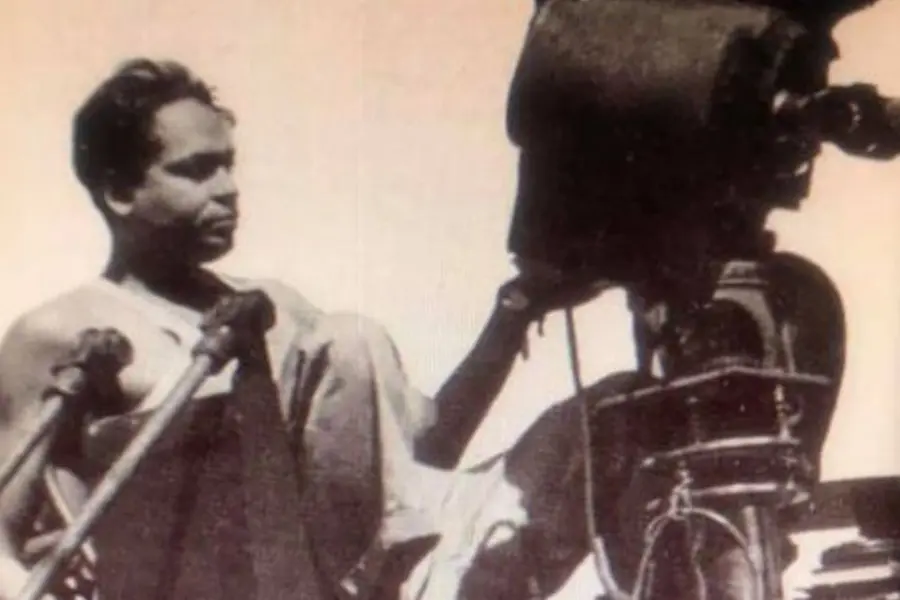
The most popular film of centenarian Ritwik Ghatak , Meghe Daka Tara( Cloud capped star) ends with the cry of the protagonist Neeta –”brother I want to live , brother I want to live”. The scene happens in a sanatorium in the hills, where the Musician brother visits the protagonist.
We, as the audience know that she is going to die, as tuberculosis is in an advanced stage. The film ends with the cry of the protagonist, leaving the audience it as her last cry or just her ardent wish to live. That is Ritwik Ghatak, the filmmaker for you. He leaves the characters and situations to your imagination, after taking them to a point triggering the audience’s imagination. The same happens in his equally significant film Subarnarekha. The sister, who became a prostitute, after the death of her husband, is faced with her own brother as a customer in an unfortunate situation devastating both of them. In a fit of emotions, she kills herself, but we do not see it literally, but through the tragic state of emotions faced by the sister and brother, conveying the depth of the human tragedies of partition in full measure.
“I have been experimenting with my films. To me, all my films are just completed exercises; I cannot have any opinion about them. But when I hear, for instance, that the non-realistic cry of a consumptive girl; “I want to live”;—just when she is at the point of death, is horribly forced in the context, I truly wonder. I feel I have not been able to convey the entire allegorical connection of Um —the wife of the Lord of Destruction, who is the archetype of all daughters and brides of all Bangalee households for centuries—with the protagonist. Or for instance, when I hear that I am guilty of expressionism in my latest film, and that expressionism and symbolism do not go hand in hand with reality, I try to think out, then what are the things on which expressionism thrives?” wrote Ritwik in the chapter Film and I, of the book -Cinema and I, containing a collection of articles and interviews of a lifetime. The book published after his sad demise in 1976, essentially is the mirror to the creative genius of the filmmaker who has inspired generations of filmmakers from the 1960s, especially those who were his students at Film Institute of India (FII) at Pune where he was the Vice Principal. His illustrious students include, Adoor Gopalakrishnan, Mani Kaul, Kumar Shahani and John Abhraham.
“Film is, basically, a matter of personal statement. All arts are, in the final analysis. And film seems to be an art. Only, film is a collective art. It needs varied and numerous talents. It does not follow that the film is not personal. It may be, at one end, the case of a collective personality, and on the other, may bear the stamp of one’s individual’s temperament upon all the others’ creative activities,” the filmmaker whose birth centenary falls in 2025 wrote putting an end to the debate whether film is an art form or not in the 1960s itself.
Though Ritwik was the script writer of the Hindi box office hit film directed by Bimal Roy, Madhumati in 1958, his ideal film remained Pather Panchali of Satyajit Ray, made in 1955. “I believe in committed cinema. I mean, committed in the broadest sense of the term. To me the great Indian example is Pather Panchali. Because of its truth, its sense of beauty, its bursts of visual ecstasy and of mental passion. I know I am being a bit old-fashioned, but there it is. Satyajit Ray, and only Satyajit Ray in India, in his more inspired moments, can make us breathtakingly aware of truth, the individual, private truth.” Ritwik observed in another article in the book.
Pather Pnachali even after decades is listed as one of the all-time greats in the decadal voting of Sight and Sound magazine of British Film Institute, affirming the “truth” as seen by Ritwik.
“Film going is a kind of ritual. When the lights go out, the screens take over. Then the audience increasingly becomes one. It is a community feeling, one can compare it with going to a church or in a Masjid or a temple.” Very few filmmakers of his era underscored the phenomenon of films affecting the collective social consciousness as a medium, the way Ritwik identified.
His kinds of films were dubbed as experimental by the critics then. But for Ritwik all experiments were to reach out to the humans through a creative route. “Experiment in films, in relation to what? In relation to man and his society. Experiment cannot dangle on a void. It must belong. Belong to man…,” Ritwik declared in his writings.
He went on to add; “I have tried to portray my country and the sorrows and sufferings of my people to the best of my ability. Whatever I might have achieved, there was no dearth of sincerity. But sincerity alone cannot be very far. My ability limits me, and I can operate within that limitation.”
Born in the Bangladesh side of undivided Bengal, Ritwik was obsessed by the partition of Bengal and the massive suffering which the people underwent from 1947. Human suffering of partition formed the core of the themes of his films and those themes peaked in films like Meghe Dakka Tara and Subarnarekha.

Though his films like Megehe are considered totally melodramatic, Ritwik continued to innovate with his socially and culturally layered approach to situations and characters. Bengal and its nuanced culture dominates the film leaving others wonder what all has been said in the film apart from the melodramatic exterior of the narrative. “In my humble opinion, Komal Gandhar probably tried to break the shackles that straight-jackets our cinema. It has a pattern and an approach which may be tentatively called experimental. Subarna Rekha. Here is a film in which I tried to deal a straight knock-out blow on the nose. It pulls no punches. It has been called melodramatic.” Melodramatic or not, no one can ignore the bare realities of life shown by Ritwik in these films, especially the individual and social suffering of the uprooted people.
In Subarnarekha, there is a heart wrenching scene of a boy separated from his mother during post partition days finding her after decades, at a railway station in a dying state, devastating the man. The incident totally changes the man ejecting him from all his physical realities of a comfortable life with his adopted family. But again, no one is making long dialogues and crying out in the film, while going through the tragic experience. But the way the events are juxtaposed gives the audience almost the same experience or more as created by the lengthy dialogues and melodramatic acting in normal films.
Ritwik’s creativity makes us go through the experiences of the characters as intensely as it could be. No wonder Ritwik wrote: “Tagore somewhere said that all art must be primarily truthful and then only beautiful. Truth does not make any work a piece of art. But without truth no art is worth its salt.” For his truth is also creativity at its best.
Ritwik ‘s journey to films was from literature and then theatre. His aim was to reach the maximum number of people instantly with his creative ideas and thoughts. Of course he was deeply influenced by the radical Left ideologies of the times, though he was thrown out of the Communist party and IPTA at one point. Over a decade he wandered as a fiction writer, play writer, actor, and theatre personality before landing in films. “Initially, I was a writer. I have written about a hundred short stories and two novels at the beginning of my career, from way back in 1943 onwards. I was always perturbed seeing the situations around me of the then Bengal.
“My colleagues and our colleagues roamed extensively all over the place and tried to rouse our people against the ills which are eating at the vitals of our society. I have played and acted before an audience of ten thousand persons. But I found it was also an inadequate medium. Then I realised that to say what you say to-day, the film is the only medium. It can reach millions of people at one time itself which no other medium is capable of reaching.
“Then I came into films. My coming to films has nothing to do with making money. Rather it is out of volition for expressing my pangs and agonies about my suffering people. That is why I have come to the cinema. I do not believe in entertainment as they say it or slogan mongering. Rather I believe in thinking deeply of the universe, the world at large, the international situations, my country and finally my own People. I make films for them. I may be a failure. That is for the people to judge.”
True to his creative self, Ritwik with all his Left ideologies could fashion himself as a political campaigner.
The centenarian Ritwik Ghatak was part of the Bengal trio- of Satyajit Ray, Mrinal Sen, but unfortunately was the first to die in 1976 at the age of 50 due to his lifestyle issues. Though he started his filmmaking career before Ray, his first film Nagarik,(1952) was released after his death. With an oeuvre of eight feature films, a host of documentaries and number of incomplete films, one on late Prime Minister Indira Gandhi (incomplete), he stands tall and an inspiration for generations with his work. Many call him the filmmaker’s filmmaker, as few in the Indians meaningful filmmaking arena have such an ardent fan following as Ritwik among filmmakers, be it Mani Kumar, Kumar Shahani, Adoor or Sayed Mirza or John Abraham. Ritwik saw the future of Indian films in his students, he mentored at Pune film institute. His films Meghe Dakka Tara, Komol Gandhar and Subarnarekha were digitally restored and added to the Criterion collection of world classics in the USA marking his strong presence for himself in the history of cinema.
( V K Cherian is the author of books-Celluloid to Digital: India’s film society movement and Noon filmsand Magical Renaissance of Malayalam Cinema”- Published by Atlantic)
Published: 25 Feb 2025, 02:44 pm IST
Related Topics
Disclaimer: Kindly avoid objectionable, derogatory, unlawful and lewd comments, while responding to reports. Such comments are punishable under cyber laws. Please keep away from personal attacks. The opinions expressed here are the personal opinions of readers and not that of Mathrubhumi.