
Dr APJ Abdul Kalam’s legacy is not in monuments or memorials, but in every missile that guards our skies and every scientist who dares to dream of an Atmanirbhar Bharat.
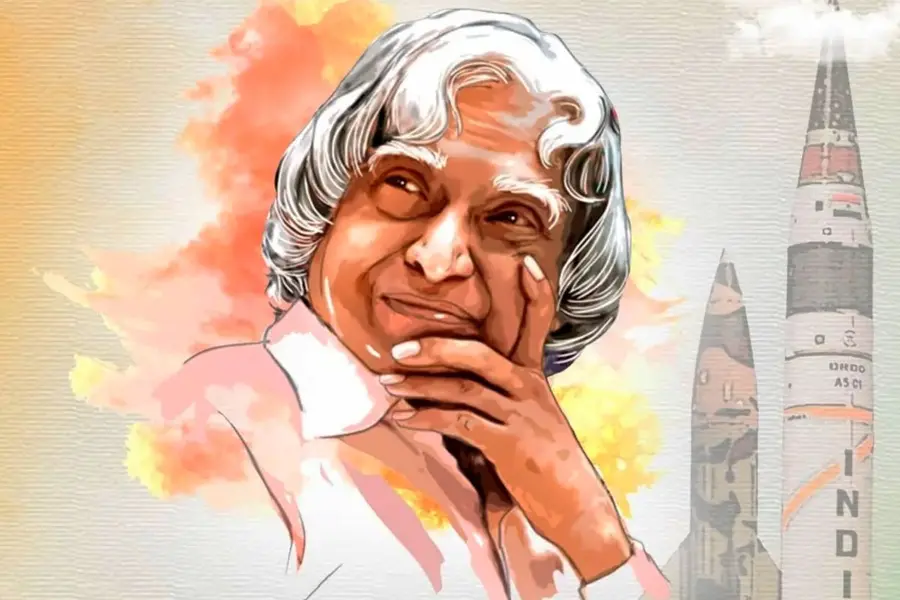
On October 15, 1931, in the small island town of Rameswaram, Tamil Nadu, a boy was born who would one day transform India into a formidable military and space power. Dr Avul Pakir Jainulabdeen Abdul Kalam, who passed away on July 27, 2015, was not just India's 11th President -- he was the architect of the nation's defence might and the guardian of its strategic autonomy.
Today, as we remember him on his birth anniversary, it is impossible to separate modern India's defence capabilities from the vision and tireless work of this humble scientist who wore many hats -- rocket engineer, defence scientist, teacher, and people's president.
When Kalam joined the Defence Research and Development Organisation (DRDO) in 1958, India was a fledgling nation struggling to establish its place in the world. The country depended heavily on foreign powers for its defence needs, a situation that left it vulnerable and compromised its sovereignty. Kalam understood that true independence could only come through self-reliance in defence technology. What followed was a journey that would rewrite India's destiny.
His greatest contribution came through India's missile programme. In the 1980s, when India faced threats from multiple fronts and international technology denials, Kalam led the Integrated Guided Missile Development Programme (IGMDP). Under his leadership, India developed five missile systems that would become the backbone of the country's defence -- Prithvi, Agni, Akash, Trishul, and Nag. Each missile served a specific strategic purpose, from short-range battlefield weapons to intermediate-range ballistic missiles capable of delivering nuclear warheads.
The Agni series, in particular, was Kalam's crowning achievement. These missiles gave India the ability to deter aggression from adversaries near and far. Today, when India speaks with confidence on the world stage, much of that confidence stems from the strategic deterrence that these missiles provide. The recent Agni-V, capable of reaching targets over 5,000 kilometers away, is a direct descendant of Kalam's original vision.
But Kalam's genius was not limited to missiles alone. He played a pivotal role in India's nuclear programme, particularly during the Pokhran-II tests of 1998. As the Chief Scientific Adviser to the Prime Minister and head of DRDO, he was instrumental in making these tests successful, establishing India as a declared nuclear weapons state. This was a defining moment in Indian history, one that fundamentally altered the nation's strategic calculus and earned it respect, if not always approval, on the global stage.
What made Kalam truly exceptional was his ability to see the bigger picture. He understood that defence technology was not just about weapons but about creating an ecosystem of scientific excellence. He championed indigenous development at a time when it was easier to import technology. He mentored generations of scientists and engineers, instilling in them the confidence that Indians could match and exceed any technological achievement in the world.
The India we see today -- launching satellites for other nations, developing hypersonic missiles, creating indigenous aircraft carriers, and building advanced fighter jets – stands on the foundation that Kalam helped construct. The Agni missiles guard our borders. The cruise missile Brahmos, developed through Indo-Russian cooperation that Kalam supported, is now among the world's fastest. The anti-satellite weapon that India tested in 2019, demonstrating its space warfare capability, was a realization of Kalam's integrated vision of aerospace and defence.
Beyond hardware and missiles, Kalam's greatest contribution was perhaps psychological. He made India believe in itself. In his book "India 2020," he outlined a vision for transforming India into a developed nation, with self-reliance in defence as a crucial pillar. He showed that a country that had been colonized for two centuries could stand tall among the world's technological powers through determination, hard work, and indigenous innovation.
His life embodied the values he preached. Born into a modest family, facing numerous failures and setbacks, Kalam never lost sight of his dreams or his commitment to the nation. He remained accessible, humble, and deeply connected to India's youth until his last breath – which came while he was doing what he loved most, teaching students at IIM Shillong.
Today's India, with its growing defence exports, indigenous aircraft carriers, advanced missile systems, and ambitious space programme, is the India that Abdul Kalam dreamed of and worked tirelessly to build. When Indian satellites reach Mars, when Indian missiles stand ready to defend the nation, when young engineers in ISRO and DRDO push the boundaries of what's possible, they walk the path that the Missile Man from Rameswaram first cleared.
On his birth anniversary, we remember not just a scientist or a president, but a nation-builder whose vision continues to guide India's journey toward becoming a global power. His legacy is not in monuments or memorials, but in every missile that guards our skies and every scientist who dares to dream of an Atmanirbhar Bharat.
Published: 15 Oct 2025, 11:03 am IST
Disclaimer: Kindly avoid objectionable, derogatory, unlawful and lewd comments, while responding to reports. Such comments are punishable under cyber laws. Please keep away from personal attacks. The opinions expressed here are the personal opinions of readers and not that of Mathrubhumi.
