
Regrets fills within as we think,
Let me add something in my own melody… (Poykayil Appachan)
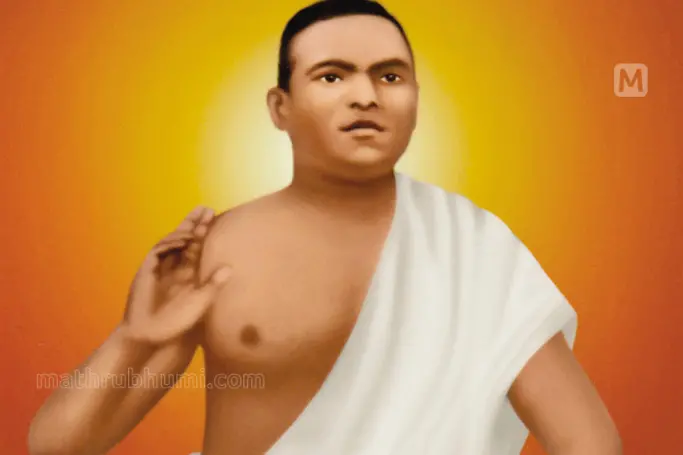
While the first world war was brewing in Europe a man from the untouchable social section in Kerala led a peace rally in Travancore. The untouchables and Avarna the outcastes outside the Varna system of Hindu caste system were not even allowed to walk on public roads and highways or temple roads. In 1910-12 even before the world war and the 1924 Vaikom struggle for entering the temple roads a leader of the socially excluded, unrepresented people of Kerala pioneered the peaceful protest and dissent rally against the world war. While innocents are suffering the calamities of the Zionist war unleashed by Israel on Palestine and Iran. Now this historic episode of Kerala’s enlightenment struggles are significant and worth recovering in totalitarian and oligarchic times of pseudo majoritarian cultural nationalism, linguistic parochialisms and fascism. He is called affectionately as Poyka or Poykayil Appachan by the people.
Poyka or Poykayil Appachan (1878-1939) is also known as Poykayil Yohannan and Sri Kumara Gurudevan now. He had 18 such names that show his plurality of subjectivity, diverse political and social praxes. He is called Appachan by the people still because he was a spiritual and community father figure for them who delivered them from slavery in which they were denied such family relations and human life. Appan, Achan, Appachan, Ayyan, Ayyappan etc. are terms of reverence originating from ancient Tamil and Pali that were originally used to address the Jinas or the Buddha/Boddhisatva in ancient Tamilakam. Kerala or Chera land was also part of this ancient Tamil country till the early middle ages when Brahmanism ascended down to South India and Hinduized the people.
Appachan was born in a dalit family of agricultural caste slaves in Eraviperur near Tiruvalla in mid Travancore in late 19th century. His parents Kandan and Lechi were slaves of the Changaramangalam (later Sanskritized as Sankaramangalam) feudal household. Since the lords were Syrian Christians he got the Christian name Yohannan. Komaran was the actual name given by the parents at birth. Komaran means Cheyon or the ancient Tamil Changam god Murugan or Kandasamy or Skanda Boddhisatva of Mahayana. Later Komaran was Sanskritized as Kumaran still signifying Murugan; but as an offspring of Siva in true Hindu Saivite fashion. He was not given much formal education but through his brilliance learned the letters of the alphabet, like Chattampi Swamikal who overheard the oral drills at a Brahman school and learned; and began to read and discuss with his fellow boys. It is also worth remembering that Chattampi Swamikal’s original name was Ayyappan, though he became famous later as Kunjan Pilla Chattampi. Ayyappan, Komaran/Murugan and Kannan were key Boddhisatvas in the Mahayana shrines in Kerala as in Sabarimala, Payyannur and Koraviur/Guruvayur till early middle ages they were modified into Saiva and Vaishnava Hindu deities by hegemonic all-devouring Brahmanism. As a slave child in the Syrian Christian household Komaran or Yohannan learned the Bible with awe and wonder and interpreted it for the silenced. He also got some alphabets from the CMS school nearby. That is why he got the name preacher Yohannan or Yohannan Upadesi. He was also called mockingly as Lohannan as he used the long robes or Loha of a preacher by the feudal minded caste Christians and the caste Hindus alike. But we can now see in hind sight that he was unconsciously as if in a spiritual instinct becoming a monk who talked to and taught the people on ethics the Dhamma of liberation. Appachan was an enlightened being a real compassionate one who walked with and talked to the people.
Poyka used the breaks and ruptures of colonial modernity of the West critically for the liberation of his people in Kerala. He cooperated with the Marthoma church, Brotheran Mission and the Verpadu Sabha for so many years but he was forced to cut off from these mainstream Christian churches as casteism and untouchability were prevalent even within these protestant groups. Thus Appachan grew critical of the Kerala Christian churches and the mission of the Bible in South India and began his critique of the Bible and the caste Christians in Kerala. As an act of symbolic protest he burned the Bible in a meeting of the dalits and declared that its manifestations and interpretation in Kerala are hijacked by caste Hindu Brahmanical status quo groups who maintain their monopoly, diminishing the light of the new faith. It can be compared to the Brahmanical infiltration into Mahayana that diluted and liberalized the original Teravada teachings of the Buddha; that was condemned as the “Hinayana” (the lacking little vehicle) by Brahmanism and made it elitist and finally allowed the Brahmanical takeover or absorption of Buddhism into Brahmanism that happened in early centuries of Common Era in India. Whether it is Buddhism, Christianity or Communism in Kerala, all these liberating praxes were abrogated and interpolated by Brahmanism in India and Kerala in particular.
Some of the democratic Syrian Christian families were also cooperating with the Poyka movement in its early stages. Appachan organized many secret gatherings and travel speeches. He adopted cultural camouflage and guerrilla forms of gathering and protest. He never resorted to violence or aggression but always walked the long and strenuous path of total liberation. He was walking the talk like the compassionate one. It was a moving audience that he addressed in Kuttanad (the land of Kuttan or Puthan/Buddha) and Western Ghats two important last locations of Buddhism in Kerala. His was a spiritual and cultural voyage and wisdom. His sect was also ordered in the manner of a Sangha. He was its wise head or lord. It was officially declared in a colonial court in 1910. He was arrested by the British police and produced in the Judicial Magistrate Court at Changanasery for leading a peace rally against the First World War. It is another historic occasion when a dalit leader has organized a peace rally in Kerala for the first time against a war that was breaking in Europe largely.
When the British Magistrate asked him about his organisation he declared that his sect is called Pratyaksha Raksha Daiva Sabha (PRDS) and he is the leader and lord or “god” of it. It is again a significant moment in colonial modernity and justice in India that made possible such an assertive articulation from the extremely excluded victim of Varna barbarism. The justice of the British Empire where the sun never sets allowed such a historic articulation by a marginalized subject. We need to remember that in India it was the rule of the Manusmruti ever since the usurping Brahman commander Pushyamitra Sunga cunningly assassinated his Mauryan Emperor. Manusmruti the Hindu law had different rules for different Varnas. According to the Laws of Manu if a Sudra listens to the Vedas boiling metal must be poured into his ears, and if he articulates the Vedas or the letters of the alphabet his toungue must be pulled or cut out. We know, as mentioned earlier the life story of Sri Chattampi Swamikal (1853-1924) who was denied formal Sanskrit education along with the Unnis or Brahman boys in the Veda Padhasala, because he was considered a Sudra in late 19th century despite the fact that his father was a Brahman. It was because of the wedlock of nocturnal alliance system called Sambandham that created and maintained sexual slavery and sexual colonies among Sudra women by Brahmanism from the early middle ages onwards in Kerala to enforce its paternal authority and paternal ambiguity among the Sudra males. But fortunately Swamikal overheard the articulation of letters and learned it well than the regular Unnis to become the monitor or Chattampi later.
Avarnas were not even considered human in the Hindu constitution called Manusmruti that was replaced by a modern democratic constitution by Ambedkar in mid 20th century. As Ambedkar burned the Manusmruti Appachan burned the Bible because it was used by the caste Christians to legitimize the apartheid in Kerala. The Savarna-Syrian nexus is the axis of evil and oligarchy in Kerala breeding power monopolies, over representation and fascism. He continued his community building and it was not simply spiritual but material and infrastructural as well. He was one of the first dalit leaders in Kerala to identify the deficiency of material resources like land for the dalits. The PRDS movement bought land through hard toil and bonded labour in various parts of Kerala, including the high ranges. Appachan made schools and community prayer halls and PRDS branches in various parts of Kerala in his life time. These community centres are still thriving, especially the PRDS head quarters at Eraviperur east of Tiruvalla and school and college at Amara near Changanasery.
He also represented the dalits in Praja Sabha the legislative assembly of Travancore twice in 1921 and 1931 and continued his legislative service till 1939 his demise. We may also remember the Prajasabha speeches of Asan, Ayyankali, Mooloor and Kurumban Daivatan at the assembly for the Avarna. The close fraternity between Mooloor and Daivatan is also worth remembering here. 2025 is the centenary of Mooloor’s Malayalm verse Dhammapada done at the behest of Sahodaran. His Pulavritangal or Pulaya Songs were composed for Daivatan in the assembly. Like these early pioneers Appachan was fighting for the educational rights and scholarships of the dalit children while at the assembly. His own creation of schools and community centres and owning of land were part of the creation of cultural, symbolic and land capitals for the dispossessed. Appachan was a visionary in the early 20th century to acquire various forms of capital for the dalit community. His attempts to join and harmonize the various dalit sects by out rightly rejecting sub caste divisions also prove that he was a pioneer of the greater democratic movement called communitization initiated and made possible by Narayanaguru, Sahodaran and Mooloor in the context of Kerala enlightenment modernity. In this sense Appachan was also a pioneer of dalit communitization. He was also an official member of Ayyankali’s Sadhu Jana Paripalana Sangham (SJPS 1907), another pioneering movement of dalits organized by Ayyankali in south Travancore who was inspired by Nanuguru’s SNDP (1903) that began the enlightenment social struggles in modern times. It is also important to see that these movements are hijacked by the Hindutva forces and reactionary Savarna caste leaders are paraded and established as “Renaissance Leaders,” and are given public holidays through the Left in Kerala. This shows the intensity and power of caste Hindu identity politics that is enforced on the Bahujans by the state and Hindu Nationalist parties that are becoming fascist in the present. The Hindu commonsense and Savarna consensus created through decades of unchecked caste Hindu pedagogy, the media and the academia are to be blamed for the decades of unchecked Hinduization discourses that are assuming fascist proportions in the present.
Appachan addressed the issue of inequality and exclusion in Kerala through his oral narratives. He used many literary and narrative tropes. He used orature and storytelling conventions and invoked the folk culture. He never sat down to write these tales; but his disciples closely listened to him and wrote and recorded his rhetoric. He used the oral folk tradition of songs and spirituals to awaken the memory of the people. He used music and memory in the liberative act of resistance and struggle against caste-Varna barbarism called Varnasramadharma or Sanatanadharma Hindusim. His was indeed an unheard and unique voice in early 20th century that captivated the caste ridden society and its dehumanized slave souls. As DuBois would say he was touching upon the souls of the black folks through the songs and spirituals. His spirituals can be compared to the African American blues tradition. Toni Morrison and bell hooks have written about the survival of slavery through music and memory. Appachan was a forerunner of that kind of creative survival of slavery in Kerala. Through his voice he survived the onslaughts of Hindu imperialism and made the people survive and dream for a better world and future for the marginalised. Sanal Mohan who has analysed this struggle in the context of colonial modernity has titled his book as Modernity of Slavery: Struggles against Caste Inequality in Colonial Kerala.
Poyka elaborated to the people through his songs, spirituals and parables that Brahamanism and its Varna-caste ideology the actual core of the popular Hinduism came and conquered the land and people through third rate cheat and usurpation. This key critique can be compared to Sahodaran Ayyappan’s song “Onapattu” or the Song of Onam where he appeals to the people to leave the ideology of Vamana the Brahman dwarf who cheated Mahabali the just and egalitarian Buddhist ruler of ancient Kerala. Appachan lamented about the enslavement of the forefathers and their suffering under Hindu colonialism in south India. He narrated through each song and oral tale to the illiterate masses animalized by centuries of enforced slavery that through religion and cultural disguise the Brahmanical religion called Hinduism and its caste feudal lords have snared and subjugated them. It must be remembered here that Ayyothee Thasar was also writing books on this historic cheat; how the “Vesha Brahmans” subverted the “Yadhardha Brahman” that is the Paraya. Poyka told the people about the inhuman mutilation and torture of their ancestors done by caste Hindu lords from early middle ages to the very day. He also criticized the Syrian Christians and dominant churches in Kerala who allied with the caste Hindu consensus of the Savarna regime in Kerala in fabricated Brahmanical paternal ambiguity. He scathingly attacked the caste Pallys or churches in Kerala. He was exposing the Savarna-Syrian nexus that is still operational in public sphere and public service in Kerala operating with the tax money of the people or Bahujans. Thus Appachan was an ardent critique of the Brahman and Sudra/Syrian alliance-regime or oligarchy that has Hinduized the Amana or Chamana (Buddhist and Jain) Kerala and made it into an inhuman lunatic asylum of untouchability and 64 atrocities of caste Brahmanism. Now dalit rap singers like Vedan and many new voices are singing Poyka as a greater voice of anti caste life struggle in Kerala.
(The author is associate professor of English and Founding Coordinator of Centre for Buddhist Studies, SSUS Kalady. He can be contacted at ajaysekher@ssus.ac.in)
Published: 29 Jun 2025, 10:16 am IST
Related Topics
Disclaimer: Kindly avoid objectionable, derogatory, unlawful and lewd comments, while responding to reports. Such comments are punishable under cyber laws. Please keep away from personal attacks. The opinions expressed here are the personal opinions of readers and not that of Mathrubhumi.
