

Ranjini Haridas shares her first-hand experience at the CJP-led Jantar Mantar protest, alleging police brutality while backing students' demands for accountability.
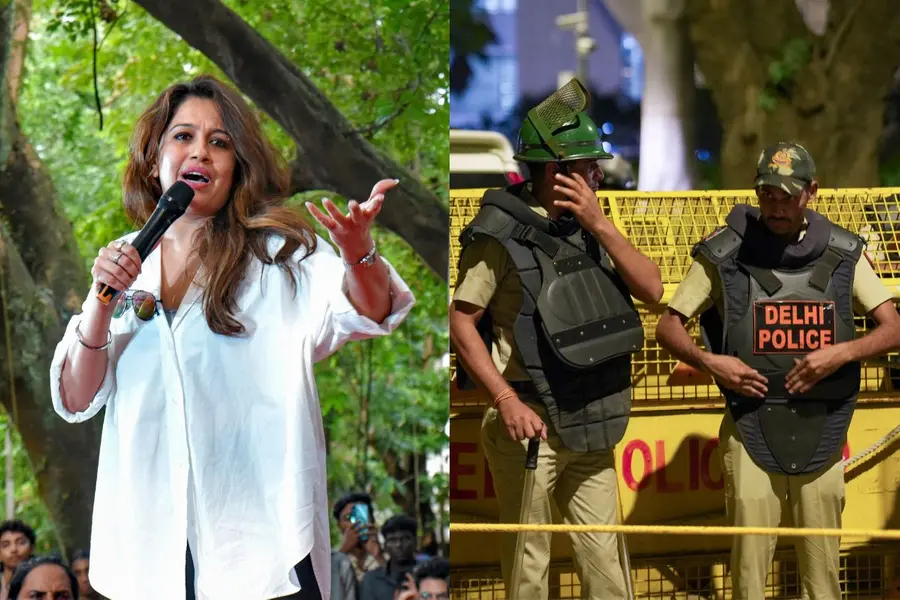
Television presenter and actor Ranjini Haridas has shared a detailed first-hand account of the Cockroach Janta Party (CJP)-led student protests at Delhi's Jantar Mantar, describing the demonstrations as peaceful while alleging that police used excessive force against protesters.
Speaking to Mathrubhumi English, Ranjini said she travelled to Delhi after following the movement online for several days. She said the turning point for her was the manner in which activist Sonam Wangchuk was removed from the protest site.
"I've been following up on the students protest for a while... I was one of their online protesters," she said. "What pushed my buttons was the way Sonam Wangchuk ji was taken off the stage. I thought it was not done the right way as they were just doing a hunger strike. They were asking for their rights. This is wrong. So it was just on impulse, to be honest."
Travel restrictions hindered access to protest site
Haridas claimed that authorities had created multiple obstacles to prevent people from reaching Jantar Mantar.
She said it took nearly four hours to travel from the airport to the protest venue because of road barricades, diverted transport routes and restrictions on public movement.
"The first thing I noticed was that there was a deliberate attempt from the police to prevent us from getting to the protest site," she said.
Ranjini said the restrictions affected not only protesters but also ordinary commuters. She claimed barricades had been erected far from Jantar Mantar, metro services were halted several stations away and commuters were forced to walk more than a kilometre to reach the area.
Watch video here.
"The barricades were really far ahead," she said. "It was also disrupting daily commuter life. People who were not also coming for the protests were really irked... The metros were stopped many, many stops ahead."
"They really tried their best and they were not in any way succumbing to the demand unless the public got riled up... that's how we managed to get in," she said.
She added that even reaching her hotel in Connaught Place proved difficult because of restrictions around the area.
'I have never felt this safe in a crowd'
Despite the heavy police presence, Ranjini described the protesters themselves as peaceful and disciplined.
She felt unusually safe despite being surrounded by thousands of people.
"I had not felt as safe in a very, very long time. I was standing amongst thousands and maybe ten thousands of young youth from across the country and also around 60-70% men, young boys and the safety that I felt cannot be explained," she said.
Ranjini estimated that thousands of young people, many male students, had gathered at the venue.
"As a person who is 44, I've been in enough crowds... Every place I've been in, it's been a little dicey. I've had to always take care of myself. So, I go into a public space with that thought in the back of my head. I need to make sure nobody touches me or grabs me. But after the first hour in this place with these kids, I realized I can take that out of my list.”
"It was intensely safe," she added. "These kids... their focus was all just voicing their dissent."
Police response described as 'brutal'
Haridas alleged that the atmosphere changed whenever police personnel or Rapid Action Force (RAF) units intervened.
"The moment I felt unsafe was when we saw people in uniforms... there were a lot of people who had lathis who were not in uniform... a lot of people without badges."
“They will cordon off people in areas for a while and then suddenly get some instruction and go crazy on the protesters,” she said.
Watch video here.
Haridas alleged that police cordoned off protesters from both directions, preventing essential supplies from reaching them. She claimed those inside the barricaded area were unable to access drinking water and not allowed to return if they stepped out.
"We weren't able to take in water or go out and get water and come back. If you leave, they don't let you back in."
According to Ranjini, protesters eventually became dehydrated and exhausted.
"What they did was make sure that after one point they teargased and lathi-charged people in front and people in the back... People just got dehydrated and exhausted."
She also alleged that security personnel used disproportionate force.
"The cop brutality was intense," she said.
"I met and spoke to enough people there to tell you that they hit these kids. You have rules on how to stop them, like ‘you have to hit them below their legs’ or that ‘men can't hit women’. They did not care. It was an attack. They wanted to hurt these children."
Ranjini further alleged that women protesters were grabbed, students were slapped and force was used indiscriminately.
Celebrities amplify the message
Ranjini said celebrities should not be compelled to speak on every issue, but argued that public figures who support a cause should use their influence.
"Celebrities play an important role. It's only because they can amplify the message further. The reason celebrities are held accountable is because their voices are loud," she said.
She pointed to actor Salman Khan's recent social media post supporting the protesters, saying such endorsements reach audiences beyond those already following developments online.
"When Salman Khan puts out a message, the audience that sees it is not us. We are already very well aware through social media. But Salman Khan's audience is so much wider."
Watch video here.
Online abuse part of public discourse
Addressing the online criticism faced by actors including Tovino Thomas, Asif Ali and Vismaya Mohanlal after they expressed support for the protests, Ranjini dismissed cyber attacks as an inevitable consequence of taking a public stand.
"I'm also getting cyber attacked. But how does it matter? Doesn't matter. That's part of the game."
She added that disagreements should focus on opinions rather than personal abuse.
"You're going to get attacked no matter what you are or who you are and what opinion you have on this planet. The problem is how you're getting attacked. Don't attack me…attack my stand. Speak well. Explain it to us. We are all willing for a conversation. "
Backs protesters' demands
Ranjini said the protests began over alleged irregularities surrounding the NEET examination process and student suicides linked to academic pressure.
She argued that the authorities responsible for conducting examinations should be held accountable.
"These kids are asking for accountability from the government... to tell us why this is happening."
Referring to Union Education Minister Dharmendra Pradhan, she said responsibility ultimately rested with the ministry overseeing education.
"When you start a protest... you're just going to say, 'You've not done this for so long. Why are you not doing your job? So resign.'"
Ranjini said dialogue should have taken place much earlier. However, she claimed the handling of the demonstrations had hardened protesters' positions.
"Now since they've pushed it and they've gone to this level of aggression and violence and trying to silence the voice of children... I don't think these demands will change. It's only going to get firmer and firmer."
She also alleged that some student representatives were misled into attending a meeting and were temporarily prevented from communicating with fellow protesters.
“They told that minister JP Nadda called them home. These kids are youngsters and they can be manipulated as they don't have experience of doing a non-political protest,” she alleged.
Raises concerns over judiciary
Ranjini criticised what she described as the judiciary's response to the protests.
“If a joke that was instigated by the Chief Justice of India, Surya Kant, can turn into one of the biggest movements in the country, there is a problem in the system.”
"The Supreme Court... is the only organisation that can supersede anything that the government does."
She alleged that the courts had failed to adequately examine evidence of alleged police excesses.
"Unfortunately, they don't even have time to listen or watch the videos of the extreme brutality."
Social media driving protest narrative
Ranjini argued that social media has become more influential in documenting protests. Thousands of students were independently recording events as they unfolded. "When I say documenting, we're not talking about 10 people with cameras. I am talking about every student who are there... recording each other."
According to Ranjini, this widespread documentation has made it harder to suppress information despite alleged internet restrictions.
"They are trying to shut the people and the protest up, but I don't think it's going to happen if social media... their game is strong."
Praising younger protesters, she added: "These Gen Z kids are freaking brave."
Background of the CJP protest
The ongoing protests have been organised by the Cockroach Janta Party (CJP), a youth-led satirical movement that emerged in 2026 following controversial remark made by the Chief Justice of India Surya Kant, comparing unemployed young people to "cockroaches". Founded by political communications strategist Abhijeet Dipke, the movement has since expanded into a nationwide campaign focused on education reforms.
The demonstrations have centred on concerns over examination irregularities, including the NEET-UG paper leak controversy, and broader issues within India's education system. Protesters have demanded accountability from the Union government, including the resignation of Union Education Minister Dharmendra Pradhan, compensation for families of students who died by suicide, withdrawal of legal cases against peaceful protesters and reforms to the examination process.
The movement culminated in the "Sansad Chalo" march to Delhi's Jantar Mantar on July 20, drawing thousands of students and supporters. It has also received public backing from several figures in the entertainment industry, including Salman Khan, Prakash Raj, Shabana Azmi, Naseeruddin Shah, Dulquer Salmaan, Tovino Thomas and others.
Published: 23 Jul 2026, 03:15 pm IST
ABOUT THE AUTHOR
Related Topics
Disclaimer: Kindly avoid objectionable, derogatory, unlawful and lewd comments, while responding to reports. Such comments are punishable under cyber laws. Please keep away from personal attacks. The opinions expressed here are the personal opinions of readers and not that of Mathrubhumi.