
Cleanliness is not about dustbins or budgets. It is about whether we believe public space belongs to us. Kochi must answer a hard question: do we see ourselves as owners of public space, or as temporary visitors passing through
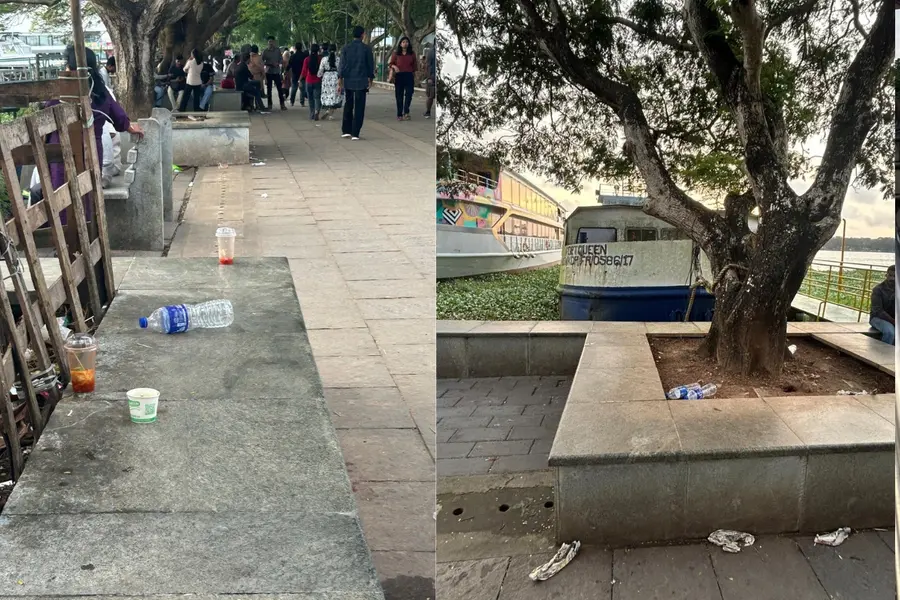
Marine Drive in Kochi has no shortage of dustbins. They line the promenade, waiting to be used. Most are ignored, as litter drifts to the ground, the benches, or the backwaters. The bins have become silent reminders that the city has not embraced Marine Drive as its own.
On my morning walks here, my thoughts go back to the years I spent in Singapore. Its waterfronts are spotless. People pose for selfies with the skyline behind them and post insta-reels in appreciation. Kochi’s Marine Drive arguably offers an even better view: the majestic apartments along APJ Abdul Kalam Road, the open sea, and the cruise boats that dock with equal warmth for visitors and locals. Yet the contrast is stark.
Instead of being an icon, it is increasingly getting littered and neglected. Even the small, beautiful bridges on APJ Road lie underused and are slipping into disrepair.
What should be a postcard of civic pride, a waterfront framed by the skyline and backwaters, ends up littered with teacups, bottles, and plastic wrappers. In one of India’s most literate and cosmopolitan cities, this cannot be explained away by lack of awareness. The gap lies not in infrastructure, but in how Kochiites treat and own shared spaces.
This brings to mind Lee Kuan Yew’s framing of "Asian values”, where social order and shared responsibility were seen as the bedrock of prosperity. Singapore is spotless not because cleaners work overtime, but because Singaporeans have internalised the ethic that littering is unacceptable. Enforcement supports that norm, but the culture created over the years, continues to carry it.
Kochi presents the reverse. Infrastructure exists, enforcement is sporadic, but civic habits remain fragile. The city must answer a hard question: do we see ourselves as owners of public space, or as temporary visitors passing through?
The Cost of Neglect
The civic habit is expensive. Under the city’s 2025 “waste-free city” initiative, Kochi Corporation has allocated ₹1 lakh to each municipal division for waste clearance, along with uniforms, health insurance and QR-code monitoring for workers. The state has sanctioned a ₹5 crore project to clean and beautify tourist-heavy areas such as Fort Kochi and Marine Drive.
A third initiative, the “Arabikkadalinte Rani Azhakinte Rani” action plan, was approved in 2024 with inputs from Kudumbashree, Suchitwa Mission, police, traders and boat operators, aimed at transforming Marine Drive into a model walkway.
The Kerala High Court has also ordered a permanent monitoring committee chaired by the district collector. Kochi was adjudged the cleanest city in Kerala in the ninth edition of the Swachh Survekshan survey 2024, and at the national level it jumped from 416th to 50th place within a year. The Corporation has made progress in sanitation, waste management, and beautification. Yet Marine Drive still begs more.
The backwater canals are often choked with water hyacinth, turning what should be a natural attraction into an eyesore. The lesson is clear: money and oversight cannot replace cultural ownership.
Shared Responsibility in Practice
Some stretches along APJ Abdul Kalam Road show what is possible. Resident associations there already keep their areas cleaner, proving that collective ownership works when people feel accountable. Without that, bins are little more than decorative objects.
Awareness campaigns alone rarely work. People respond more to what they see others doing than to what they are told. Visibility matters, which is why deploying paid volunteers to pick up litter in public view, even if it feels theatrical, can be a good idea.
Watching someone stoop to collect a wrapper makes bystanders uncomfortable enough to reconsider their own behaviour. That is social psychology, not sermonising.
Vendors too can be turned into allies. Their stalls generate much of the waste, but they also set the tone for their surroundings. The city could certify those who keep their areas clean with a visible tag “Parisaraṁ Sūkṣikkunnavaru” (those who safeguard the environment). A badge like that, displayed at a stall, is likely to become a mark of pride and help internalise that “Keeping streets clean is cool”.
And yes, enforcement has its place. A few fines, issued in public view, would sharpen the message. But enforcement without example breeds resentment, and example without consequence risks becoming theatre. The balance lies in doing both together.
Marine Drive does not need more bins. It needs a visible rhythm of ownership: citizens, students, volunteers, and vendors showing every day that the waterfront is theirs to protect. When people see that rhythm, they will happily fall into step.
Government as Enabler
Government must move beyond episodic clean-up drives. The collector-led committee may consider publishing quarterly audits and hold agencies accountable when standards slip. Fines for littering must be applied consistently, not as rare warnings.
Recognition matters too: clean stretches and responsible vendors should be publicly acknowledged. This system of accountability and honour, where citizens, vendors, and institutions are all measured by the cleanliness of the space they share may be a gamechanger.
The Role of Kochi Metro
One of Kochi’s most admired achievements is the Metro, known for its spotless stations. Despite heavy footfall, the Metro has maintained order through strict routines, clear signage, vendor regulation, and consistent enforcement. Users themselves behave differently there.
That responsibility should not stop at station gates. Even the roads leading to the High Court Water Metro Station deserve the same care. A small surcharge on tickets if required could create a fund for extending that discipline beyond the stations.
If the Metro can keep stations clean every day, there is no reason the city cannot apply similar discipline to its premier public space. Order is not a miracle. It is the result of habits built through consistency.
Lessons From Elsewhere
Other cities show that culture matters more than infrastructure. Tokyo has few public dustbins, yet litter is rare because people carry their waste home. Zurich’s lakefronts stay pristine because citizens equate littering with disrespect, backed by enforcement.
Closer home, Alappuzha has shown how community-led segregation can control waste. Lucknow has climbed steadily in Swachh Survekshan rankings through consistent municipal engagement. Chandigarh, with its planned spaces, has managed to keep its promenades relatively clean. These examples prove that shared ownership works, and Kochi can join them if it builds stronger peer accountability.
A Call to Action
Marine Drive could be more than a walkway. It could become the test case for whether an Indian city can move from cleanliness by compulsion to cleanliness by conviction.
In God’s own country, where Kerala’s poets and reformers have long spoken of beauty joined with responsibility. Marine Drive deserves nothing less. For that to happen, citizens must take pride, resident associations must take ownership, and government must sustain engagement. The Metro shows that consistency works. Marine Drive can show that culture can change.
Who knows beyond the iconic cheena vala (Chinese fishing nets) that symbolise Kochi today, Marine Drive itself could one day stand as the city’s new signature, a place where civic pride is visible in every view.
Cleanliness is not about dustbins or budgets. It is about whether we believe public space belongs to us. If we do, Marine Drive’s bins will no longer stand lonely.
The author is Regional Provident Fund Commissioner (Kochi), with public service experiences across India and Afghanistan. His work focuses on social security, digital governance, and Policy Reforms. Views expressed are personal
Published: 30 Sept 2025, 05:35 pm IST
Related Topics
Disclaimer: Kindly avoid objectionable, derogatory, unlawful and lewd comments, while responding to reports. Such comments are punishable under cyber laws. Please keep away from personal attacks. The opinions expressed here are the personal opinions of readers and not that of Mathrubhumi.
