
Analyse India`s new labour codes: wages, industrial relations, social security, etc . Will they reform or retreat worker protections?
On November 21, 2025, the Centre finally pulled the trigger on a project that had been drifting through legislative and administrative corridors for half a decade: the four labour codes—on Wages, Industrial Relations, Social Security and Occupational Safety, Health and Working Conditions—were formally brought into force, subsuming 29 central statutes into a single, compact framework. The government’s case is straightforward and, in many respects, compelling: India’s patchwork of archaic laws has long been a compliance nightmare for employers and a delivery failure for workers. A simpler architecture that promises a single registration portal, clearer entitlements, and broader coverage, explicitly including gig and platform workers, is an attractive idea on paper and a necessary one in principle. That is why the moment is important; but it is also why the moment must be scrutinised, not just celebrated uncritically. The codes’ true test will be whether they redistribute bargaining power and protection toward workers, or merely repackage the status quo while shifting both risks and regulatory gaps.
At the heart of the reform lies an ambiguous duality: consolidation and expansion on the one hand, flexibilisation and procedural restraint on the other. The new Code on Social Security formally recognises gig and platform workers and creates architecture for their welfare—a real step forward in principle given that platformised labour in India numbers in the millions and has been largely invisible to social-protection schemes. Yet the contours of that recognition matter more than the headline. The Centre’s notifications envisage mechanisms by which platforms, employers and even consumers could be required to contribute to social-security funds; industry sources have already signalled that compliance might translate into levies or costs passed through to consumers, and business associations are wrestling with scenarios in which contributions could rise to material fractions of turnover. This is not a theoretical worry: in other jurisdictions the transition from informal recognition to enforceable employer-side contributions has generated litigation, lobbying and regulatory patchwork. The promise of expansion must therefore be measured against the risk that the design and implementation of funding mechanisms will either be inadequate for genuine coverage or will become a new cost that precarious workers ultimately bear.
The codes also contain provisions that materially change how the labour market operates for millions of workers, and not always in the worker-friendly direction. The Industrial Relations Code tightens rules on strikes and lockouts by requiring prior notice, prohibiting strikes during conciliation and tribunal proceedings, and extending moratoria on industrial action. This is presented as a peacekeeping device to prevent sudden stoppages and foster continuity. The practical effect, however, is to institutionalise delay as a first resort for resolving disputes, and to insulate firms and state machinery from disruptive collective action by making lawful strikes more conditional and protracted. For a democracy in which industrial action has historically been one of the few levers of collective voice, such procedural constraints risk emptying the right to strike off much of its bite while leaving the institutional grievance machinery under-resourced and slow. In short: if the state tightens lawful avenues for protest but does not equip conciliation and tribunal mechanisms to deliver timely justice, the reform will have methodically strengthened managerial authority without delivering better outcomes for workers.
Equally revealing are the changes to employment benefits that have been packaged as progressive wins but contain ambivalences. One headline now circulating across mainstream outlets is the reduction in the minimum period of continuous service needed for fixed-term employees to qualify for gratuity from five years to one year. At first glance this appears to be a complete victory for a heterogeneous and casualised workforce: it recognises that the modern employer often hires people for short bursts and that “five years” was an anachronistic threshold for many contributors to the economy. But the devil lies in the distinction between entitlement on paper and enforceability in practice. Fixed-term workers are more likely to be dispersed, subcontracted, and excluded from payroll formalities; widening eligibility creates a statutory obligation that will only be meaningful if administration, record-keeping and adjudication are simplified and accessible to transient workers. Without an implementation architecture that makes claims cheap, fast and binding, the nominal expansion of gratuity risks becoming a legal fiction; one that increases employers’ accounting liabilities without meaningfully improving worker welfare.
The codes’ orientation toward “ease of compliance” is another source of ambivalence. For decades India has suffered from a shortage of labour inspectors and weak enforcement: inspections per thousand workers have fallen, and factory-level oversight has been sporadic. The new codes lean heavily on digital registration, self-certification for lower-risk establishments, third-party audits, and randomized checks—measures that can improve coverage and reduce petty harassment if implemented with integrity. But these are governance innovations that demand capacity, independence and a politics of enforcement. When self-certification is coupled with underfunded inspectorates and constrained trade-union capacity, the outcome can be regulatory capture by the organised employer sector. The question is not whether self-certification is modern; it is whether it will be accompanied by the institutional muscle required to punish fraudulent certification and to make compliance verifiable in real time. Historical experience in India cautions that the mere conversion of rules into online forms alone will not substitute for boots-on-the-ground oversight in hazardous or informal workplaces.
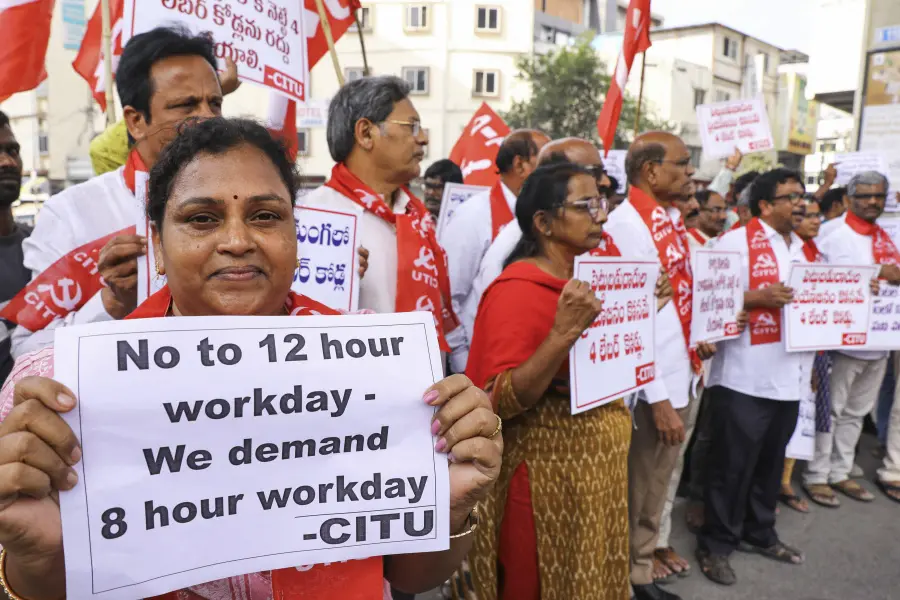
Finally, there is the political economy of the reform. The codes were framed as a compromise, intended to improve worker protections while reducing compliance burdens on business, but they have been adopted in the face of sustained opposition from major trade unions and civil-society actors who say the balance has tilted against workers. That opposition cannot be dismissed as reflexive resistance to change. It is rooted in a few substantive concerns: a narrowing of collective bargaining power, procedural bars on strikes, the dispersed nature of new entitlements that makes enforcement difficult, and the very real risk that social-insurance formulas will default to minimal contributions or consumer-cost pass-throughs rather than robust employer-financed schemes. If reform is to be durable and equitable, it must acknowledge and address those concerns through implementation choices, raising the ESI wage ceiling to bring more workers into medical coverage, investing in the inspectorate and dispute-resolution bodies, enabling low-cost claims for gig and fixed-term workers, and ensuring that recognition of new worker categories translates rapidly into cash and care.
The Labour Codes, then, represent an opportunity and a hazard in equal measure. At their best they can create a simpler, more inclusive legal scaffold for a labour market that is rapidly digitalising and atomising. At their worst they can become a smokescreen that makes the regulatory environment administratively neater while doing little to rebalance power, prevent exploitation, or expand real, enforceable benefits to the informal majority. The test that will matter is not the statute-book at midnight of its notification; it is the rules, the budgetary allocations, the inspectorates, the online interfaces, the independence of adjudicators, and the practical ease with which a gig courier with a fractured femur or a fixed-term technician can access compensation. If policymakers truly want to make the codes a pro-worker transformation rather than a managerial consolidation, they should focus on measurable implementation milestones: revising ESI thresholds, resourcing labour-inspection, fast-tracking dispute-resolution centres, and making contribution mechanisms progressive rather than merely fiscal. Without those choices, the codes will be remembered as a legislative tidy-up that looked like modernity but left the structures of precarity intact.
The sober conclusion is this: simplification without redistribution is merely rearrangement; recognition without enforceable mechanisms is rhetoric. India badly needs a 21st-century labour law framework. The new codes could supply it, but only if the state treats implementation as the hard political project it is, and not as a bureaucratic afterthought to a tidy legislative scoreboard. If the next months see rules, budgets and institutions crafted to make entitlements real, the codes will be an overdue step forward. If they do not, they will be remembered as an administrative victory for simplification that left the deeper imbalances of power and protection untouched. The choice now sits with the executive and the public, whether they will use the codes to expand justice at the workplace, or merely to streamline its governance.
(The author is an author, policy analyst and columnist. He tweets @ens_socialis)
Published: 26 Nov 2025, 09:52 am IST
Related Topics
Disclaimer: Kindly avoid objectionable, derogatory, unlawful and lewd comments, while responding to reports. Such comments are punishable under cyber laws. Please keep away from personal attacks. The opinions expressed here are the personal opinions of readers and not that of Mathrubhumi.
