
India–US trade negotiations are nearing completion. Geopolitical expert Girish Linganna explores how a 17% versus 25% tariff outcome could affect Indian exporters and workers.
For a shrimp farmer in Andhra Pradesh, a weaver in Tiruppur or a diamond polisher in Surat, two numbers may soon decide whether American orders keep arriving. Those numbers are 17 and 25. On Friday, Union Commerce and Industry Minister Piyush Goyal gave a hopeful signal about which one India might get. Speaking virtually at the India Debt Capital Market Summit 2026, he said the trade agreement with the United States is "close to culmination," as the process and pathway that had held it back were now taking shape.
His remarks follow Washington's announcement on November 25, when the Office of the US Trade Representative (USTR) proposed import duties of up to 25 per cent on Indian goods.
A tariff is like an entry fee at the border: the higher it climbs, the costlier Indian products become in American shops. If India signs a trade agreement that addresses US concerns, the fee would be capped at 17 per cent. These rates are still only a proposal, open to public comment and possible change, and are expected to take effect in January 2027.
The proposal stems from a probe under Section 301 of US trade law, which targets trade practices America considers unfair and sets no maximum rate. The USTR placed India among 14 economies it believes have built lasting excess capacity, meaning factories that can produce far more than markets can absorb.
Washington's worries range across Make in India and the Production Linked Incentive (PLI) scheme, which rewards companies for expanding domestic manufacturing, India's labour laws, and financial repression, where the state nudges banks to lend cheaply to favoured industries.
It also objects to barriers facing American farm produce, dairy and machinery, and to Chinese imports and investment, which could make India a back door for Chinese goods. New Delhi has firmly rejected these findings, saying its schemes seek self-reliance and less dependence on a few countries for components, not surplus production.
The arithmetic matters. Since July 24, most Indian exports have already carried a 10 per cent duty, imposed after a separate Section 301 probe into forced labour. Importers will pay only the higher of the two rates, so the burden would rise by 7 percentage points at 17 per cent, or by 15 points at 25 per cent.
Goods already taxed on national security grounds under Section 232, like steel, aluminium, copper, cars, auto parts and heavy vehicles, stay untouched.
Some of India's biggest earners are spared. Going by USTR data on US imports from India in 2025, telecom was the largest category at $25 billion, and smartphones are exempt, though most other telecom equipment is not.
Pharmaceuticals worth $16.5 billion, including generic and patented medicines, largely escape, as do petroleum products worth $3.3 billion, and gold.
The pain falls on labour-heavy sectors where livelihoods are most fragile: diamonds and jewellery worth $6.3 billion, readymade garments worth $5.5 billion, home textiles such as bedsheets and towels worth $4.4 billion, shrimp and seafood worth $1.9 billion, and solar cells and modules worth $1.3 billion.
At 17 per cent, India would edge out Bangladesh and Cambodia, which face 18 per cent in clothing, and Vietnam, which faces 20 per cent with a deal and up to 35 per cent without one. Indonesia and Thailand face 18 per cent in seafood, as do Cambodia, Malaysia and Thailand in solar products.
Without a deal, India would match those Southeast Asian rivals at 25 per cent.
In April 2025, Washington started at 26 per cent before settling at 25, with US officials calling India a "maharaja of tariffs." An extra 25 per cent penalty for buying Russian crude oil then pushed the total to 50 per cent.
On February 2, 2026, a framework deal promised an 18 per cent rate and removal of the oil penalty, but on February 20 the US Supreme Court ruled that the emergency powers behind those tariffs gave the President no such authority. A temporary 10 per cent global duty under Section 122 followed for 150 days.
Written comments are due by January 5, 2027, and public hearings begin on January 25 in Washington. The USTR is also exploring a quota letting a fixed volume of textiles and clothing enter at lower rates, a possible lifeline for garment makers.
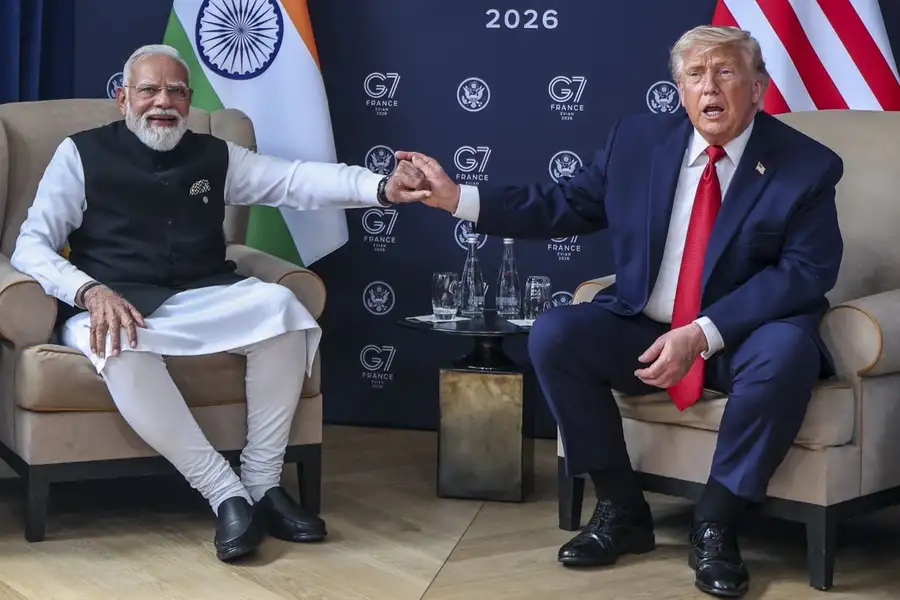
Prime Minister Narendra Modi is expected to meet President Donald Trump at next month's G20 summit in Florida, and millions of Indian workers will be hoping that firm negotiation protects the dignity of their labour.
The author is a defence, aerospace & geopolitical analyst.
Published: 27 Nov 2026, 05:09 pm IST


Related Topics
Disclaimer: Kindly avoid objectionable, derogatory, unlawful and lewd comments, while responding to reports. Such comments are punishable under cyber laws. Please keep away from personal attacks. The opinions expressed here are the personal opinions of readers and not that of Mathrubhumi.
