
The achievement was part of the Indian Army's ongoing 'Wings of Valour and Unity' Expedition 2026.
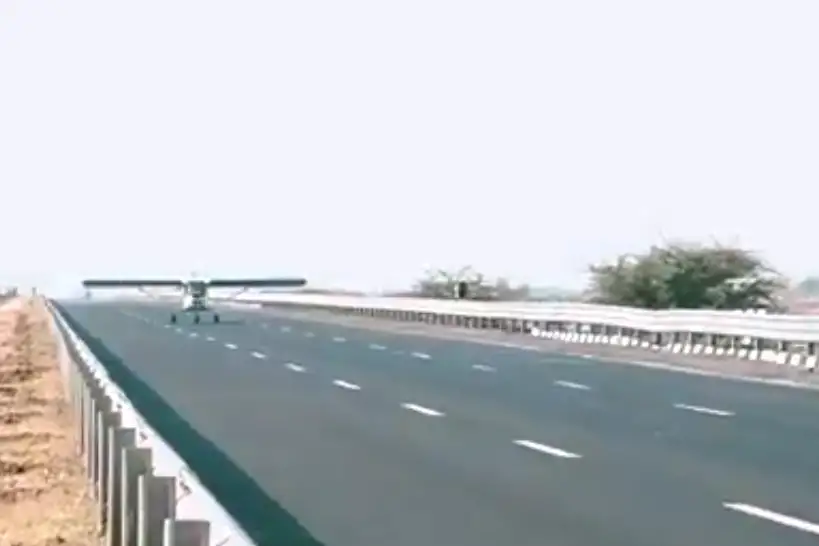
In an unusual display of flying skills and coordination, four aircraft operated by the Indian Army's Team Mountain Eagles successfully landed on a national highway in Gujarat, marking the first such formation landing on a national highway or expressway in India.
The exercise demonstrated how sections of the country's expanding highway network could potentially serve as alternative landing grounds for small aircraft during emergencies.
Imagine driving along a national highway and suddenly looking up to see aircraft approaching for a landing. That unusual sight became a reality when four aircraft belonging to the Indian Army touched down on the Amritsar-Jamnagar Expressway in Gujarat.
In a remarkable aviation demonstration, the Army's aero-adventure team, known as 'Team Mountain Eagles', successfully landed a formation of four aircraft on National Highway 754K near the Bakutra Toll Plaza in Santalpur tehsil of Patan district.
The formation included two microlight aircraft and two powered hang gliders. The successful operation marked the first time that a formation of four such aircraft had landed on a national highway or expressway in India.
The achievement was part of the Indian Army's ongoing 'Wings of Valour and Unity' Expedition 2026. More than an adventurous flying exercise, the operation demonstrated the potential of India's national highway infrastructure to serve as alternative or emergency landing grounds for small aircraft.
From the skies to the highway
The four aircraft began their journey from Kandla Airport in Gujarat. After taking off from the airport, the team made its way towards the Amritsar-Jamnagar Expressway, where the planned landing exercise was carried out.
The aircraft approached the designated stretch of NH-754K near the Bakutra Toll Plaza and successfully touched down on the highway.
Landing an aircraft on a conventional runway requires careful coordination between the pilot, air traffic control and ground personnel. A highway landing presents a different set of challenges, as the available landing space, road surface, surrounding environment and traffic conditions need to be carefully assessed.
The successful landing of all four aircraft demonstrated the flying skills, preparation and coordination of the Army personnel involved in the exercise. Following the landing, the aircraft also demonstrated their ability to take off from the highway, completing an important part of the operation.
The exercise was particularly significant because it involved four aircraft operating as a formation rather than a single aircraft carrying out an isolated landing.
Four aircraft, one historic formation
The formation consisted of two microlight aircraft and two powered hang gliders, representing different categories of lightweight flying machines.
Microlight aircraft are small, lightweight aircraft generally designed to carry one or two people. They are commonly used for recreational flying, pilot training and aerial adventure activities.
Powered hang gliders, meanwhile, are lightweight flying machines fitted with engines that allow them to take off and fly without relying entirely on natural air currents. Their relatively simple construction and compact design make them suitable for specialised flying activities.
Operating these aircraft as a coordinated formation requires considerable attention to flight positioning, speed, distance and communication between pilots.
For Team Mountain Eagles, successfully bringing all four aircraft down on a highway and taking them airborne again was an important demonstration of its flying capabilities.
The achievement also highlighted the versatility of lightweight aircraft and the possibilities they offer for specialised aviation operations.
How highways could support emergency aviation operations
One of the most important aspects of the demonstration was its focus on the potential use of national highways and expressways as alternative landing grounds. Airports and dedicated airstrips remain essential to aviation operations. However, in certain emergency situations, access to a conventional runway may become difficult or unavailable.
Natural disasters, infrastructure damage and other unexpected situations can affect airport operations. In such circumstances, suitably designed and prepared highway sections could potentially offer alternative landing options for certain types of aircraft.
India's expanding network of national highways and expressways has opened up possibilities beyond road connectivity. With appropriate planning, designated stretches could also be considered for specialised emergency aviation requirements.
The Army's demonstration on NH-754K offered a practical example of how such infrastructure could be used by small aircraft under controlled conditions.
However, not every highway can automatically function as an airstrip. Factors such as road width, surface quality, available length, surrounding structures, overhead obstructions and traffic control arrangements would need to be assessed before any such operation.
The successful exercise demonstrated the possibilities of this concept while highlighting the importance of careful preparation and coordination.
Civil-military cooperation makes the operation possible
The achievement was also an example of coordination between the Indian Army, the National Highways Authority of India (NHAI) and the local civil administration. The arrangements for the demonstration landing were made jointly by the authorities to ensure that the operation could be conducted safely.
The local administration and NHAI coordinated the necessary preparations, including safety arrangements and traffic management along the designated highway stretch.
The operation was personally supervised and witnessed by the Sub-Divisional Magistrate (SDM), Tehsildar and NHAI Director, along with local police authorities.
Such coordination is essential when an active road infrastructure facility is temporarily used for an aviation-related exercise. It requires planning between multiple agencies to manage road traffic, secure the landing area and ensure that the aircraft can operate without interference.
The successful completion of the demonstration highlighted how civil and military agencies can work together to explore new uses for existing infrastructure.
Team Mountain Eagles and the spirit of adventure
The expedition was undertaken by the Army Adventure Nodal Centre (AANC) at the Military College of Telecommunication Engineering (MCTE), Mhow, Madhya Pradesh.
Known as the 'Wings of Valour and Unity' Expedition 2026, the initiative reflects the Indian Army's focus on adventure activities, aviation skills and challenging operational environments. The latest achievement adds another milestone to the team's aerial journey, demonstrating the ability of its personnel to undertake specialised flying exercises in unfamiliar settings.
For the Army personnel involved, the successful operation was a test of preparation, coordination and flying precision. It also brought attention to the possibilities of using lightweight aircraft in different operational environments.
The landing on NH-754K was therefore more than an unusual aviation spectacle. It demonstrated how military expertise, modern road infrastructure and cooperation between government agencies could come together to explore new possibilities.
A new perspective on India's highway network
India's national highway network has traditionally been viewed as the backbone of road transportation, connecting cities, towns, industrial centres and remote regions.
However, the demonstration by Team Mountain Eagles offers another perspective on how selected sections of this infrastructure could serve additional purposes during emergencies.
The successful landing and take-off of four aircraft on the Amritsar-Jamnagar Expressway could encourage further exploration of highway-based emergency landing capabilities, particularly for suitable small aircraft.
As India continues to develop its road and aviation infrastructure, the possibility of integrating these networks for specialised emergency requirements could become an important area of planning.
For now, the achievement in Gujarat stands out as a memorable aviation milestone. Four aircraft took off from Kandla Airport, landed on a national highway and took to the skies again, demonstrating that, under the right conditions and with careful coordination, the road beneath our wheels could also offer a pathway to the skies.
Published: 25 Nov 2026, 05:33 pm IST


ABOUT THE AUTHOR

Related Topics
Disclaimer: Kindly avoid objectionable, derogatory, unlawful and lewd comments, while responding to reports. Such comments are punishable under cyber laws. Please keep away from personal attacks. The opinions expressed here are the personal opinions of readers and not that of Mathrubhumi.