
China is expanding its ambitions beneath the ocean, combining seabed exploration with deep-sea technology and an established minerals industry.
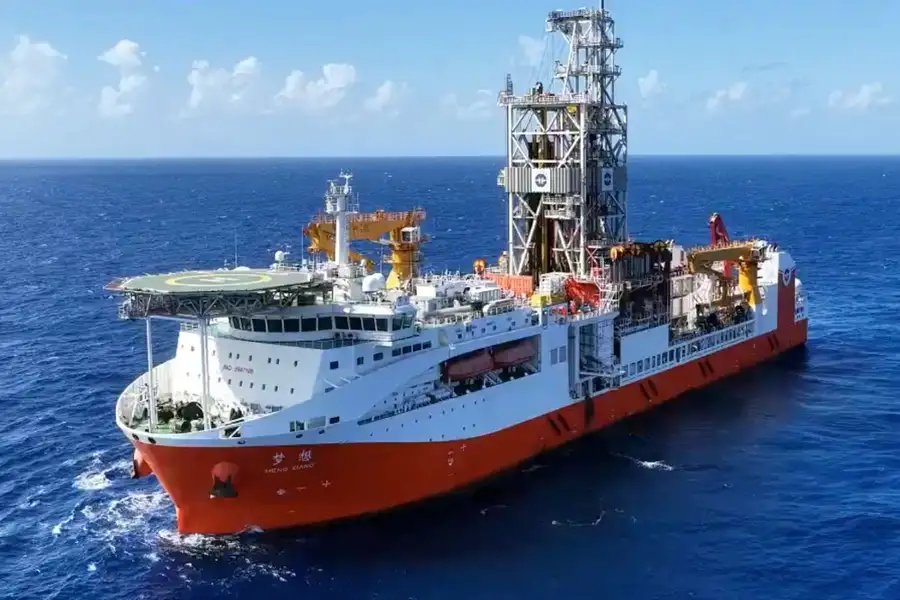
Some time in November 2026, a robotic vehicle named Kunpeng -- after a mythical Chinese giant fish -- crawled across the abyssal plains of the eastern Pacific Ocean, some 5,330 metres (17,500 feet) beneath the surface, collecting potato-sized rocks rich in nickel, cobalt, manganese and copper. The trial, described by Chinese state media and the South China Morning Post as China's first large-scale deep-sea mining trial in international waters, marked a milestone in Beijing's bid to lead the world in extracting minerals from the ocean floor.
The achievement puts the spotlight on a reality that has become increasingly difficult for other nations to ignore: when it comes to unearthing rare earth minerals and other critical metals from deep-sea and ocean environments, China is not merely participating in the race -- it is running ahead of the field.
The trial took place inside a 72,745-square-kilometre (28,000-square-mile) exploration block in the Clarion-Clipperton Zone (CCZ), a vast stretch of the Pacific between Hawaii and Mexico. The block -- larger than the US state of West Virginia -- is licensed to China Minmetals, the state-owned mining giant that built the Kunpeng collector vehicle.
The robotic vehicle operated across freezing, high-pressure abyssal saltwater, gathering polymetallic nodules using an acoustic navigation suite developed by researchers at Harbin Engineering University. The system achieved a positioning accuracy of one metre on the dark ocean floor -- a remarkable feat at such depths.
To lower its survey submersibles to 5,330 metres, China deployed the Haiwei GD11000, a deep-sea winch system led by Dalian Maritime University professor Li Wenhua. According to Interesting Engineering, the Haiwei GD11000 is the only winch system in the world capable of reaching the ocean's deepest point.
The submersibles spent approximately 197 hours underwater during the operation. China Minmetals announced the trial in November 2026, reporting sustained operation despite cold conditions, high pressure and soft sediment.
Why deep-sea minerals matter
The polymetallic nodules targeted in the trial contain nickel, cobalt, manganese and copper -- key ingredients in batteries for electric vehicles and smartphones.
The CCZ, where the trial took place, is estimated to contain more copper, cobalt, nickel and manganese than all known land deposits combined, according to the US Congressional Research Service (CRS). The zone spans approximately 1.7 million square miles of the Pacific seafloor, reaching depths of up to 3.4 miles.
Deep-sea mining targets three types of mineral deposits: polymetallic nodules on abyssal plains; polymetallic sulphides around hydrothermal vents, rich in copper, zinc, gold and silver; and ferromanganese (cobalt-rich) crusts on underwater mountains, which contain cobalt, manganese, nickel, platinum and rare earth elements.
China's structural advantages
China's lead in deep-sea mining is not accidental. It is the product of years of strategic investment across multiple dimensions.
The most exploration contracts: China holds five of the 31 exploration contracts issued by the International Seabed Authority (ISA), the UN-backed body that regulates seabed mining in international waters -- more than any other country. These include three contracts for polymetallic nodules (two in the CCZ), one for polymetallic sulphides, and one for cobalt-rich ferromanganese crusts, covering all three mineral deposit types the ISA regulates.
The largest financial contributor: China is the ISA's largest financial contributor, giving it significant influence within the very body that will write the rules for commercial extraction.
The world's largest research fleet: China's blue-water marine scientific research fleet comprises more than 40 vessels -- the largest in the world, according to the China Maritime Studies Institute. CNN and Mongabay tracked eight Chinese research vessels that have undertaken deep-sea mining exploratory missions over the past five years, including the Xiang Yang Hong 01, which has conducted dozens of expeditions since entering service in 2016.
End-to-end processing dominance: Extracting minerals from the seabed is only the first step. Turning them into finished products requires mining, processing and refining networks that China largely dominates -- an advantage that extends from terrestrial rare earths to future seabed production.
A permanent deep-sea presence: Beijing has begun construction on a permanent deep-sea research hub roughly 2,000 metres beneath the South China Sea, due for completion in 2030. The manned station will focus on cold-seep ecosystems -- critical for understanding energy resources including hydrocarbon and gas hydrate reservoirs -- while reinforcing Chinese reach in one of the world's most contested maritime regions.
Corporate expansion: In early 2026, China National Offshore Oil Corporation (CNOOC), the offshore oil and gas giant, quietly included "marine characteristic mineral resources" in its "15th Five Year Plan" development goals, formally entering the deep-sea mining industry.
The governance vacuum that favours Beijing
The International Seabed Authority has yet to finalise its Mining Code -- the regulatory regime for commercial extraction. At the close of the ISA's March 2026 session, the code remained unfinished; the ISA Secretary-General aims to complete a draft by the end of 2026.
This regulatory vacuum has created a divide. While China, Russia and other nations have waited for the ISA to establish a legal framework, the United States -- which has not ratified the UN Convention on the Law of the Sea (UNCLOS) and therefore cannot sponsor ISA contracts -- has pursued a unilateral path.
In April 2025, President Donald Trump signed Executive Order 14285, "Unleashing America's Offshore Critical Minerals and Resources," directing NOAA to expedite seabed mining licenses and permits outside the international framework. By late 2026, the Trump administration planned to auction nearly 100 million acres of Pacific Ocean seafloor near American Samoa and the Northern Marianas Islands.
Meanwhile, nineteen countries hold licenses in the CCZ, including Russia, Japan, France, Germany, South Korea, Cuba and Tonga -- but none match China's combination of contracts, funding, fleet and processing capacity.
The dual-use dimension
China's deep-sea programme has attracted scrutiny for reasons that go beyond minerals. An investigation by CNN and Mongabay found that eight Chinese research vessels engaged in deep-sea mining exploration spent only around 6% of their total open-water time in areas reserved for exploration by Chinese companies over the past five years.
Instead, the ships logged extensive trips in strategic waterways from the South China Sea and Guam to the Indian Ocean and the Arctic -- regions experts say could prove critical in any future maritime conflict with the United States.
The vessels displayed behaviours suggesting attempts to avoid detection, including hundreds of instances of "going dark" by disabling the mandatory Automatic Identification System (AIS). Some appeared to operate within other nations' exploration areas, including those of India, Germany, South Korea, Poland, France and Russia.
Experts suggest the pattern reflects China's military-civilian fusion policy, blurring the line between civilian research and military advancement in pursuit of Xi Jinping's goal to make China a "maritime power." "They'll be the first mover, if they can," Isaac Kardon, a senior fellow for China studies at the Carnegie Endowment for International Peace, told CNN.
China's foreign ministry, in a statement, said it "conducts activities in deep-sea exploration, scientific research, and environmental protection" within the ISA framework and "highly values deep-sea environmental protection."
Rivals are racing to catch up
The United States and Japan have pushed seabed mining as UN rules stall. In August 2026, the two countries worked together to explore extracting rare-earth-rich mud from the seabed near Minamitorishima, a Japanese island -- but the project remains experimental, not a commercial mine, and commercial-scale output remains years away.
Japan's mud trial illustrates the challenge facing China's rivals: even where promising deposits exist, the mining, processing and refining networks needed to turn seabed rock into usable metals remain overwhelmingly in Chinese hands.
Meanwhile, China continues to leverage its terrestrial rare earth dominance as a diplomatic lever, using export controls on some rare earths while its two largest producers report surging profits on the back of supply caps. In the first ten months of 2026, China's rare earth exports totalled 48,097 tons, according to customs data.
Environmental concerns shadow the race
The deep ocean remains one of the planet's largest and least known habitats. Forty countries, along with hundreds of scientists and environmentalists, have called for a moratorium on deep-sea mining, warning it could cause irreparable damage to species and ecosystems that evolved over millions of years.
A study published in December 2025 in the journal Nature Ecology and Evolution found that industrial-scale deep-sea mining tests caused a 37% reduction in animal abundance within directly mined areas of the Clarion-Clipperton Zone.
The environmental stakes add urgency to the governance debate -- even as China's technological momentum continues to build.
China's lead in deep-sea mining rests on a combination of factors no other nation currently matches: the most ISA exploration contracts, the largest financial stake in the governing body, the world's biggest research fleet, unmatched processing and refining capacity, proven deep-sea engineering feats like the Kunpeng trial, and a strategic vision that links seabed resources to maritime power.
As Xi Jinping told Chilean President Jose Antonio Kast on November 17, China intends to expand cooperation in "polar scientific expeditions and deep-sea exploration" -- signalling that Beijing views the ocean floor not just as a mineral frontier, but as a pillar of its global strategy.
For now, the race to the bottom of the ocean has a clear leader. The question is whether the rest of the world can close the gap before the rules -- and the resources -- are locked in.
Published: 25 Nov 2026, 03:31 pm IST


Related Topics
Disclaimer: Kindly avoid objectionable, derogatory, unlawful and lewd comments, while responding to reports. Such comments are punishable under cyber laws. Please keep away from personal attacks. The opinions expressed here are the personal opinions of readers and not that of Mathrubhumi.
