

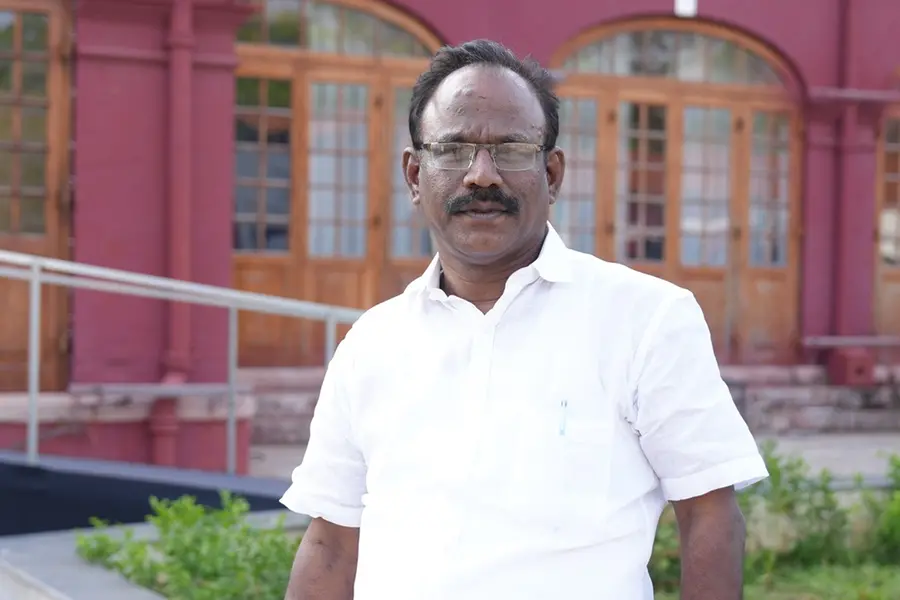
Coming from Cuddalore district in Tamil Nadu, contemporary writer Imayam, whose real name is V Annamalai, is a bold and fearless writer who gives voice to the many faces of modern India. Exploring caste, gender, and power, his women and men are the people we meet in our daily lives.
A recipient of the Sahitya Akademi Award in 2020 for his novel Selladha Panam (A Woman Burnt), Imayam's works have found their way into Malayalam, Kannada, Hindi, and Telugu. His debut novel 'Koveru Kazhudaigal' has been translated into English, French, and many other Indian languages. His stories echo with everyday life and has earned a place in university curricula and cultural studies programs across the country.
Also Read
Recently, he was appointed as the Vice Chairperson of the Tamil Nadu State Scheduled Castes-Scheduled Tribes Commission. He is also the brother of CV Ganesan, Tamil Nadu Minister of Labour.
Imayam carries with him memories that have deeply shaped his story telling. He recalls a personal incident from his childhood—a moment that still echoes in his heart. During a family meal, a quarrel erupted between his parents. In a fit of rage, his mother ran out of their home and towards a small canal in their village. With an intent on ending her life, she took the seeds of the arali (nerium), a dangerously poisonous plant, and began to grind it. Young Imayam, full of fear, followed her. As he neared the canal, he could no longer see her, and his feeble, desperate voice cried out, "Amma... Amma... where are you?" Moved by his plea, his mother immediately turned back, forgetting her intent and moved by her son's plea. Imayam says that he would not have seen his mother had he not gone there to search for her. This unforgettable moment is etched deep in Imayam's memory, and his stories are not merely written by him but are written by the society around him. Imayam talks on how the experiences of ordinary people have shaped him into the writer he is today.
How did you become a writer? Does your personal experience influence your writing style and choice of subjects?
I didn’t become a writer by reading books. I became one because the world around me, gave me stories that demanded to be told. Until college, I had never read a novel, a short story, or even a poem outside my Tamil curriculum. My only exposure to literature was through the textbook from grades 6 to 12—just enough to get pass marks. Books were not my teachers, nor were literary journals. My inspiration came from life itself.
But how does someone who never read literature become a writer? Does your early life impact your literary works?
Life was my book, and society, my teacher. The realities of agrarian life—meals shared at home, temple festivals, scorching summers, and the unpredictable rains—these were my first lessons. The classmate who shifted to another bench upon finding my caste—that was my first taste of social prejudice. The upper-caste women who insisted I cup my hands together so they could pour water for me to drink —these moments taught a powerful lesson. The teachers who demanded, "All SC boys, stand up!" in class, making our peers stare at us - planted the seeds of a literary voice that refused to be silent.
The barber who turned me away after learning my caste, the tea shop owner Kuppusamy Pillai who made me wash my own glass after drinking—each act of discrimination shaped my understanding of the world. They didn’t just wound me, they became the ink with which I would later write.
Life in early years is the very fountainhead of my writings. My life experiences during the early years formed the basis of my writing. Without that part of my life, there would be nothing for me to reflect and write.
Your novels and stories document the sufferings of oppressed people more. That is the lead character in all your stories. Why is that?
I myself belong to the ranks of the oppressed. The people who shared my physical universe are those who faced exclusions and oppressions. What else could I write about. I have not written about any suffering or poverty that Tamil society has not been a witness to. That is why all my stories and novels emphasise on the sufferings associated with the lives of ordinary people. Why social existence is not joyful? The aim of my writings is to raise questions about these entanglements. I would say, so far, we have not been able to record even one percent of the social realities of exclusions, sufferings, oppressions and outright violence.
All your writings are written with a simple style of narrative story-telling method. Have you attempted to employ other story-telling techniques like magical realism, surrealism or existentialism etc?
Life exists as neither magically real nor surreal. It is just plain reality. That is why I write that way. Only those who declared narrative story-telling to be dead are long dead and gone. Indian writers no more indulge in discussions of literary theories or philosophies. Simply put, ‘Indian literary universe’ is a field devoid of any critical doctrine or worldview.
There is a criticism that your novels and stories mostly represent the village life and its people and ignore urban social life. How would you respond to that?
That criticism is entirely misplaced. “God’s Grace’ is the story of a woman living in the city of Tirunelveli. “Heartbreak” is the story of someone who works in Chennai IT industry. The story of “Arumugam” novel plays out in Puducherry city. The novel “Invalid currency” happens in JIPMER hospital, Puducherry. The background of “Still Alive” novel is a prominent private hospital in Chennai. “The lady who owns the dead body” is also a story that happens in Chennai. It is not important to analyse whether I am writing about people living in the villages or in the cities. It should be a literary work of art, be it a story or novel.
The novel “Invalid currency” talks about the death of a woman who self immolates....isn’t it?
Yes, this phenomenon has happened at all times. We are the same society that instituted a horror like ‘Sati’. Most female deities worshipped all over India are those women who were murdered for the cause of marrying crossing caste boundaries. Mother goddesses like “theeppaanjamman (the immolated one)”, mariamman and chelliamman are some examples. Still there are many instances of well-educated and employed women who are dying either because of being burnt alive or committing self-immolation. Isn’t Sita also the one who was forced to enter the pit of fire? All big hospitals have an exclusive “burn ward” which primarily treat such victims.
Even after progressing in all aspects like education, employment, economy and culture, why such horrors still take place in our country?
It is the system of marriage we still follow. Our marriages are not based on the natural principle of a suitable man or woman need a suitable man or woman as a match. Social status, caste, money and so many other factors decide who we marry. In fact, astrologers play a major role. Even timings for ‘first night’ are chosen by astrologers. This kind of ‘absurdities’ can pass as normal way of life only in India. In such a society, it is no surprise that not only the unlettered, even the well educated women continue to die by fire.
Does literature have the power to bring about social change?
NO, from the time of writing until now, all the works of literature, religious or otherwise, only teach and preach love. Have human beings transformed to show only love and compassion to each other. Caste, religion, race, money, power and politics don't allow us to come together and live harmoniously. We have created a bizarre classification of society based on eating habits. Those eating ‘vegetarian diet’ are considered superior and ‘non-vegetarians’ are considered inferior. Further, among meat-eaters, those eating beef and pork are treated as the lowest. Only legislations can bring about concrete social changes.
Out of the 8 novels and 8 short stories, which ones would you categorise as being most challenging?
When I wrote the first draft of my first novel Koveru Kazhuthaigal “Mules”, I was 19. I wrote it from the perspective of a 70 year old woman called ‘Arokiyam’. Then, when I was 50 years old, I wrote the story of a 15 year old boy called Tamilarasan from his perspective. This is my challenge.
Have your writings made any impact on society?
After my novel "Mules" was released, Tamil Nadu government set up a development board for "Puthirai Washerpeople Welfare". When the novel "Begetter" was released, it was distributed as a return gift to people who attended marriage ceremonies and other social functions.
Whom would you label as the main culprits who damage social harmony?
In my opinion, it would be the television presenters and Youtubers. They want to keep the society in a state of panic for 24 hours a day. To create sensational news, they go to any extent. They talk about freedom of expression, but never respect the opinion of others. They feel no remorse to invade the private lives of individuals.
What do you think of the writings of this generation? Do you see any marked shift from the writers of the previous generation?
The generation of yesteryears fought against globalisation. But, the current generations celebrate globalisation. Getting more 'likes' seems to be the driving force for this generation. Content creators are ready to go to any extent for getting more views/likes/followers. We live in strange times. Of course, there are exceptions to this trend. How long will the "Print Media" manage to survive is a million dollar question. The media houses themselves are rapidly adopting "e-magazines". Today, every individual is a medium in them.
Currently, what are you busy writing?
In earlier days, many families lived in poverty. But still the older parents lived at home. But now, there is not much poverty. But old parents are living in old age homes. The short story I am currently writing titled "Father and Son" happens in an old age home. Today, senior living is emerging as a big business proposition across India. Agencies that provide caregivers on contract are already a thriving business. Emerging social phenomena provide the themes and impetus for writing. That's how writers are born.
Published: 06 Apr 2025, 11:12 am IST
ABOUT THE AUTHOR
Related Topics
Disclaimer: Kindly avoid objectionable, derogatory, unlawful and lewd comments, while responding to reports. Such comments are punishable under cyber laws. Please keep away from personal attacks. The opinions expressed here are the personal opinions of readers and not that of Mathrubhumi.