

Long before the Koodathayi case, Kerala was rocked by the 1980 Aluva Cyanide Murders.
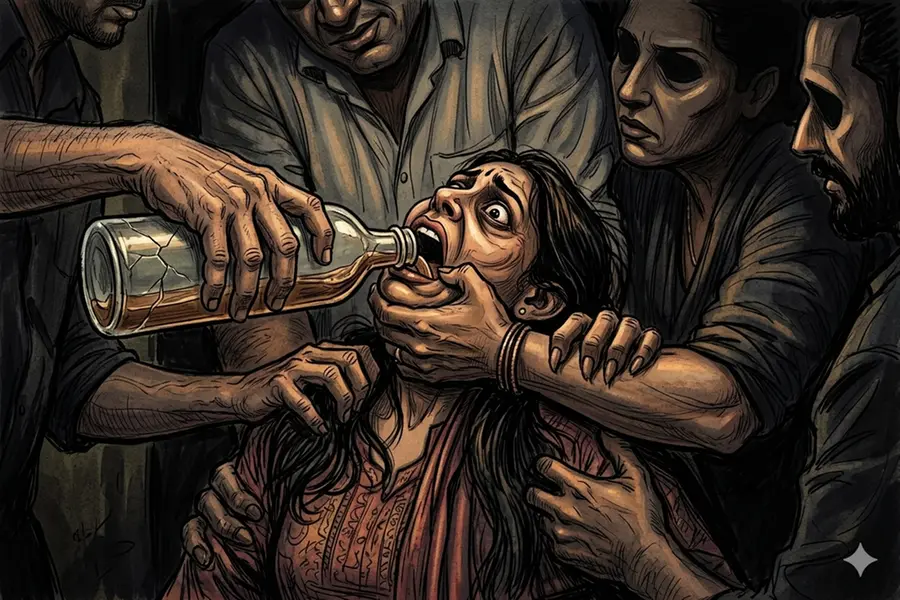
Long before the Koodathayi Cyanide Murders shocked Kerala and turned cyanide into a word associated with betrayal, greed and calculated murder, the state had already witnessed one of its most horrifying poisoning cases.
In June 1980, in what later came to be known as the “Ammini murder case” or the Aluva cyanide murders, a housewife and her two children were killed inside their home using potassium cyanide in a meticulously planned conspiracy that stunned investigators, courts and the public alike.
Also Read
The murders, committed in Aluva near Kochi, would later lead to one of Kerala’s landmark criminal judgments, shaping how Indian courts interpreted circumstantial evidence, conspiracy and forensic proof.
A family tragedy rooted in resentment
At the centre of the case was Ammini, the widow of Francis and the sister-in-law of businessman Tomy. Court records reveal that the families were financially well-off and jointly involved in several textile businesses in Aluva.
The relationship began deteriorating after Francis died in 1975.
According to the Kerala High Court judgment, Ammini believed she was denied her rightful share in family businesses and harboured growing resentment towards Tomy and his wife, Merly. What started as bitterness over finances allegedly evolved into a deadly obsession.
The court document traces several incidents that prosecutors argued deepened her anger. One involved Ammini being humiliated at a textile shop when Tomy allegedly refused to give her an expensive polyester fabric for her child. Another involved suspicions that Merly had informed Tomy about Ammini’s alleged relationship with a telephone department lineman named Karthikeyan.
The High Court judgment observed that the animosity “naturally grew wilder” over time.
From black magic to murder conspiracy
The prosecution's case also painted a disturbing picture of escalation.
Initially, the conspirators allegedly attempted occult practices and black magic to “annihilate” Tomy’s family. When that failed, they allegedly shifted to poisoning attempts using insecticides such as Dalf and Eccalex.
The conspiracy widened as more people joined.
Karthikeyan, the second accused, allegedly became a close associate of Ammini and helped coordinate the plan. Two others, Johny and Thomas, were later recruited with promises of money. Court records reveal that multiple failed attempts were made before the murders finally succeeded on June 23, 1980.
One attempt failed because an employee unexpectedly arrived at Tomy’s house. Another collapsed because Tomy’s sister, Josephine, was present. The conspirators then decided to use potassium cyanide, a poison known for acting within seconds.
The court noted that the conspirators knew cyanide was used by goldsmiths for electroplating work. Thomas, the fourth accused, was allegedly tasked with obtaining it.
After “hectic efforts”, he procured potassium cyanide from a goldsmith. The group allegedly tested the poison on a cat before carrying out the murders.
The High Court judgment states that the cat “suddenly died” after consuming the substance, and its body was secretly buried in the compound.
The night of the murders
The prosecution’s reconstruction of June 23, 1980, remains one of the most disturbing narratives in Kerala criminal history.
According to the court, Ammini entered Tomy’s home around 7 pm pretending to make a casual visit. Shortly afterwards, Johny and Thomas arrived pretending they had come to meet her.
Thomas allegedly asked Merly for water. As she turned to get it, the attackers allegedly grabbed her from behind and forced cyanide into her mouth.
The judgment records that Merly struggled violently and bit Johny’s fingers during the attack, causing injuries that later became a crucial piece of evidence.
While Merly collapsed and died almost instantly, Ammini allegedly took the children, eight-year-old Sona and five-year-old Rana, into another room where cyanide was forced into their mouths as well.
All three victims died within moments.
Investigators later argued that the killers intended to murder Tomy too when he returned home later that night. But panic disrupted the plan.
One accused reportedly feared he had been poisoned after being bitten by Merly during the struggle. The conspirators fled before Tomy returned home.
When Tomy entered the house around 9.30 pm, he found his wife and children dead inside their bedroom.
The investigation and early setbacks
Initially, police registered the case merely as “suspected poisoning”. But forensic examinations confirmed cyanide poisoning, ruling out suicide or accidental consumption.
Police arrested Ammini and Karthikeyan within days. The remaining accused were arrested soon after.
The investigation relied heavily on circumstantial evidence, forensic analysis, witness testimonies and a confession made by the fourth accused before a magistrate. Yet the case almost collapsed in court.
In 1981, the Additional Sessions Court in Paravur acquitted all four accused, rejecting much of the prosecution evidence and expressing doubts over the reliability of the confession and the circumstances presented. The acquittal shocked prosecutors.
In its observations, the trial court accepted that the victims had died due to cyanide poisoning and ruled out both suicide and accidental death. However, it acquitted the accused based on what was later criticised as an unrealistic appreciation of evidence. The Sessions Judge himself acknowledged the difficulty of the case, stating that he had to “wade through a heavy mass of oral and documentary evidence” without having had the opportunity to personally hear or observe witnesses during the recording of evidence.
The judge also expressed reservations about his own verdict, remarking, “I do not claim that my appreciation of the evidence on record and the judgment I have given today are absolutely free from all possible infirmities; but I can get consolation by reminding myself of the fact that there is a Court of appeal.”
Among the reasons cited for acquittal were doubts over the authenticity of a 20-page judicial confession, which the judge felt was too detailed to have been voluntarily produced by the accused, and suspicion over wound certificates merely because they were written on plain paper instead of printed forms.
Following this, the case was brought before the Kerala High Court. In a strongly worded judgment, the Kerala High Court criticised the trial court’s judgment, observing that “criminal justice unfortunately became a casualty in this case” due to the “unrealistic approach” adopted by the Sessions Judge.
The court further said the judge was swayed by “fanciful and remote possibilities” backed by “flippant or puerile reasoning” and expressed “unreserved disapproval” over the sidelining of crucial evidence. It further noted that the Sessions Judge had committed an illegality by misapplying the law relating to police diaries, ultimately leading to the “unmerited acquittal” of the accused in the “diabolically planned and heinously perpetrated triple murder case.”
The High Court concluded that the murders were indeed homicidal, carefully pre-planned and executed through conspiracy.
The court accepted the prosecution’s chain of circumstantial evidence, including the accused persons’ movements, procurement of cyanide, prior failed attempts and the injuries sustained during the attack. All four accused were convicted and sentenced to life imprisonment.
The convicts eventually approached the Supreme Court. In 1997, the apex court upheld the convictions in the case.
The ruling became important in Indian criminal jurisprudence because it reinforced how circumstantial evidence, forensic science, fingerprints and co-conspirator confessions could together establish guilt even in the absence of direct eyewitness testimony.
Published: 24 May 2026, 12:56 pm IST
ABOUT THE AUTHOR
Related Topics
Disclaimer: Kindly avoid objectionable, derogatory, unlawful and lewd comments, while responding to reports. Such comments are punishable under cyber laws. Please keep away from personal attacks. The opinions expressed here are the personal opinions of readers and not that of Mathrubhumi.