
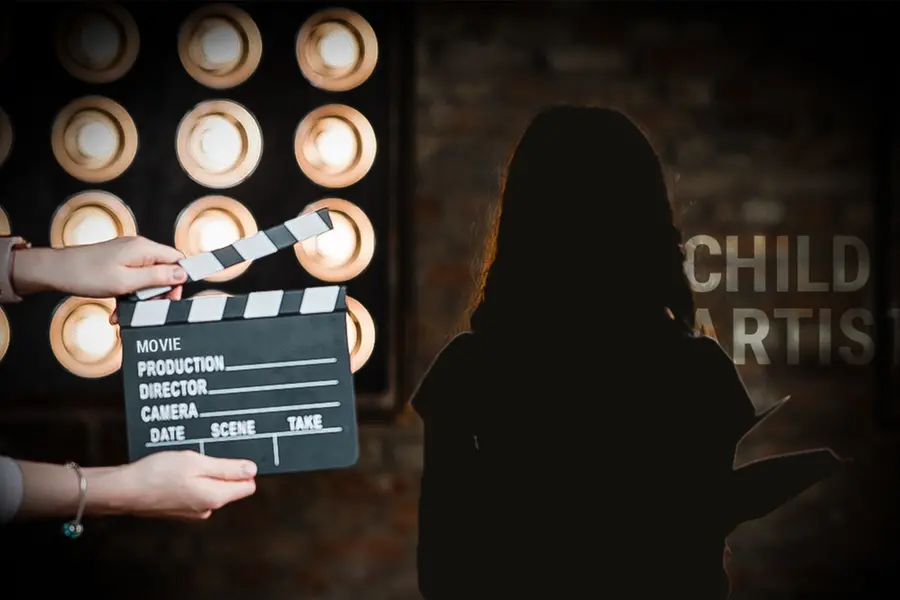
For Shalin Zoya, a popular face among Malayali television audience, growing up as a child artiste wasn't a dream come true, rather a difficult chapter in life. She started acting from the age of three and has been facing the camera ever since until stepping into the shoes of a director recently. Back then, being on sets was not a cheerful experience at all, asserts the actor.
'As a child, there were times when I had to shoot continuously for days, day and night. The role I played then was very hectic and I had to do lots of fight sequences. Once, I ended up vomiting and that's when the director said pack up,' reveals Shalin Zoya.
'It happened when I was in my fifth standard. I was working on a popular TV serial. There was a scene wherein an elephant was supposed to run amok with a kid sitting on its top. Day before the shoot, they (production team) asked me whether I could do it, and being a child, I gladly said yes. It was only later that I discovered that that jumbo had killed people before. I went up the elephant and the scene was shot, but the episode director was not satisfied and I had to do repeated takes, nearly 23 times. By then, I got scared and passed out. I fell upon the jumbo itself, lost consciousness and could not grab onto the rope tied on the animal's neck. For the shot, they had hit the elephant with a stick and it got agitated. The people in the sets did not bother about me or take the matter seriously.

Then, it was actor Kalasala Babu (late), who played the role of my grandpa in the serial, who came to my rescue. He insisted that I should be brought down immediately. That's when they finally let me down and came to know that I was not even conscious. Fortunately, I did not fall down. Later, they used a dummy and finished the shot,' recollects Shalin Zoya.
The actor, who never took a break from acting all through her childhood, admits that she was mentally drained after acting in television serials.
'Although I had played strong characters in my serials, many a time, I was ragged a lot by co-actors on sets. They considered it fun, but for me, it was more like mental torture. During those times, we were not aware of complaining to anyone, nor did we realise the need, considering the fame and attention that came through the process,' she adds.
For every aspiring artiste, the world of entertainment remains alluring and scintillating. The perks of fame, popularity and stardom often tend to cloud judgements about the industry, making onlookers fail to notice even the troubles laid out in the open. We watch them on screens, admire how adorable they are, and envy their talents. Beyond which, none of us finds the need to bother about what exactly happens in film/television shooting locations.
Recently, the National Commission for Protection of Child Rights (NCPCR), in an aim to protect child artistes from psychological and physical stress in workplaces, issued a revised set of guidelines (replacing the 2011 one) to be followed in the entertainment industry. According to the commission, child artistes have been exploited unnecessarily and subjected to perform or narrate dialogues beyond their understanding. Hence, minors in showbiz need protection under law and the guidelines, which also brings OTT platforms and social media under its ambit, serves the purpose.
| NCPCR guidelines for adolescent participation in entertainment industry |
| No minor should work for more than 27 consecutive days in a year. |
| The child shall participate in one shift each day with a break of every three hours. |
| At least 20 percent of the child's income from the production has to be directly deposited in a fixed deposit account in a nationalised bank under the child's name. |
| Producer should obtain a clearance certificate from the concerned district magistrate to involve a child in shooting. |
| No child/adolescent should be cast in a role or situation that is inappropriate to the child or that may distress him or put him in embarrassing situations. |
| No child/adolescent shall be made to participate in any audio visual and sports activity including informal entertainment activity against his will and consent. |
| At least one parent or legal guardian or a known person shall be present at all times if the child is above the age of 6 years. |
| Minors, especially below the age of 6 years should not be exposed to harmful lighting, irritating or contaminated cosmetics. |
| Children/Adolescents shall not be made to share dressing spaces/rooms with adults especially of the opposite gender. |
| No child/adolescent shall be made to work overtime. |
| No child/adolescent shall be made to enter into an agreement. |
Nonetheless, in Kerala's entertainment industry, there have not been many reports about exploitation faced by minor artistes. Does that mean Mollywood is free of violations? One can hardly say yes on delving deep into reality.
Impact on mental health
Kids are very gentle, so are their minds. Nowadays, child performers get noticed easily. Especially with the advent of social media, there are a wide range of platforms to showcase talents. However, one needs to be on the guard about how such fame and popularity could adversely affect the mental well-being of children.
'When I see kids, child artistes doing Instagram reels and gaining popularity, I kind of see myself in them. Right now, they are enjoying this, but what they fail to realise is that one day, they could lose all the current fame. Then, it will drastically affect their mental health. Why am I not getting the attention that I used to receive? Am I not special now? Such kinds of self questioning will take place,' said Shalin Zoya.
When a child is called up for an audition, selected for a role and later replaced by someone else (due to various reasons), it could indeed have negative effects on their mental health.
Actor-screenwriter Vishnu Unnikrishnan, popularly known for 'Kattappanayile Rithwik Roshan', who shares the concern recalled, 'When I was a kid, I was called to play a role in a movie by a production controller and I went to the location in Palakkad alone. The next day, I was given Rs 100 and asked to leave. They told me that the shooting was cancelled due to shortage of funds and the controller, who brought me there, was nabbed by police. It was my first time travelling that much distance alone. I was a kid after all. The next day, I caught a KSRTC bus and somehow returned home.'
'It was a tragic experience for me and it still pains me after all these years. But I was able to encash and use the incident as a scene in my movie (Kattappanayile Rithwik Roshan). The same may not be possible for all. Sometimes, such incidents could have depressing effects on our mental health,' he added.
Fear to lodge complaints
In spite of the existence of various difficulties regarding payment, work hours, or even abuse, nobody is willing to voice out their worries nor lodge complaints. The authorities are also of the view that there is no need to carry out inspections or take further action considering the absence of legit complaints.
'Not many complaints have come to our attention so far. Also, I don't think that a follow-up has been carried out on the proper implementation of the (NCPCR) guidelines, particularly due to lack of an accurate monitoring mechanism,' states GL Arun Gopi, general secretary, Kerala State Council for Child Welfare (KSCCW).
'There is an evident issue concerning the lack of awareness about the guidelines in our society. If you take a look at many of our television shows, you'll find that children are being used to increase TRP and businesses. A couple of years back, children's misery and tears were the major source of TRP for daily soaps. In my personal opinion, such serials and talent shows go a long way in promoting unhealthy competitions and comparisons, instead of nurturing the talents of kids,' he adds.
The official further advised people to feel free to raise their voices and lodge complaints with the child welfare committee, child rights commission, or even approach nearby police stations.
What's there to lose?
As in any workplace or industry, fear of not gaining new opportunities, angst of victim shaming, lack of job security etc. prevail in the film world too. 'There is no security of work in cinema. A lot of people work here without job agreements. Contracts are rare, except for senior artistes. Ergo, it is of utmost concern that how many people are willing to speak up and file complaints,' says Sangeetha Janachandran, founder of Stories Social, a marketing and communications agency based in Kochi.
'If the production houses and other organisations concerned stand by those who face unpleasant experiences, reassure them and resolve their problems without compromising their work, then things could change and many will find the courage to speak out. Not just in cinema, in any workplace, a large number of people still lack the confidence to raise their issues. For children, the situation could be much worse,' she adds.
Meanwhile, one cannot ignore the positive changes taking place in the industry with the emergence of new production banners with structured, well-organised work profiles. Insiders do feel that things are slowly getting better with the work atmosphere getting process-oriented in nature.
Passion and performance
"We have been watching children perform on talent shows for a long time now. Such programmes provide a lot of opportunities and experiences for the kids. It helps them learn to manage stressful conditions, provided the stress they face isn't too much to bear for their age. You can't keep kids stress-free always. Saying that, it needs to be assured that kids are not subject to any physical harassment or mental abuse. If they enjoy what they do and are performing with passion, then no problems will arise,' opines Dr Vani Devi, child psychologist.
To those who feel that children acting in movies and participating in reality shows could distance them from academics and schooling, she adds, 'Extra-curricular and co-curricular activities should go hand-in-hand with studies. Kids are not sent to school to acquire mere textbook knowledge. A child should not be evaluated on the basis of his academic performance alone. Rather, social and survival skills, knowledge acquisition, artistic talents, understanding one another etc. should be considered comprehensively too. Still, when parents attempt to pressure kids to participate in talent programmes, without realising or misjudging their true potential, it could lead to adverse consequences.'
Lost childhoods
When you look into the lives and biographies of yesteryear heroines, who began their lives as child artistes, it is evident how lost childhoods and tiresome shooting experiences affected the development of their characters later on. One needs to remember that during those days, there were not many avenues to register complaints as well. Fast forward to the 2020s, the scenario has improved a lot with more priority given to work rights and secure workplaces. Rules and guidelines have been issued by the government too. Yet, are they enforced properly? The question garners mixed responses.
'As far as I know, no such guidelines are followed in our film locations and sets. In general, our film industry is not a work-friendly place for artistes, other than a few privileged ones. I have heard about the difficulties faced by the child artistes and their mothers in the industry. But, no concrete incidents can be pointed out as people do not register complaints or voice out such exploitations. In short, we can only count on hearsay comments, but cannot substantiate any of our claims. But it is in the air,' said a noted screenwriter in the Malayalam film industry, who opted to remain anonymous.
'For many prominent actors, child abuse is one chapter that they wish to skip in life. Many are unable to recover from that trauma, but none will be ready to confess it. Not even those artistes, whose film career has reached its culmination, will open up about such experiences. That's the sad reality and we can't blame them,' she adds.
Does it account for child labour?
As per the revised NCPCR guidelines, 'The involvement of children in the entertainment industry is governed by the provisions of Child Labour Act which permits under Section 3(2)(b). That is, a child artiste can take part in the entertainment industry provided that there is no denial of their rights or hindrance of their physical-mental-social development in any manner.
According to KV Manoj Kumar, Chairman of the Kerala State Commission for Protection of Child Rights, the work of child artistes do not exactly come under the definition of labour in the Child Labour (Prohibition and Regulation) Act. Also, child actors cannot enter into any contracts as they are minors and do not fall under the Contract Act. Any such contract can only be signed by the parent or guardian.
Nevertheless, whenever there is any violation of the Juvenile Justice (Care and Protection of Children) Act or the Right to Education Act, we, as in the commission, can intervene and take action. However, strict enforcement of the commission's guidelines lies with the government, Manoj Kumar said.
As a means of assessing the implementation of the guidelines, district-level meetings of various stakeholders (JJ, RTE, POCSO) are being held over several issues, including child labour. Certain projects are also in the pipeline to carry out operations over complaints, he added.
The need of the hour
Often, tight work schedules and financial constraints are the root cause for staunch responses from the parts of the production teams, be it towards child artistes or others. Here, a change should come about from the decision makers themselves. For instance, organising workshops to create awareness about the existing rules and guidelines could go a long way in making the workspace child-friendly. However, the implementation of changes will differ from each production house to the other.
'Producers' associations should take the initiative and create awareness. Not all of us would be following media reports regularly. So, if a new guideline is issued, then they (association authorities) should take the responsibility and inform people. They can easily share it through WhatsApp groups or other social media platforms. Or else, when we approach them with a movie that includes child artistes, proper instructions must be given,' opined Sandra Thomas, actor-cum-film producer.
'Further, if a new guideline is in effect, then when we advance the producers' association to register a movie, they should educate us on the changes and direct us to follow the rules. At present, many among us in the industry are not aware of such rules and reports about such rules tend to crop up only after a serious violation takes place,' she added.
Changes in the air
Over the years, the film-television industry has undergone valuable changes, to a certain extent, in terms of acknowledging the concerns of child artistes and taking measures to rectify their problems. Several actors, directors and producers have begun taking initiatives to make kids feel at home in sets.
Actor cum producer Maniyanpillai Raju, who is currently working on a movie featuring child artistes, remarked that his team had even made arrangements to provide tuition classes for kids during their free time on sets. They also conducted a four-day acting workshop for the children in order to make them mentally accommodated with the whole shooting process.
'We did not schedule any night shoots after 9 pm for children. As the kids were from different backgrounds and they had to get to know each other to emote better in scenes. For that, we conducted the workshop through games, wherein they were able to leave all their inhibitions and get accustomed to the environment, feeling comfortable,' he said.
Similar changes are also evident in the Malayalam television industry. According to Prasanna, mother of child artist Sona Jelina ('Vanambady', 'Mounaragam' fame), shooting sets have been treating her daughter like family.
'Sona is always taken care of by all, including co-actors, and is encouraged to perform well. In the sets, she also brings her textbooks and finds time to study amid the scenes. She has received complete support for the same as well,' she adds.
Parents of several other child artistes, including Da Vinci and Vriddhi Vishal, also reiterated the views. While these positive changes definitely deserve a pat on the shoulder, one should not turn a blind eye towards the excruciating past and address the elephant in the room accordingly.
Published: 01 Nov 2023, 07:39 am IST
Disclaimer: Kindly avoid objectionable, derogatory, unlawful and lewd comments, while responding to reports. Such comments are punishable under cyber laws. Please keep away from personal attacks. The opinions expressed here are the personal opinions of readers and not that of Mathrubhumi.