

What happens when women reclaim a centuries-old male tradition? The Vanitha Kathakali Sangham’s story is one of discipline, defiance, and deep cultural change
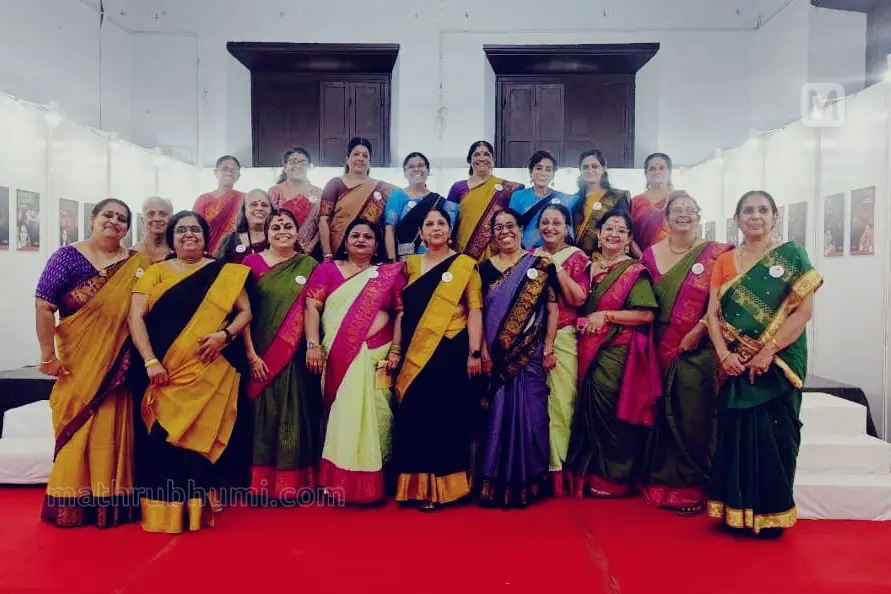
As the deep rhythm of the maddalam echoed through the halls of Kalikkotta Palace, heralding the second day of ‘Suvarna Sushamam’, a grand tribute to their 50-year journey, members of the Thripunithura Vanitha Kathakali Sangham spoke to Mathrubhumi about their path-breaking journey, the lessons learned on stage and off, stories of struggle, sisterhood, and the joy of shaping a space of their own within the world of Kathakali.
Traditionally viewed as the domain of men, Kathakali was considered too physically taxing for women to perform. Thripunithura, among several towns in Kerala known for its deep-rooted love for Kathakali, became the backdrop for a subtle but significant shift.
K T Rama Varma, an art enthusiast and connoisseur, enrolled his daughter Radhika Varma in Kathakali, a move that would quietly question age-old norms. His bold move, supported by veteran Kathakali maestro Kalamandalam Krishnan Nair, quietly challenged long-held norms.
In 1975, that spark grew into a full-fledged movement with the formation of the Vanitha Kathakali Sangham, an all-women troupe determined to claim their space on the Kathakali stage. They performed Kalyanasaugandhikam at Tripunithura, featuring Radhika Varma, Sreemathi Antarjanam, Radhika Ajayan, Shailaja Varma, Vrinda Varma, and Meera Narayanan. Sathi Varma, the troupe’s founding manager, was instrumental in shaping its direction and mentoring emerging talent.
Trained under legendary gurus like Kalamandalam Krishnan Nair, RLV Damodara Pisharody, FACT Padmanabhan, Cherthala Thankappa Panikkar, and Kalamandalam Keshavan Poduval, each artist brought a unique style and discipline to the group. While some of the founding members stepped away due to personal commitments, others returned, and the troupe has steadily grown from 20 members to a dynamic collective of over 40 performers, including many from the younger generation.
“The performers were mainly women. From portraying both male and female characters to handling most of the musical accompaniments, everything was done by women, Vijayamani on the chenda, except for the maddalam. But now, even that is changing. Women are learning the maddalam too, and soon they will be on stage creating magic,” says Suma Varma, who predominantly performs Minukku veshams (often female characters in the story) on stage.
Parvathi Menon, popularly known among Kathakali enthusiasts as ‘Duryodhanamenon’ for her commanding portrayal of the character, spoke about the evolving dynamics of a traditionally male-dominated art form. She highlighted two distinct aspects of change: how women performers adapted themselves, and how audiences responded to their presence on stage. “From our side, the transformation begins the moment we decide which character to perform,” she explains. “Whether it’s performing mudras (hand gestures), executing kalashams (intense rhythmic movements), or embracing a powerful role on stage, we train ourselves to embody the character fully, not as women portraying men, but as the character itself. We adjust the aaharyam (costume and makeup), focus on stage presence, and refine our expressions and movements. Facial expressions are universal, but the way we perform mudras, the strength in our gestures, and the sharpness of our eye movements can convince the audience that what they’re seeing is the character, not a woman playing a male role.”
However, she admits that audience perception doesn’t always keep pace with performance quality. “There are still viewers who come with preconceived notions, ‘Oh, it’s the ladies’ troupe, it will only be so-so.’ Some form opinions even before the performance begins, because for many, Kathakali is still seen as a male preserve,” she says. “Now, everyone says gender doesn’t matter, but beneath it all, gender still does.”
Parvathi stresses the importance of conviction and clarity in such situations. “Even when we innovate or improvise, there will be resistance. But it’s important to stay rooted in what we do, to stand by it confidently, and be prepared to explain the thought and logic behind our artistic choices.”
She also urges audiences to approach performances with an open and unbiased mind. “Focus on the portrayal, not the gender of the performer,” she says. “Only then can the art be truly appreciated for what it is.”
Ranjini KP, advocate, former Chairperson of Thripunithura Municipality, and now the founder of a Kathakali school, famous for her Ravana character on stage, reflects on her lifelong journey balancing multiple roles, as an artist, public servant, teacher, and mother. “My life as an artist has always been about balance,” she says. “My motto has been: where there’s a will, there’s a way, and I’ve lived by that. No one else will carve out a path for our dreams. But if people see that we’re truly committed, they will eventually support us.”
She credits her family for being her strongest foundation. “My parents and brothers always stood by me. I performed well academically, securing an LLM rank. At one point, my brother brought me civil service preparation books. But when he saw my dedication to Kathakali, he said, ‘Sachin was born for cricket, Ranjini was born for Kathakali.’ That one line meant everything to me.”
On managing home and work, she says, “In my house, no one asks whether I’ve done the chores. My husband, daughter, and son take care of everything when I’m away. Our daily life
doesn’t get disrupted because we understand the nature of this art form. They’re also Kathakali lovers, so if someone questions my priorities, they are the first to answer.”
Having started learning Kathakali at the age of 3 and performed at countless venues over the years, Ranjini has witnessed a clear shift in how women are received in the traditionally male-dominated world of Kathakali.
“There’s been a remarkable change. Earlier, acceptance was limited. But now, being a Kathakali performer, especially as a woman, is celebrated, even on social media,” she notes. “Many of our fellow artists, be it singers or co-performers, treat us as equals. They don’t see us as women on stage; they see us as artists. That respect has grown.”
She acknowledges that women still face unique challenges, such as late-night travel and lack of basic facilities like restrooms, but says those gaps are now being bridged through mutual care. “We travel like a family. Maybe it’s because women are now part of the Kathakali fraternity, there’s a stronger sense of community. Whether it’s the singers or the co-performers, we support one another. It feels less like a crew and more like a family trip.”
“Family support is essential in an artist’s life,” Ranjini concludes. “But so is community. When both exist, at home and on stage, you grow not just as a performer, but as a person.”
“In those early days, we weren’t even aware of the criticism. Our focus was entirely on learning and earning the appreciation and guidance of our ashans (gurus). It was only later that we came to know about the heated debates happening behind the scenes. Most of the resistance came from men who were reluctant to accept women portraying strong, traditionally masculine characters. Many doubted whether we could succeed. But gradually, with each performance, some of those very sceptics began to acknowledge, and even appreciate the troupe,” recalls Geetha Varma, who is mainly into Kaththi and Pacha veshams.
Radhika Ajayan and Meera Narayanan, both accomplished artists, reflected on the evolving role of women in Kathakali and the emotional depth that defines the art.
“Each performer brings their depth and interpretation to a character,” they shared. “Today, more women are drawn to Kathakali with passion and purpose. Institutions are slowly beginning to acknowledge this shift, though challenges remain.”
They pointed out that subtle discrimination still lingers in some formal settings. “Girls may sometimes face fewer opportunities in institutions, and that needs to change. There should be no gender-based distinction, every character has its internal complexity, and every vesham (role) is an opportunity to explore that, regardless of who is performing it,” they said.
“What matters most is not who’s playing the role, but how the artist builds and enhances the context of the character. That artistic honesty is what defines a true performance.”
For Meera, Kathakali is as emotionally transformative as it is performative. “At the end of the day, we’re all human,” she says. “There’s a deep emotional shift that happens when performing. And when we return to ordinary life, it often feels like we’re just switching emotional states. Our real-life experiences naturally find their way into our performances; it’s all interconnected.”
Both artists emphasised that beyond technical skill and discipline, what sustains them is the support they receive off stage. “Family plays a crucial role in helping us pursue this path,” they
noted. “But equally important is the friendship and sisterhood we share within the troupe. That bond is at the heart of our journey as performers.”
“We approach Kathakali with joy,” Meera adds with a smile. “Every rehearsal, every gathering, every stage moment, it all feels like one big family trip. And that sense of camaraderie makes all the difference.”
In recognition of its pioneering role in breaking gender barriers within classical art, the Vanitha Kathakali Sangham was honoured with the prestigious Nari Shakti Puraskar in 2016. The award is a proud milestone in the troupe’s ongoing journey of resilience, artistry, and empowerment.
Published: 14 Jul 2025, 10:59 am IST
ABOUT THE AUTHOR
Disclaimer: Kindly avoid objectionable, derogatory, unlawful and lewd comments, while responding to reports. Such comments are punishable under cyber laws. Please keep away from personal attacks. The opinions expressed here are the personal opinions of readers and not that of Mathrubhumi.