

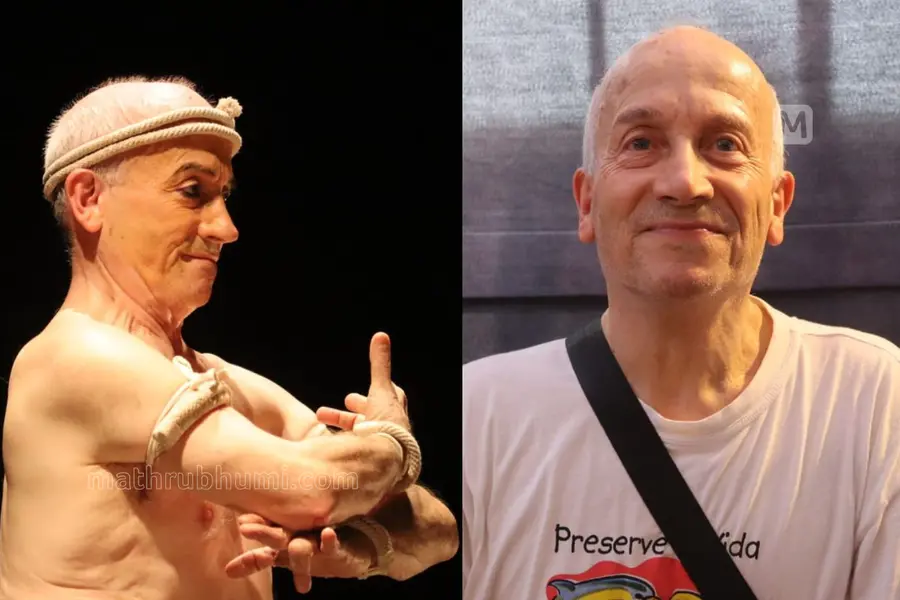
From years of rigorous training to performing in Kerala, Italian artist Mario Barzaghi reflects on discipline, devotion and the transformative power of Kathakali and classical art traditions.
“Look. Art knows no prejudice,
art knows no boundaries,
art doesn’t really have judgment in its purest form.
So just go, just go.”
is a famous quote by K D Lang.
These words find a living example in Italian theatre practitioner Mario Barzaghi, whose journey with Kathakali demonstrates how art transcends geography, language and cultural difference. He played the role of Santiago in Kerala Kalamandalam’s Kathakali adaptation of Ernest Hemingway’s 'The Old Man and the Sea', staged at the Peruvanam International Village Festival recently.
Through years of dedicated training, discipline and unwavering respect for the form, Mario proves that artistic commitment can erase barriers and build deep emotional and creative connections.
Speaking to Mathrubhumi, the Milan-based artist reflects on his enthusiasm for learning, the seriousness with which he embraced a new tradition, and his love for performance and Kathakali.
When did your journey with Kathakali begin?
I first began practising Kathakali in 1981 in Italy, when artistes from Kerala visited as part of a theatre exchange. At that time, I was working with Teatro Tascabile di Bergamo – Accademia delle Forme Sceniche, and that was my first real encounter with the discipline of Kathakali.
How did Kathakali first come into your artistic life?
It was not something I sought out personally. Our theatre director attended a major festival organised by Eugenio Barba in Bergamo, where he saw Kathakali, Balinese theatre, Odissi and Bharatanatyam for the first time. He returned convinced that our training needed to change. Instead of continuing with a Grotowski-inspired method (method, developed by Polish director Jerzy Grotowski, is a rigorous actor training system focused on stripping away theatrical artifice to find authentic expression through intense physical and vocal work, emphasizing the actor-spectator relationship in "Poor Theatre" (minimalist stage) and later evolving into participatory "Paratheatre" and "Art as Vehicle" for inner transformation), we began training in these Asian forms. That decision marked the beginning of my Kathakali journey.
Who have been your teachers in Kathakali?
My present teacher is Kalamandalam Neeraj. Earlier, I spent a short period training with Kalamandalam John and Kalamandalam Padmanabhan Nair Ashan. However, I do not think of teachers as “gurus” in the traditional sense. A guru, to me, is someone who draws a student out of darkness. Modern teachers carry many responsibilities, so I prefer to think of them as friends who are humane, yet completely professional once class begins. Friendship alone is not enough; discipline is essential.
Kathakali is known to be physically demanding. How challenging has it been for you?
Kathakali is extraordinarily demanding. In the beginning, it feels less like theatre and more like a rigorous martial discipline. The only true instruction a teacher can give is: practise, practise, practise. Today, many people have lost patience for hard effort, but classical art requires tremendous physical labour, concentration and endurance.
How frequently do you visit Kerala for training and performance?
I generally come every year and stay for at least two months. In 2004, I ruptured my Achilles tendon, which forced a long break. When I returned, I had to reset everything and start again from the basics before learning anything new. Kathakali is rooted in divine characters with extraordinary bodies, so achieving these positions is always challenging.
What does your practice routine usually look like?
My teacher conducts class, and then I spend one or two days working alone, memorising and internalising what I have learnt. Gradually, fragment by fragment, we construct a performance.
How long were you in Kerala for the production of 'The Old Man and the Sea'?
For this production, I trained for about two months at a stretch, and the work continues even now. The teachers may not require such constant rehearsal, but I do. Since I do not speak Malayalam, I must memorise every mudra, every movement and every expression precisely.
Without knowing Malayalam, how do you understand the performance text?
My teacher explains the entire dramaturgy of this text to me. I then translate and absorb it. Mudras certainly communicate meaning, but Kathakali functions on many levels: pure dance, expressive movement, visual poetry, navarasa and emotional states. Within my limits, I try to enter that complex world.
Apart from Kathakali, could you tell us about some of your other theatre projects and the themes you explore in your work?
Alongside the other members of Teatro dell’Albero, where I am the director, I have developed a show titled 'An Athlete of Heart', which examines the interplay between Eastern and Western acting traditions, highlighting the links between the two. This work has been performed in theatres, universities, academies, schools, festivals, and theatrical reviews across Italy, as well as in many countries in Europe and Latin America.
How do you approach the complexity of Kathakali, especially with its multi-layered, intricate structures?
Yes, of course. Kathakali operates on many classical parameters. There are generally three levels: one is pure dance, focusing on the legs and feet; the upper body conveys meaning, but it is essential to think about drishti (the looks) and chavittu (the rhythmic beats), the visible poetry, rather than relying on translation, which is not really appropriate in Kathakali. Then there is Navarasa, encompassing the nine emotions, along with sancharibhava, sthayibhava, and many other expressive elements. I am constantly trying, within my limits, to navigate and enter this very complex world.
How many venues have you performed Kathakali in outside India?
Performing Kathakali in Italy or Europe is very challenging. Occasionally, we perform at an academy or a university where students study the art, but opportunities to stage a full performance are limited. Very often, we also conduct workshops for students, but actual chances to perform are rare.
How do you structure your workshops for audiences unfamiliar with Kathakali?
It depends entirely on the context. If students have no prior knowledge, we must introduce the form carefully. Sometimes we do lecture-demonstrations. Sometimes we give a detailed introduction first and then perform.
Another factor is the professor or institution. They set the limits so that sometimes the lectures may not be fruitful. This has also happened.
The most effective approach is when audiences receive some understanding beforehand; it helps them engage far more deeply with the performance.
Watching the performance first only makes the audience view the art but not understand its complications and nuances. So, according to my view, at a minimum, there should always be an introduction before the performance. At the very least, they should have a basic “sense” or “smell” of the art form before watching. I am quite rigorous about this. I do not prefer short workshops because they only serve as tourist experiences. Today’s world runs on 20-second Instagram reels, but this kind of art, Kathakali, Koodiyattam, Odissi, Bharatanatyam, demands years of training, dedication and discipline. It's not child's play.
Art and artistic commitment are often described as inseparable. From your perspective, how would you define or explain this relationship?
Yes. I like to speak about Kronos. Kronos is the human watch, the measurable time we live by. But art does not belong to Kronos. In Greek philosophy, there are two kinds of time: Kronos, human time, and Aion, the time of the divine. Art belongs to Aion, not to our schedules, deadlines or convenience. To truly enter this artistic world, you must give years of your life. If someone is unwilling to commit, they shouldn't step in at all.
Have other art forms influenced your artistic journey?
Yes, Pantomime (the storytelling practice of using only body movement, gestures, and facial expressions to convey a narrative or emotion, without speech, rooted in ancient Greek and Roman drama) has influenced me, especially the work of Étienne Decroux, the father of modern Pantomime in France. In my early years, Polish theatre director Jerzy Grotowski also inspired my training and approach to theatre.
Do you have a ‘comfort zone’ in any particular art form?
I do not believe in the concept of a comfort zone. It is a construct of capitalism, useful for business, not for art. Where is the comfort zone for a worker doing hard labour? In Kathakali, there is no comfort zone. When we begin ilakiyattam ( performance of the actor after the Cholliyattam, which is without the support of the dialogue or lyrics) or kalasham (foot works), there is only effort. In classical art, beauty is directly linked to effort. Without effort, there is no beauty. Human beings must move, work and transform. That is how art is created.
How do you see Kathakali evolving today?
The traditional style remains strong, but at the same time, many parameters are evolving. That is what fascinates me. Here in India, such visionary projects are conceived with depth and courage, something that is often difficult to realise in Europe.
What would you like to tell students who are beginning to learn Kathakali?
My message is: please come to India. There is so much to learn here. In the West, we often believe we are the centre of the world, but that is not true. Here, people are creating extraordinary artistic works that we could never imagine. Come, learn, train seriously and make a sincere effort. And remember, art is proportional to the efforts. As much as you are ready to work and put effort, art will embrace you, and you will be a happy practitioner in life too.
Published: 11 Jan 2026, 02:53 pm IST
ABOUT THE AUTHOR
Disclaimer: Kindly avoid objectionable, derogatory, unlawful and lewd comments, while responding to reports. Such comments are punishable under cyber laws. Please keep away from personal attacks. The opinions expressed here are the personal opinions of readers and not that of Mathrubhumi.