
Suman Mukhopadhyay`s film adaptation of Manik Bandopadhyay`s Putul Nacher Itikatha explores destiny, hypocrisy, and social reform in rural Bengal.
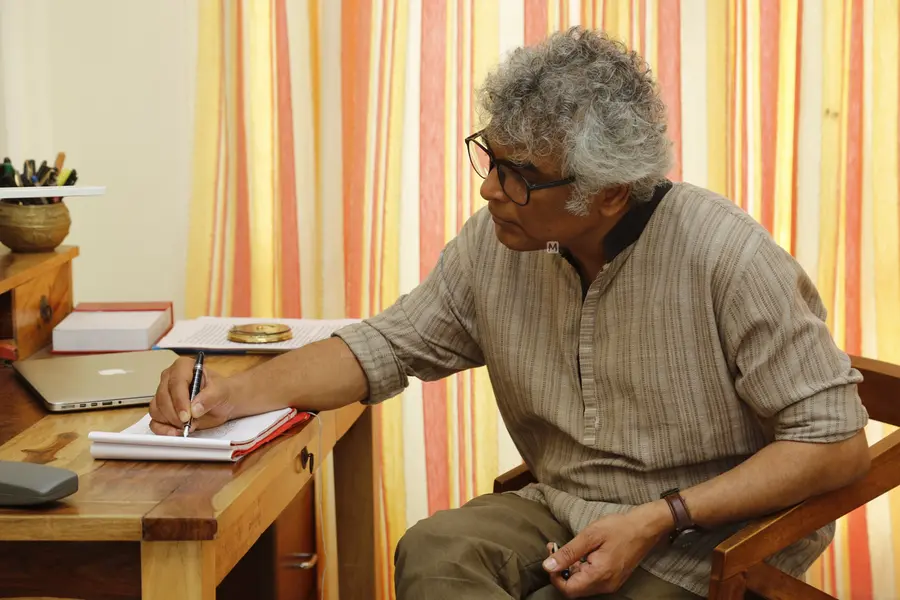
Manik Bandopadhyay was a writer born ahead of his time. He died, reportedly in penury, depression and purportedly, of alcoholism at the young age of 48. Within that brief span, he wrote 36 novels and nearly 250 short stories, most of them defining not only a new style of writing but also opening up a completely new world of the marginalised and the oppressed in which he cut open the economic deprivation of his characters to expose their ever-changing emotional vacillations they suffer mainly rooted in societal inhibitions and blind belief, unlettered in science.
However, not too many of Manik Bandopadhyay’s works have been a favourite with Bengali filmmakers probably because of the complexity of the characters and also because these stories were anticipated to have little box office value. Among the films made on his stories, the noted ones are Dibaratrir Kabyo, Shilpi, Calcutta ’71, Padma Nadir Majhi, Putul Nacher Itikatha and a few more.
Manik Bandopadhyay is counted among the trio Bandopadhyays as the most outstanding post-Tagorean writers in Bengali literature, the other two are Bibhuti Bhushan Bandopadhyay (Pather Panchali) and Tarashankar Bandopadhyay (Abhijaan).
According to historical data, the first celluloid adaptation of a Manik Bandopadhyay novel was PutuL Naache Itikatha (1949). The film was directed by Asit Banerjee who claimed to have done the story and the script. Records make no mention of Manik Bandopadhyay in the credits. The story, though set within a village hub, is filled with very modern concepts and ideas and many critics of the time found it too explosive and bold.
This writer happens to have watched the theatrical presentation of the play more than a decade ago staged by Chetana, a famous theatre group founded by Suman Mukhopadhyay’s father the great Arun Mukhopadhyay. It was a brilliant representation of the spirit of the novel within the limitations of a proscenium space specially as the backdrop is set in a very rural and remote village deprived of basic scientific knowledge, medicine and healing methods.
Putul Nacher Itikatha (A Puppet’s Tale) is one of the most outstanding works of Manik Bandopadhyaya. In one of his letters Manik informed that this novel is a humble protest against those who tend to play with the lives of human beings as if they are puppets. It was serialized in the prestigious magazine Bharatbarsha from Poush 1341 to Agrahayana 1342. D. M. Library of Calcutta published it in book form in 1936.
The individual is a puppet of destiny. This universal truth is borne out powerfully and incisively in Putul Nacher Ititkatha. The novel is a critique on the hypocrisy – social, religious, filial and economic that rules the lives of people in a Bengal village a few years before World War II. This hypocrisy intensifies their struggles, deprivations and suppressions instead of bringing in harmony and peace. The concretization of the main ‘puppet’ finds realization through the character of Shashi (Abir Chattopadhyay), a city-bred doctor who returns to his boyhood village before moving off to UK for further studies with the aim of bettering the health education and information on the science of medicine among the ignorant villagers who still rigidly believe in superstitious and religious beliefs.
In Putul Nacher Itikath, an elderly couple, Jadav Pandit (Dhritiman Chatterjee) and his wife, are canonised as saints after committing opium-induced suicide just to prove that the man, respected as the learned elder of the village, is right in holding belief in religion, superstition over science and can predict his own death. He does this when he finds himself pitted against Shashi, the doctor who is aghast at the way the entire village joins in the canonization of Jadav Pandit.
Through Shashi, we are introduced to the different characters in the story of who, the three main people are Jadab Pandit (Dhritiman Chatterjee), Shashi’s father (Shantilal Mukherjee) an exploitative moneylender in the village, Kusum (Jaya Ahsan), the wife of an elderly man who is attracted to Shashi and he too, feels pulled to her sensual beauty. Then there is Shashi’s medical college brilliant friend Kumud (Parambrato Chatterjee) who surprises Shashi as a young man, distanced from medicine running his own jatra company and travelling through villages with his jatra performances. This young man marries Moti (Surangana) the pretty teenager of the village and takes her away as his bride. And who can forget the tragedy of Sen Didi (Ananya Chatterjee) forcibly married by Shashi’s father to a man double her age. She is saved from death of small pox by Shashi but loses her sight in one eye.
Shashi’s plans to go abroad are blocked as he gets helplessly and hopelessly trapped in the health care of his village people followed by the construction of the village’s first hospital. Shashi is gifted with a bicycle for his efforts. But the irony happens when, cycling through the rough pathways of the village at night, Shashi sees the burning eyes of a wolf hiding behind bushes in the village forest. There are departures from the original literary work but it does not intrude into the narrative of the film. Nor does this jar with the novel.
Suman Mukhopadhyay, a national-award winning director, teacher of cinema at global universities and a noted theatre personality, has made A Puppet’s Tale adapted from Manik Bandopadhay’s Putul Naacher Itikatha. The film, a poetic, lyrical unfolding of this classic, timeless novel that dates back by almost a century, is running to packed theatres in Kolkata and the suburbs. Mukhopadhyay has directed eight full-length feature films. His first directorial film, Herbert (2005) won the National Award for Best Regional Film that year. His films have been screened in Munich, San Francisco, Busan, Toronto, India, Kerala, Kolkata International Film Festivals, among others.
Says Suman, “I struggled for 15 years to bring this film to life, revisiting the script as socio-political changes inspired new insights. Although I had no clear timeline for production, I travelled extensively to scout locations for this period piece. When the pieces finally fell into place with a producer on board, assembling the right cast and crew proved challenging. I sought a team that not only possessed acting and technical skills but also deeply understood the cultural milieu and moral values woven into the narrative. To achieve this, I assembled a cast from both India and Bangladesh, emphasizing a shared understanding of the story's context. I also immersed myself in literature from the era, encouraging my cast and cinematographer to read selected works to grasp the nuances of the time and space we aimed to depict.
“In my cinematic interpretation, I focused on the character of Shashi, exploring his internal struggles. Rather than being a transformative agent, he embodies a tragic failure to act, remaining a passive observer in both love and significant social events. Despite the story's setting in an obscure and prejudiced rural environment, I found inspiration in the resilience of the women in the film. Kusum's candid admission of her feelings for Shashi and Sendidi's bold pregnancy serve as powerful counterpoints to the prevailing chauvinist social order, highlighting their strength and agency amidst adversity.”
He goes on to add, “I set out to create this film as an adaptation of Manik Bandyopadhyay’s 1936 novel Putul Nacher Itikatha, believing it could have a therapeutic effect on the deadlock created by the vastly differing worldviews within our society today. The doctor’s dilemma becomes even more pressing in a context where death looms over everyone. What are the repercussions of his attempts at social reform? Shashi embodies a pessimism fuelled by a yearning for intellectual engagement that eludes him in the confines of village life. He is trapped in a world where meaningful dialogue with his peers feels impossible. Despite his efforts to ‘reform’ what he perceives as a troubling native lifestyle, he finds himself meet frustration and futility. This adaptation aimed to explore these themes, reflecting on the complexities of human connection and the challenges of enacting change in a resistant environment.”
The period flavor of the film’s ancient recreation is enriched by the brilliant cinematography of Sayak Bhattacharya who invests every frame with the authenticity of the period making them look like a continuous flow of water colour landscapes. The bright, electric impact of the shining eyes of the wolf when Shashi sees them is both shocking and scary. So is the standing dead body leaning against a tree, discovered by Shashi. The cinematography can be qualified as the spirit of the film along with the frustrated and pained Shashi. The cinematography is perhaps the backbone of the film. It is both omniscient and objective, which sometimes changes into comments and questions that might arise in the audience. The same goes for Prabuddha Banerjee’s low key and subtle music. The editing by Tinni Mitra is butter smooth, seamless and sustains the flow of the rural-rooted period narrative beautifully.
What takes the cake are the brilliant performances of the actors. Abir Chatterjee as Shashi gives the best performance of his career, finally breaking out of the image of the detective or saviour or police chief he has been trapped in for many years. As Shashi, he arrives with great hopes of improving the health conditions of the poor and ignorant villagers but is sorely disappointed when Jadav Pandit tries to point out that science cannot win against religion and superstition. He never once loses control of his character even when he feels he perhaps ought to have. But that is true to his nature. His constant rejection of Kusum’s seductive advances is destroyed completely when he wants her in his life but she is no longer interested and wants to move out of the village with her old and unwell husband. Jaya Ahsan proves her versatility as Kusum with her suppressed sexual desires and is both beautiful and versatile while Shantilal proves that he does not need footage to prove his talent. Parambrata as Kumud and Surangana as Moti add some more flesh and blood to the script rounding up the key characters with closure with the sole exception of Shashi whose plans of going abroad are nipped in the bud. He unhappily gets used to his fate of living on in the village that does not understand him but begins to like him for his services in medicine. Is he the “putul” (doll) in the story? He might appear to be so but so are the other characters, pulled by those invisible strings called destiny, each one tied to his/her own beliefs or non-beliefs expecting destiny to take its own course.
Manik Bandopadhyay distinguished himself with focus on the life of ordinary rural and urban people, with the colloquial language and with a neat narrative. He was a great story-teller who perfected his fiction with insight into the human mind. In his earlier works he took a Freudian approach. In later life, he showed the influence of Marxist theory. His treatment of human sexuality in Chatushkone and somewhat in Putul Naacher Itikatha is path-breaking. Suman Mukhopadhyay with his dedicated team which includes four National Awardees has enriched the novel through the three-dimensional language of cinema. Take a bow, team.
Published: 14 Aug 2025, 11:05 am IST
Related Topics
Disclaimer: Kindly avoid objectionable, derogatory, unlawful and lewd comments, while responding to reports. Such comments are punishable under cyber laws. Please keep away from personal attacks. The opinions expressed here are the personal opinions of readers and not that of Mathrubhumi.
