
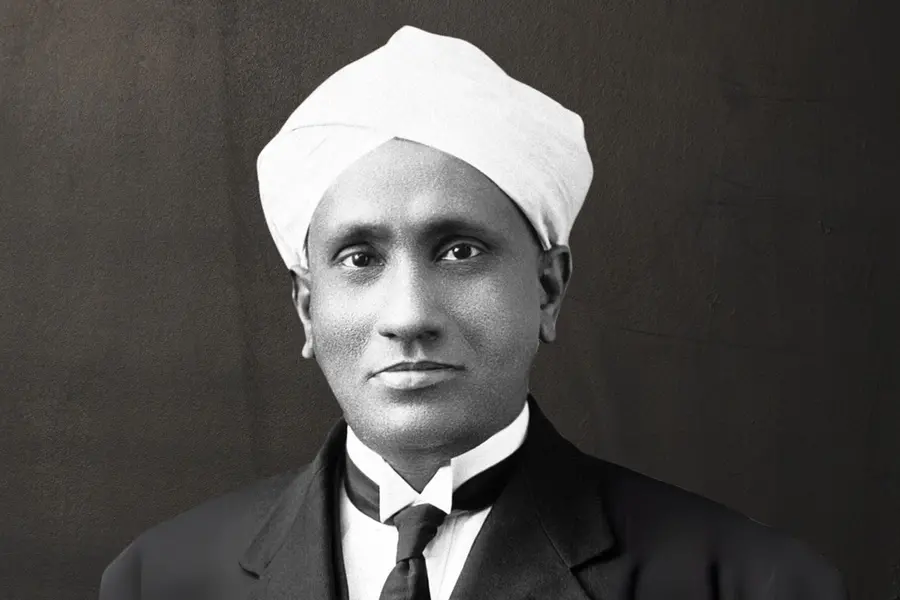
India is today observing the birth anniversary of acclaimed physicist and the first Asian to receive Nobel Prize for Physics, Sir Chandrasekhara Venkata Raman.
Raman was born on November 7, 1888, in Tiruchirappalli, India. Growing up in a scholarly environment -- his father was a lecturer in mathematics and physics -- Raman developed an early passion for science. This interest took him to Presidency College in Madras, where he graduated in 1904 with top honors and a gold medal in physics.
The Nobel Prize and the Raman Effect
CV Raman etched his name in history in 1930 when he became the first Asian to win the Nobel Prize in Physics for his groundbreaking research on the scattering of light, famously known as the Raman Effect. This phenomenon, where light changes wavelength when interacting with molecules, revolutionized the study of material properties and molecular structure and cemented Raman’s legacy in the scientific community.
Academic journey and research contributions
Raman’s academic career began in 1917 when he accepted the Palit Chair of Physics at the University of Calcutta. He spent 15 years there before moving to the Indian Institute of Science in Bengaluru, where he worked from 1933 to 1948. Post-1948, he established the Raman Research Institute in Bengaluru, serving as its director and turning it into a center of scientific innovation.
Raman's dedication to science also led him to create the Indian Journal of Physics in 1926, serving as its editor. He founded the Indian Academy of Sciences and was its first president, promoting scientific research and publishing much of his work in the academy’s Proceedings. Additionally, he led the Current Science Association, which publishes the journal Current Science.
Beyond the Nobel-winning discovery
Raman’s scientific explorations extended far beyond the Raman Effect. His extensive research included studies on molecular light diffraction, crystallography, and the optical properties of minerals such as opal and labradorite. He also contributed to the understanding of acoustic wave diffraction, the impact of X-rays on infrared vibrations, and crystal dynamics. His work encompassed colloid optics and investigations into human vision.
Awards and global recognition
Raman’s contributions earned him widespread recognition. He was elected a Fellow of the Royal Society in 1924 and was knighted in 1929. He received numerous honorary doctorates and memberships from prestigious scientific societies around the world, affirming his place as one of India's most celebrated scientists.
Published: 07 Nov 2024, 01:39 pm IST
Related Topics
Disclaimer: Kindly avoid objectionable, derogatory, unlawful and lewd comments, while responding to reports. Such comments are punishable under cyber laws. Please keep away from personal attacks. The opinions expressed here are the personal opinions of readers and not that of Mathrubhumi.
