
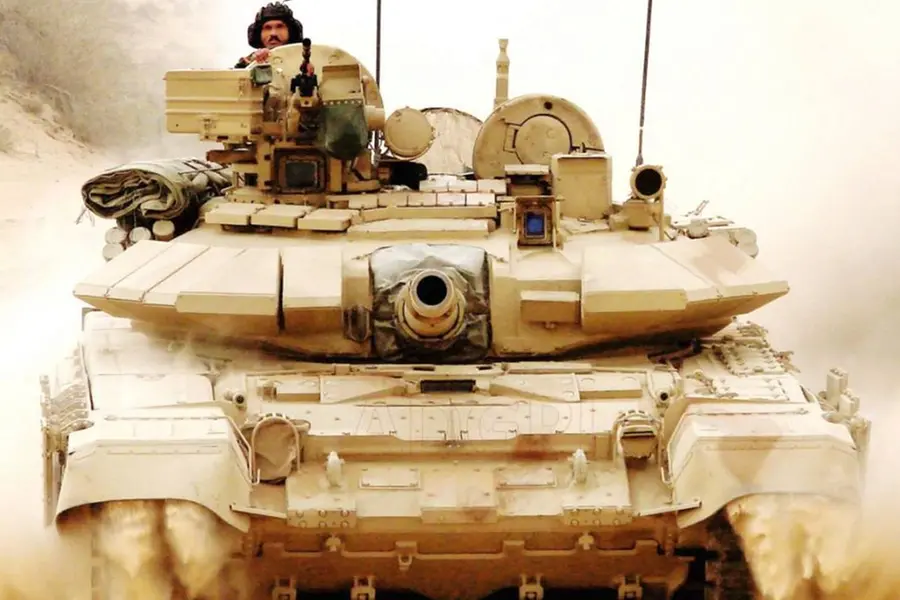
India is upgrading its tanks to face the new challenges of modern warfare, especially the growing threat of drones. The Indian Army is working hard to modernize its fleet of T-72, T-90, and Arjun Mk-1 tanks, turning them into advanced combat machines.
This transformation is led by the Army Base Workshop (ABW) in Delhi, where around 50 tanks are upgraded every year. These improvements boost the tanks' firepower, speed, and protection. India also plans to add 464 new T-90 tanks by 2027–28 and equip tanks with anti-drone systems using both Soft Kill and Hard Kill technologies.
Also Read

The ABW began this major initiative in 2023 under the guidance of General Upendra Dwivedi. This facility has become a key part of India’s defence strategy. It focuses on updating over 2,400 T-72s, 1,200 T-90s, and more than 100 Arjun Mk-1 tanks.
These upgrades include better fire control systems, stronger armor, and improved engines. By doing this work in India, the country reduces its reliance on foreign suppliers. This effort fits well with the 'Make in India' and 'Aatmanirbhar Bharat' missions, which aim to boost local manufacturing and innovation. The 2019 agreement with the Heavy Vehicles Factory (HVF) in Chennai to deliver 464 T-90 tanks by 2027–28 will further strengthen India's tank forces and regional military power.
In today's world, drones have changed the way wars are fought. Conflicts in Ukraine and the Middle East show how drones can easily target tanks. To fight back, India is introducing 75 anti-drone (Counter-Unmanned Aircraft Systems or C-UAS) units for T-72 and T-90 tanks. These systems come with two main technologies: Soft Kill and Hard Kill. Soft Kill works by jamming a drone's GPS or radio signals, which confuses the drone and makes it crash or retreat without using any weapons. Hard Kill is more aggressive -- it uses machine guns, lasers, or small missiles to destroy the drone completely.
Here's how these systems work: Powerful sensors, including radars and radio detectors, scan the surroundings in all directions (360 degrees). When a drone is detected, the tank crew can decide whether to use Soft Kill to disable it quietly or use Hard Kill to shoot it down. Technologies like Bharat Electronics Limited's (BEL) CUAS-HK and systems from companies like DroneShield help make this possible. With these upgrades, the tanks will be protected from air threats and better equipped for modern, chaotic battlefields.
Let's take a closer look at the tanks' firepower
The T-72, which has been in service for decades, uses a 125mm smoothbore gun. It can hit targets 2–3 km away with regular shells and 5–6 km away with guided missiles (ATGMs). Its lightweight design (41 tonnes) and composite armor make it quick and dependable.
The T-90, a more advanced version, also carries a 125mm gun. It has a range of 3–4 km with regular rounds and 6–8 km with ATGMs, thanks to advanced laser and thermal imaging systems. It is protected by explosive reactive armor and powered by a strong engine for better speed and toughness.
The Arjun Mk-1, India's own tank, features a 120mm rifled gun. It can fire high-explosive shells over 3–5 km and hit targets 6–8 km away with ATGMs. Its 1,400-horsepower engine can push the tank up to 70 km/h. It also includes a modern fire control system for improved accuracy.
The ABW's upgrades aim to further increase these tanks' firing range and accuracy by adding better sights and ammunition, making them even more lethal.
The addition of C-UAS systems is a smart and timely decision. Soft Kill systems, like those from DroneShield, use signal jamming to stop drones without firing a shot. Hard Kill systems, like those made by FN Herstal, can shoot drones down with great precision. These systems use radars and other sensors to monitor the surroundings and detect drones from all directions. This is very important, as even cheap drones (costing as little as a smartphone) can carry bombs or spy on positions. By combining Soft and Hard Kill methods, India ensures its tanks are not just strong on the ground but can defend against aerial threats too.
Upgrading tanks like this is not just about technology -- it is a major strategic move. Tanks are still vital for India's defense, especially with long borders and ongoing tensions with China and Pakistan. The T-72's rugged performance, the T-90’s advanced tech, and the Arjun’s indigenous design make for a powerful combination, adaptable to deserts, hills, and plains alike. With the risk of drone attacks growing every day, the C-UAS systems offer much-needed protection.
The work at ABW and the production at HVF are helping India become more self-reliant in defense, reducing the need for foreign support. This also boosts local industries, creates jobs, and builds technical knowledge -- important goals under the ‘Aatmanirbhar Bharat’ mission.
Of course, challenges remain. The ABW must scale up its capacity, the T-90 tanks must be delivered on time, and the C-UAS systems need to be installed across thousands of tanks. This will require careful planning and funding. But the direction is promising. With smarter upgrades, stronger tanks, and anti-drone protection, India’s armored forces are becoming future-ready.
As 2027–28 approaches, India's tanks aren’t just being maintained -- they’re evolving. With new technologies, better weapons, and a strong focus on self-reliance, these battle machines are turning into unstoppable guardians -- ready to defend the country with unmatched strength, vision, and pride.
Published: 16 Apr 2025, 10:40 am IST
Related Topics
Disclaimer: Kindly avoid objectionable, derogatory, unlawful and lewd comments, while responding to reports. Such comments are punishable under cyber laws. Please keep away from personal attacks. The opinions expressed here are the personal opinions of readers and not that of Mathrubhumi.