
Two Malayalam literary giants, Vysakhan and TD Ramakrishnan, look back at decades spent in the Indian Railways and how the journeys, people and struggles became the foundations of their writing.
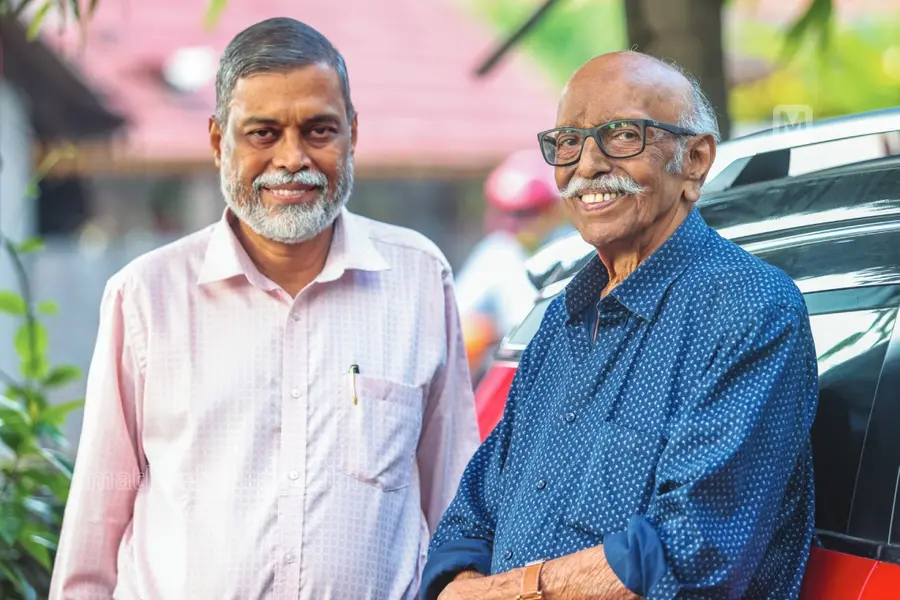
Writers Vysakhan and TD Ramakrishnan were railway employees for decades. Vysakhan joined the railways in 1963 at the age of 23, while TD Ramakrishnan was only two years old. They worked at many big and small stations in the country.
The vastly different railway work introduced them to different lives. They became stories... When these writers, who have similar backgrounds in many ways, talked, literature, life, and railways intertwined...
Vysakhan Mash and TD Ramakrishnan have written against the backdrop of the Indian Railways. Before getting to that, a question. How have the railways influenced the shaping of India? Writer Anand has said that the railways have helped India's nationalism the most.
Vysakhan: Anand is absolutely right. Although the British developed the railways for military operations, later railways helped instil a sense of nationalism in the common people. Railways unite India, which has cultural diversity. Moreover, railways are still the cheapest means of transport. "When asked why people travel in third class on trains, Gandhiji famously replied that there was no fourth class", is a popular saying.
TD Ramakrishnan: Railways are what make India 'India'. Railways unite people who speak many languages. This creates unity. Railway employees, on the other hand, have relationships with people who speak many languages. Southern Railways has a Tamil culture. It is jokingly said that Tamil is the unofficial official language of Southern Railways. It is difficult to work in Southern Railways without knowing Tamil.
Will ‘homeland’ become irrelevant for those who work in remote stations of the railways and for employees who have to travel to many places with the train, or will a supranational perspective develop instead of that feeling? How can a writer cope with that?
TD: 'Homeland' is developing. It is not disappearing. The world is widening. When I went to UC College in Aluva from a village called Eyyal near Kunnamkulam, Thrissur, my world expanded a little. When I turned 20, I got a job in the railways. With that, my world expanded a lot. I worked in 19 places for 35 years. I had connections in all these places. I worked on the Salem-Bangalore route during 1984-85.
The train arrives at Bangarapet at 6 in the morning. I still have the friendship I had with some of the people who regularly go to work in Bangalore at 6 am. It remains intact. If it wasn't for this job, it would never have happened. At that time, most of the youth from Kerala went to metro cities like Delhi, Bombay, and Madras in search of work. However, we went to remote villages in India. At that time, I longed to read a piece of paper in Malayalam. That's how I learned Tamil. If there were no Malayalam, then at least the nearest Tamil.
When train passengers from Kerala would throw out the newspapers they were carrying with them, I would pick them up and read them eagerly. Some would be the previous day's newspapers. Others were months old. In those days, there was no other way to get to know the news and the country. I got to know many different people through this journey.
Vysakhan: It was a great advantage for TD to get a job travelling. He got to know many different people. For the stationmaster, this is not the case. I have worked in 48 places in my 20 years of service. In the meantime, I have met the poorest people in India. At that time, the railway stationmaster was the only representative of modernity in the villages. The locals used to come to the stationmaster to read telegrams, write their husbands' addresses in letters, and tell them which doctor to see. Instead of making 'homeland' irrelevant, the important thing is that you can see the different aspects of life everywhere. And, I have not lived in my homeland for the most part. My childhood in Muvattupuzha, Ernakulam, in distant lands with work, as the president of the Sahitya Akademi, I spent a long time in Thrissur, and now I live in Palakkad. All of these are my homeland.
Vysakhan has said that 'The railways have destroyed my pride and strengthened my self-awareness'. Can you explain?
Vysakhan: When you work in small stations, you cannot go home after duty. There is only a store room in addition to the stationmaster's room. It smells of kerosene. Therefore, you sleep on a cement bench on the platform at night. You use the registers as a pillow. The poor people who have to go to work as wage labourers on the 4 am passengers must be sleeping on the bench next to us. The conversations between them have become the subject of my story. Familiarity with them is what will make my ego disappear. Another reason is that we don't have any other acquaintances there.
We realised that the living conditions of the locals are so miserable. That too made us lose our ego. Self-awareness is born from not having an ego. This is what happened when we saw the lives of people and lived with them. I will never forget the rice that a poor porter named Rasool used to make. The rice is made by adding eggplant, okra, potato, tomato and green chilli. We eat it without paying attention to the taste, without knowing it. That too will destroy our ego. Our mind will keep saying, 'Be a human being... be a human being'.
You both joined the railways not because of your passion for a railway job. It was a job that came to you by chance. Can you tell us how to do it?
TD: When I turned 18, I would apply for any job I could find. My goal was to somehow get a job. Taking tuition for children in those days was very beneficial. It helped to consolidate the basics of the subjects. I was in the final year of my degree when I saw the advertisement for the Railway Service Commission. I wrote the exam during a break from teaching children. Till then, I had never travelled much by train. I did not even know that I could reserve the pass sent for the interview.
I learned a lot about the railways for the interview. But they did not ask me anything about it. The first question was whether I had read the 'Mahabharata'. That made me sure that I would not get it. I have taught Shanti Parva from the 'Mahabharata' to children. With that courage, I said yes. The interviewer then asked nine questions from the 'Mahabharata' in a row. Fortunately, I was able to answer all of them. But I returned with the assurance that I would not get the job. Because the talk in the country was that there was fraud and corruption in the railway recruitment. But they called me for the medical test. Since I had asthma, I was also doubtful whether I would pass that, too. But I passed that, too. So on December 7, 1981, I started working as a ticket collector at Salem Junction.
Vysakhan: It is now clear that what was said about our similarities and differences is true. Both of us studied physics. I have also benefited from what was taught at the parallel college. I could write the entire answers for the railway exam. The interview questions asked were things like the distance to the moon, how long it takes for a ray of light from the sun to reach the earth, and the speed of light. I answered 80 per cent of the questions correctly. I went with a little hope.
The medical test was a joke. Due to the intense heat, none of the eight people who were with me could take a urine test. When one of them got it, the rest handed over the bottles to him. After that, I was worried. If he had been ill, everyone would have been out. Even though it was a fraudulent thing to do, we luckily escaped. I reported to Vijayawada on February 20, 1964.
If I had not joined the railways, I would not have become a writer. Can you say that?
TD: I don't think so. I started writing very late. I wrote my first novel, 'Alpha', at the age of 42. Till then, I had not written a story, poem or article. I had no connection with literature. I came to writing by chance. But I read a lot.
Vysakhan: Even if I had not joined the railways, I would have become a writer. But it’s the railways that gave me a story worth telling.
The All India Rail Strike of 1974 will be mentioned as long as the railways exist. There has never been anything like it before or after that. Has this strike influenced your outlook on life?
Vysakhan: I learned how a movement can isolate a person. I also learned how to unite. That strike taught me how the rest of us feel isolated and lonely when a few people break away from unity. During the strike, I was in hiding for 20 days. The false case against me was that I had removed the railway bridge. The case was that another person and I changed the track that would not have been lifted by 30 people together. By the time the strike had passed 10 days, people had started going back to work. We were shaken when we heard the sound of a train in the distance. That sound was a sign that the strike was breaking down. That strike was the inspiration for the declaration of a state of emergency.
TD: I joined the job after the strike. That strike was for a minimum wage to live on. After the strike, I went to an atmosphere where fear prevailed. My story 'Abhayarthikal'(Refugees) is about that strike. I wrote it because I needed to mark that strike. Later, when I approached the trade union movement, people were hesitant to cooperate. When I searched for the reason, some people told me about the painful experiences of the old strike. Forgetting political differences, the strike by the workers was brutally suppressed. Oppressive laws were implemented. If the protestors go into hiding, the Railway Protection Force will come and evict the family at midnight and seal the quarters.
A senior employee explained to me the torture they suffered that day. While he was in hiding, the family was evicted from the quarters. Everyone went to his wife's house near Kozhinjampara, Palakkad, in a bullock cart at night. The cows were given to the neighbouring houses. When he came home in the morning, his wife's father was only willing to accept his daughter and not him because he had learned about the employee's arrest from the newspaper. The question was 'whether he (the senior employee) had gone to support them unnecessarily'. Returning home without finding shelter, they lived for three years running a tea stall under a tamarind tree on the Pollachi road. He got the job back after the Janata government came to power. That was considered a new appointment. This experience is the story of 'Refugees'. Only five per cent of the story has been fictionalised. Many employees were sent back to remote stations. They could not easily return home.
The power system in the railways is still inhumane. It is a system where employees at one level harm those below them. Even small mistakes would cause a lot of harm.
Vysakhan: When another stationmaster from Thrissur lost his job during the strike, he lived by running a tea shop.
Vysakhan has written more than 250 stories. Of these, only about 40 are railway stories. Some of TD's main novels are also not set in a railway setting. But why do readers hold these up?
Vysakhan: Only 35 of my stories are set in a railway setting. But perhaps because the railway is a special setting, it has been discussed. Moreover, my first story set in a railway setting in Malayalam is 'Nizhal Yudham'. It was published in the 'Mathrubhumi' weekly. But being associated with the title of Railway Storyteller has affected me a lot. But Ramakrishnan has not faced that problem. Although he has written a novel on the subject of railways, 'Pacha Manja Chuvappu', it is because he has written magnificent novels before that.
Generally, I have faced two problems. One, this title of railway storyteller. I believe that I have written better stories than railway stories. Two, the positions I have held. President of the Sahitya Akademi, President of the Purogamana Kala Sahitya Sangham (PuKaSa), Chairman of the Thunchan Memorial Trust and Research Centre. These positions have camouflaged my story. Before that, it did not exist. If I am invited to a function, this title is written below my name. There is no "storyteller" (Author). Now I insist on telling the organisers of the functions that it is enough to write "storyteller".
Both of you have written on many occasions about the hardships experienced due to asthma. Does asthma affect writing and life? Even Vaikom Muhammed Basheer was troubled by asthma.
Vysakhan: Malayalam writer Kovilan has said in the past, "When one doesn’t have asthma, it is the asthma that is writing stories". Writing is a suffocation. Mental stress and lack of love can all cause asthma. Writers are sensitive, so it may cause allergies. Basheer has experienced it a lot. I have suffered from asthma when I worked in cold places. The main character in my first railway story is an asthmatic stationmaster.
TD: Asthma is what made me a reader. There was no electricity at home until I passed the tenth grade. It was a lantern. My mother suffered from asthma more than I do. There were no better medicines back then than today. Many of the medicines that were taken then were later banned. Those medicines made people weak if taken. Then tried some herbal medicines. They didn't do much good. In those days, I would take two books from the library. One for my mother and the other for me. When I got asthma, I couldn't sleep. It was at night that it was the worst. All that is needed is to sit and read. Then reading is the refuge. I would bring thick Bengali and Russian novels. My mother would say, "Bring a bigger book so that it could last for some time?" We would spend our asthma nights reading those books. My mother would read one. I would read one. Then we would take turns reading. I started reading in the sixth grade. My mother died when I was in the ninth grade. I got into the habit of reading before that. I couldn't function without reading a book. This has led me to literature. I can say that my mother and Asthma led me to reading.
TD says that Vysakhan Mash is his guru in literature. Can you explain that?
TD: Vysakhan Mash is my guru in every sense. It was only after 2000 that I felt the need to write a book. I rewrote what I had written a lot. Until I gained confidence in myself. It was at such a stage that I showed my manuscript to Vysakhan Mash. Vysakhan Mash was a refuge for the writers in the railways. I thought I could continue writing based on the comments he gives. If he had said it was not good, I would have stopped there. But he said I should publish it anyway.
I didn't expect that. It gave me a lot of confidence. I thought he would say it was good, but some corrections were needed. After it was published, I went to Mash to give him a copy. Mash had written the introduction. He received it and asked me what the plan was. I replied that a big novel is in plan, and when I said it would take five or six years, he said I should write something continuously in the meantime and publish it in magazines. The advice was to let the readers know that such a writer exists. I took it. So I interviewed a famous Tamil writer named Manushya Puthiran. Later, I have done 60 interviews.
I translated from Telugu and Tamil. During this time, I had an 'informal literary education'. I interviewed Karunanidhi and Balu Mahendra. Ilayaraja, Bharathiraja, Gaddar and others. I interviewed Veerappan's wife. I was shocked when she said that 'he (Veerappan) has many connections in the railways'.
I had decided on one thing while interviewing. I should not say a single word that he/ she does not want to say. I do not create a controversy by pointing out something that was said accidentally or something else. That is not in line with my beliefs. Some prominent people have said some things that could lead to controversies. I did not use any of that for publication.
Vysakhan Mash had told TD, 'We can have anarchic thoughts as we want. But not in life.' There are those who believe that a writer/artist cannot completely avoid anarchy.
Vysakhan: Only if there is anarchy in writing we can create a break. Ramakrishnan's ‘Ittikora’ was born because there was anarchy in the writing. It is within the writers themselves. But it should not be in life. Because A Ayyappan and John Abraham collapsed because of anarchy in life. ONV Kurup does not have anarchy in life. But he wrote beautiful poems. Wasn't it ONV who brought a revolution in drama songs? It will be useful only if it reaches the common people. I admire such people. Those who are anarchists mess up their families and the lives of others.
Published: 07 Dec 2025, 02:58 pm IST
Disclaimer: Kindly avoid objectionable, derogatory, unlawful and lewd comments, while responding to reports. Such comments are punishable under cyber laws. Please keep away from personal attacks. The opinions expressed here are the personal opinions of readers and not that of Mathrubhumi.
