
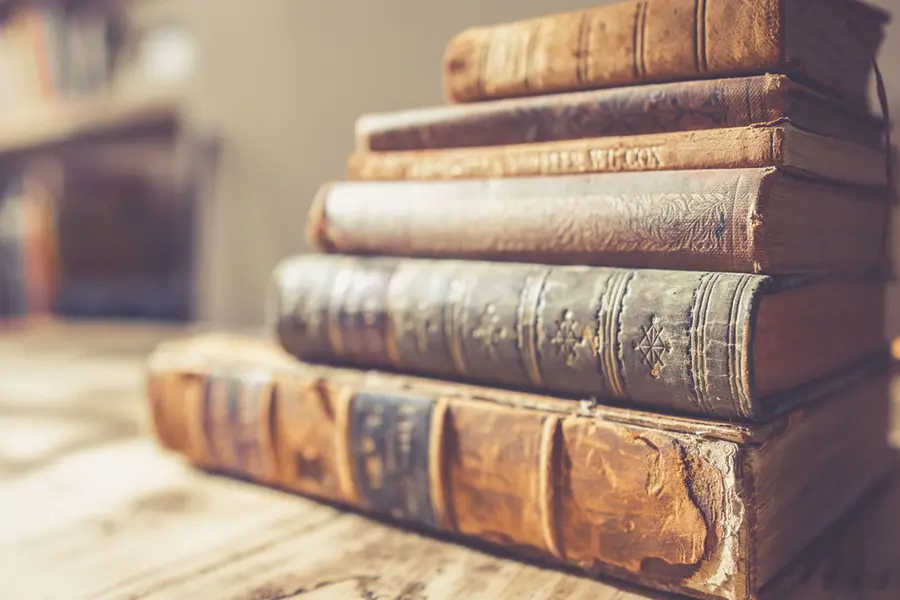
New Delhi: Researchers at Lipscomb University have warned that brightly coloured, cloth-bound books from the Victorian era may pose health risks due to toxic dyes. Their study, released on Sunday, found that these books could contain harmful pigments that may be dangerous if they come into contact with skin or become airborne.
“These old books with toxic dyes may be in universities, public libraries, and private collections,” said Abigail Hoermann, an undergraduate chemistry student at Lipscomb University.
Also Read

The research began when Lipscomb librarians, concerned by findings from the Winterthur Museum about arsenic in book covers, requested the chemistry department test their collection of 19th- and early-20th-century books. Using three techniques—X-ray fluorescence (XRF) for detecting heavy metals, inductively coupled plasma optical emission spectroscopy (ICP-OES) for measuring metal concentrations, and X-ray diffraction (XRD) to identify pigment molecules—the team discovered high levels of lead and chromium, notably in lead(II) chromate, a pigment also used by Vincent van Gogh.
Some books were found to have metal concentrations surpassing safety limits set by the US CDC for chronic exposure. As a result, the Lipscomb library has sealed these books in plastic for safe handling and storage. The researchers are now advocating for non-destructive testing methods like XRD to preserve historical collections while ensuring safety. “Moving forward,” says Hoermann, “we want libraries to be able to test their collections without destroying them.”
The findings will be presented at the American Chemical Society (ACS) Fall 2024 meeting, scheduled to be held both virtually and in person from August 18-22.
Agencies
Published: 19 Aug 2024, 11:18 am IST
Related Topics
Disclaimer: Kindly avoid objectionable, derogatory, unlawful and lewd comments, while responding to reports. Such comments are punishable under cyber laws. Please keep away from personal attacks. The opinions expressed here are the personal opinions of readers and not that of Mathrubhumi.