
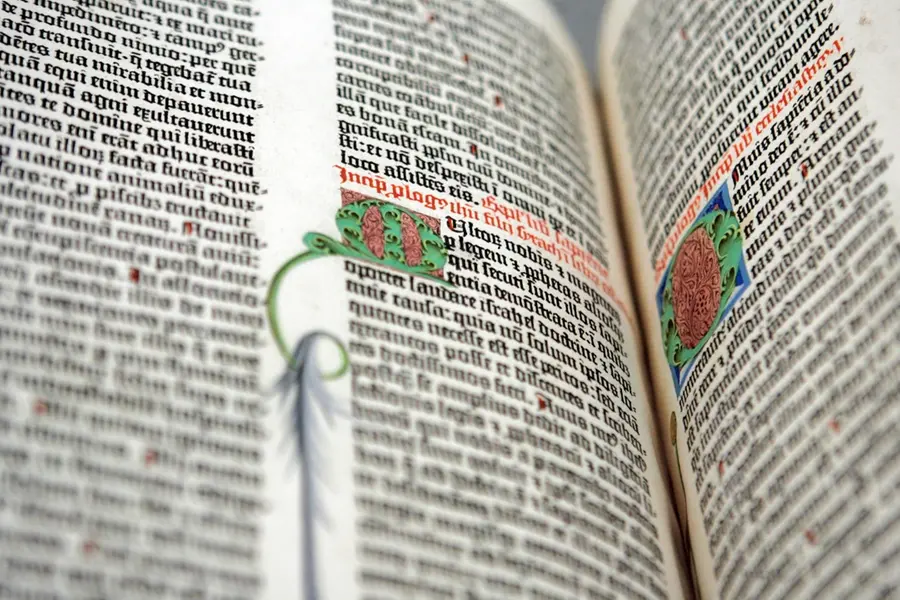
New York: In the 1450s, when the Bible became the first major book printed in Europe using movable metal type, Johannes Gutenberg had a clear plan. The German inventor aimed to make the most of his new technology, the movable-type printing press, by creating an exceptional version of the Scripture for wealthy customers who understood Latin: leaders of the Catholic Church.
Originally planned to print 150 Bibles, Gutenberg ended up making 30 extra copies due to high demand, bringing the total to 180. These are now known as the ‘Gutenberg Bibles’, and approximately 48 complete copies still exist today.
None of these rare Bibles are privately owned. In the United States, one can be viewed at the Morgan Library & Museum in New York City, while two others on animal skin are stored in vaults alongside 120,000 other books.
Why should anyone, whether religious or not, want to see a Gutenberg Bible up close? It's because of its impact on the history of books and religion over the past 500 years. This ancient volume reveals much about early printing techniques and its influence on religious practices.
Before Gutenberg's invention, Bibles were painstakingly copied by hand, a process taking up to a year. Gutenberg completed his work in about six months, printing each Bible with nearly 1,300 pages, weighing about 60 pounds. Written in Latin, the Bibles were printed in double columns with 42 lines per page.
Most copies were printed on paper, though a few were printed on animal skin. After printing, the black letters were added first, while decorative elements and bindings were customised later to suit each buyer's preferences and budget. These decorations varied, with some added in Germany and others in France, Belgium, or Spain, making each Gutenberg Bible unique.
Gutenberg's invention revolutionised the availability of Bibles, making them more accessible to scholars and priests, said Richard Rex, Professor of Reformation History, the University of Cambridge. “This massive multiplication even led to the wider adoption of the term ‘Bible’ (Biblia) to describe the book,” he added. “Medieval authors and others do speak sometimes of ‘the Bible’, but more commonly of ‘scripture’.”
It standardised the text, influencing theological discussions and, later, the printing of Bibles in languages spoken by ordinary parishioners.
Despite the increase in availability, literacy limitations meant not everyone could read the Bible immediately. Over time, however, people began to interpret the Bible for themselves rather than relying solely on religious leaders. “The phenomenon of lay people questioning or interpreting the biblical text became more common from the 1520s onwards,” Rex said. “Although the early Protestant Reformers, such as Luther, emphasised that they did not seek to create an interpretative ‘free for all’, this was probably the predictable consequence of their appeal to ‘scripture alone’.”
At the Morgan Library, curators turn the page of the Gutenberg Bible on display three times a year. Its pages tell stories not only of Scripture but also of those who owned it. Recent studies have revealed fascinating details, such as the origins of its decorations in a now-defunct German monastery and marks suggesting reuse of its paper in later editions.
JP Morgan collected thousands of Bibles, and many owners left personal marks and annotations in them, reflecting their individual stories and connections to these ancient texts.
“A Bible is now sort of a book on the shelf,” he said. “But at one point, this was a very personal object”.
“In a museum setting, they become art and a little bit distanced, but we try to break that distance down.”
AP
Published: 30 Jun 2024, 12:37 pm IST
Disclaimer: Kindly avoid objectionable, derogatory, unlawful and lewd comments, while responding to reports. Such comments are punishable under cyber laws. Please keep away from personal attacks. The opinions expressed here are the personal opinions of readers and not that of Mathrubhumi.
