
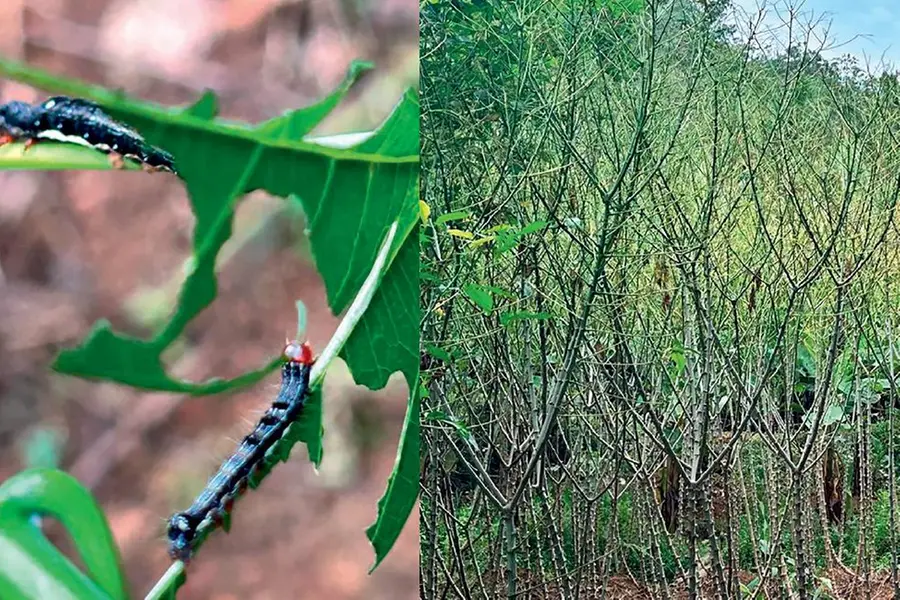
Kollam: Cassava and pepper crops in the Kollam district of Kerala are facing severe damage due to an infestation of plague caterpillars (Tiracola plagiata).
The pest attack was first reported in the paddy fields of Andoor in the Kottarakara's Ummannoor Panchayat. Subsequently, the infestation spread to cassava plantations in areas such as Aryankavu and Rosemala.

The plague caterpillar is devouring the leaves of crops, which hampers photosynthesis and ultimately affects the harvest. Farmers are now concerned about significant yield losses as the crops are being badly affected. Those in Rosemala, where several acres of pepper plantations have been affected, have expressed concerns about the damage, particularly as the infestation coincides with the critical fruit-bearing period.
The Agriculture Department has initiated emergency pest control measures, anticipating the spread of the infestation to banana and vegetable crops as well. A team of experts from the Kollam Agricultural Knowledge Centre (Krishi Vigyan Kendra), including entomologists and horticulturists, visited the affected fields for an assessment. Dr M. Lekha (Entomology), Dr V. Sarojkumar (Horticulture), and Dr C.R. Manu (Entomology) from the Kollam Agricultural Knowledge Centre are the ones who visited the areas to study the infestation.
They emphasised that the plague caterpillar's complete destruction of leaves results in a loss of light absorption, severely impacting crop growth.
Immediate Action and Control Measures
The team emphasised the need for urgent pest control, as the plague caterpillar, similar to armyworms, feeds on leaves in large quantities, causing substantial crop destruction. They recommended using biological pesticides, such as Bacillus thuringiensis kurstaki (B.T.K.), to combat the pest in severely affected areas.
Additionally, natural predators like Beauveria bassiana or Metarhizium can be used to control the weevil population by spraying a 20-gram solution per litre of water.
The presence of the plague caterpillar was first reported in 2022. Aside from cassava and pepper, the pest has also been known to affect rubber plantations, other tree crops, and grass.
Published: 10 Nov 2024, 10:06 am IST
Related Topics
Disclaimer: Kindly avoid objectionable, derogatory, unlawful and lewd comments, while responding to reports. Such comments are punishable under cyber laws. Please keep away from personal attacks. The opinions expressed here are the personal opinions of readers and not that of Mathrubhumi.