
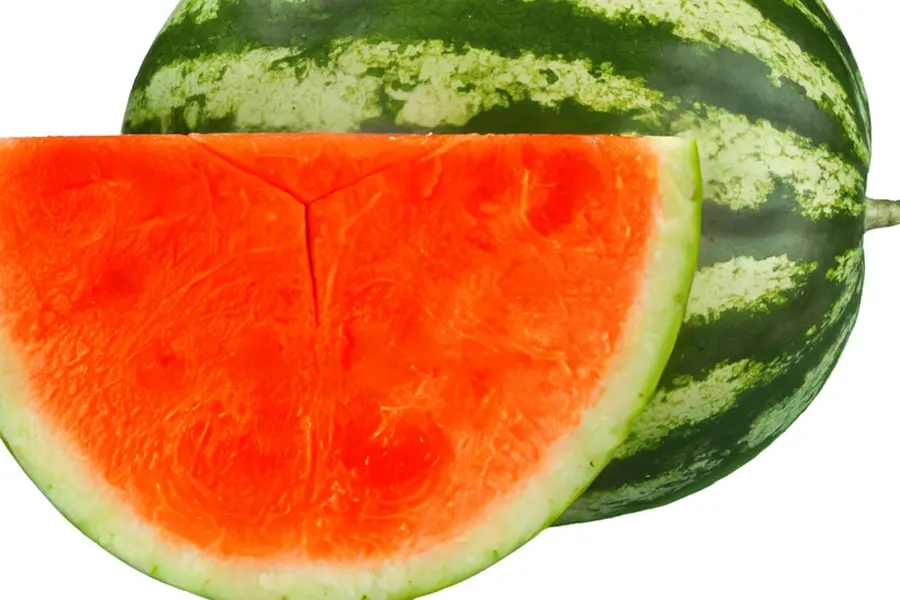
After successfully developing the red-fleshed Shonima and yellow-fleshed Swarna, Kerala Agricultural University (KAU) has introduced another innovation—an orange-fleshed seedless watermelon. This new variety was developed at the Department of Vegetable Science, KAU, Vellanikkara, as part of the PhD research project of Ansaba, a scholar working under Pradeepkumar T, the principal breeder of Swarna and Shonima.
This marks a major milestone, as it is the 'first time in India that a public-sector research institute' has developed a seedless watermelon with an orange core.
Sweeter and better quality
The orange-fleshed seedless watermelon weighs around 3.5 kg and is sweeter and of better quality than conventional varieties. However, before seeds can be made available to farmers, detailed experiments are required to ensure stability and large-scale production.
Previously, Kerala Agricultural University had transferred the technology for producing seeds of Shonima to the Vegetables & Fruits Promotion Council Kerala and a private seed company based in Bangalore.
What did the research find?
Watermelon is a fruit known for its nutritional benefits, including essential phytonutrients, minerals, and antioxidants. As part of the study, researchers at KAU assessed 20 watermelon genotypes with different flesh colours—red, pink, orange, yellow, and white—to evaluate their nutritional potential.
The research was conducted over two growing seasons (December-March of 2021-2022 and 2022-2023) at the experimental field of the Department of Vegetable Science, KAU, Thrissur.
The study revealed variations (p=0.05) in nutritional quality among different watermelon genotypes, particularly in the levels of lycopene, beta-carotene, citrulline, and ascorbic acid.
- Lycopene content ranged from 0.037 to 66.963 µg/g (fresh weight), with red-fleshed varieties being the richest source.
- Beta-carotene content varied from 0.037 to 7.423 µg/g, with orange-fleshed genotypes containing the highest levels.
- Citrulline content was highest in orange and yellow-fleshed varieties, ranging from 843.810 ppm to 2589.750 ppm.
- Ascorbic acid (Vitamin C) content ranged between 21.410 and 49.827 mg/kg, with red-fleshed varieties showing the highest levels.
- White-fleshed watermelons had the lowest levels of lycopene and beta-carotene.
The study also found major differences in yield per plant among different flesh-coloured genotypes.
Published: 04 Mar 2025, 04:08 pm IST
Related Topics
Disclaimer: Kindly avoid objectionable, derogatory, unlawful and lewd comments, while responding to reports. Such comments are punishable under cyber laws. Please keep away from personal attacks. The opinions expressed here are the personal opinions of readers and not that of Mathrubhumi.
