
Centre agrees to introduce comprehensive sex education in schools and colleges after Supreme Court approval.
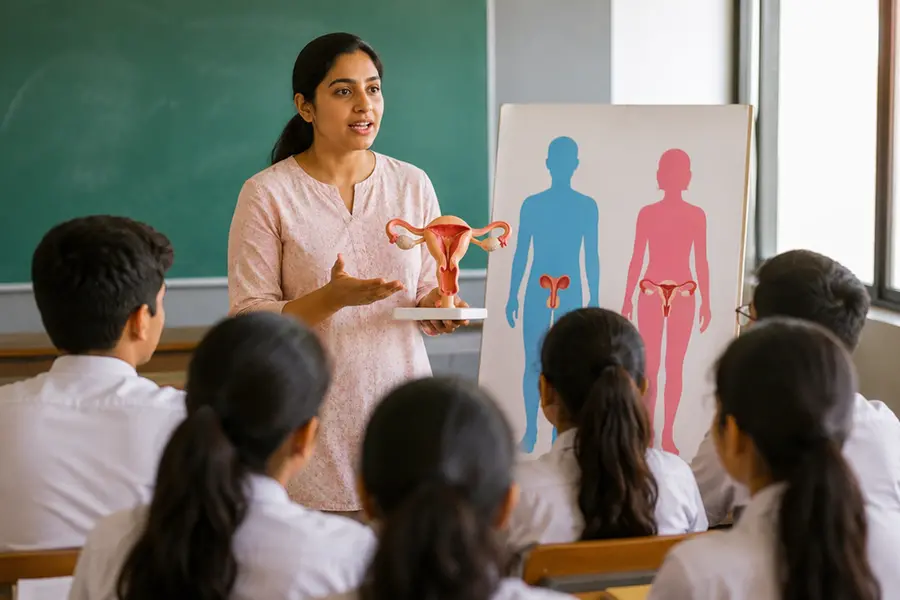
New Delhi: The Centre has informed the Supreme Court that it is ready to introduce comprehensive sex education in schools and colleges across India after the court approves recommendations made by a 26-member expert committee. The proposed curriculum includes consent, child sexual abuse awareness, body safety and age-appropriate sexual health education.
India could soon see comprehensive sex education become part of the school and college curriculum after the Central government told the Supreme Court that it has accepted the recommendations of an expert committee and is prepared to implement them nationwide once the court grants approval.
Also Read

The proposal is part of an ongoing Supreme Court case examining how to better protect children while addressing concerns that consensual relationships between adolescents are sometimes prosecuted under the Protection of Children from Sexual Offences (POCSO) Act.
What has the Centre proposed?
Appearing before a bench of Justices B V Nagarathna and R Mahadevan, Additional Solicitor General Aishwarya Bhati said the government had accepted the expert committee's report and would implement its recommendations after receiving the Supreme Court's approval.
The recommendations were prepared by a 26-member national expert committee headed by an Additional Secretary in the Ministry of Women and Child Development. The panel included representatives from central ministries, state governments, the National Commission for Protection of Child Rights (NCPCR), Tata Institute of Social Sciences (TISS), the National Legal Services Authority (NALSA), psychologists and education experts.
What will students learn?
The committee has recommended introducing comprehensive sex education as part of the core curriculum in both schools and colleges.
The proposed syllabus includes:
- Age-appropriate sexual health education
- Consent and healthy relationships
- Child sexual abuse awareness
- Personal safety and protection
- Safe and unsafe touch
- Body awareness and hygiene
- Understanding developmental changes during adolescence
- Life skills and critical thinking
According to the report, basic lessons on body safety, hygiene and safe and unsafe touch should begin from the foundational stage, with more age-appropriate topics introduced as children grow older.
How will it be taught?
The committee has recommended that the National Council of Educational Research and Training (NCERT) develop the curriculum in line with the National Education Policy (NEP) 2020.
It also suggested:
- Dedicated trained teachers for these lessons.
- Mandatory classes lasting 15 to 20 minutes, twice every week.
- Parent and guardian awareness sessions to explain children's developmental milestones and the importance of sex education.
- A review of existing adolescent education programmes to align them with NEP 2020 and strengthen child safety education.
Why is the Supreme Court hearing this matter?
The case began after the Supreme Court took suo motu cognisance while hearing matters related to adolescent relationships under the POCSO Act.
The court has repeatedly expressed concern that the law may sometimes be applied mechanically in cases involving consensual relationships between teenagers aged 15 to 18.
Justice B V Nagarathna has observed during earlier hearings that adolescence is often a period of emotional and social development, and that not every teenage relationship should automatically be treated as a criminal offence.
The bench has also noted that in some cases, parents file criminal complaints after teenage couples elope, resulting in consensual relationships being prosecuted under laws primarily designed to protect children from sexual exploitation.
The present proceedings also stem from the Supreme Court setting aside a Calcutta High Court judgment that had advised adolescent girls to "control" their sexual urges. Since then, the apex court has been examining legal, educational and social measures that can both protect children from abuse and ensure that consensual adolescent relationships are assessed appropriately under the law.
Why is this proposal significant?
If approved by the Supreme Court, this would mark one of India's most significant changes in school health and safety education.
Supporters argue that structured, age-appropriate sex education can help children recognise abuse, understand consent, seek help when needed and make informed decisions about personal safety. Experts have also long argued that providing scientifically accurate information reduces myths, misinformation and stigma surrounding sexual health.
At the same time, the proposal does not change the POCSO Act. The Act will continue to apply in cases involving child sexual abuse and exploitation. Instead, the committee's recommendations focus on education, awareness and improving understanding among children, parents, teachers and law enforcement.
The Supreme Court will now examine the committee's recommendations before deciding whether the Centre can proceed with implementing them across the country.
Published: 14 Jul 2026, 09:09 am IST
Disclaimer: Kindly avoid objectionable, derogatory, unlawful and lewd comments, while responding to reports. Such comments are punishable under cyber laws. Please keep away from personal attacks. The opinions expressed here are the personal opinions of readers and not that of Mathrubhumi.