
By securing a three-carrier fleet, New Delhi ensures that its strategic voice is not merely heard through diplomatic dispatches, but visibly stamped across the horizon
On 8 October 2023, the day after the Hamas attack on Israel, United States Defence Secretary Lloyd Austin ordered USS Gerald R. Ford and her carrier strike group to the eastern Mediterranean. The carrier arrived at the station on 10 October. No strike was conducted that day. No orders to engage were issued.
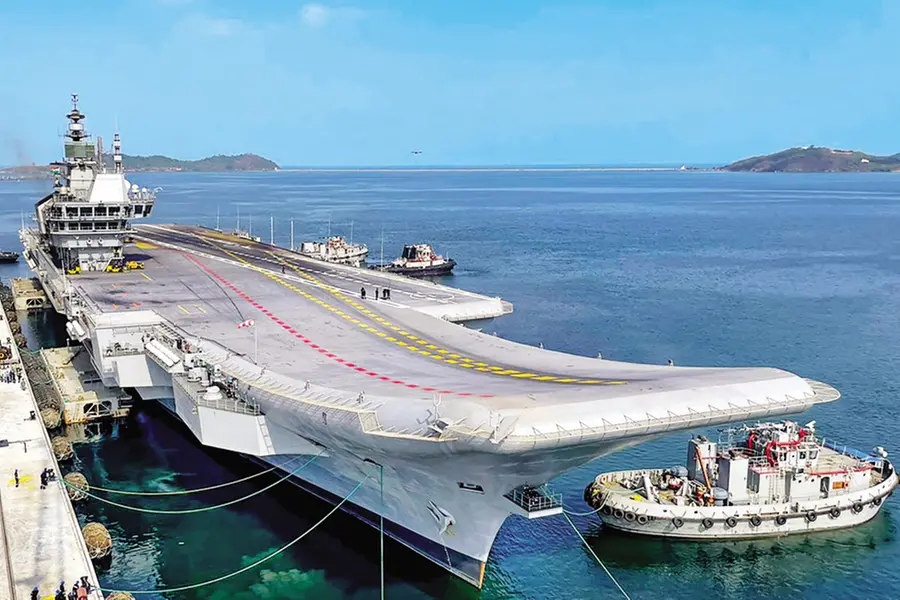
The carrier group's presence was the message, and it was received by every government and every armed actor in the region. By the end of October, a second carrier strike group built around USS Dwight D. Eisenhower had joined the theatre. Together, the two groups communicated American intent at a speed and with a clarity that no diplomatic communiqué, no phone call between heads of state, and no UN Security Council statement could have matched. India has been watching this pattern repeat for decades. With INS Vikrant, it now has the platform to begin replicating it.
The signalling value of a carrier deployment is proportional to the credibility of the force sent. A single destroyer dispatched to contested waters is a gesture. A carrier strike group is a commitment. When India deployed surface combatants to the Gulf of Aden during the period of elevated Houthi attacks on commercial shipping, the absence of carrier-based air cover meant the escort mission was defensive in character. Ships like INS Kolkata and INS Visakhapatnam could protect specific vessels in a defined corridor. They could not hold a combat air patrol over open ocean, suppress the threat at its source, or present an adversary with the prospect of sustained air strikes from a sovereign platform requiring no host nation permission.
A carrier changes that calculus entirely. The term “sovereign territory” applied to a carrier is precise. An aircraft carrier operating in international waters requires no basing rights, no overflight permissions, and no diplomatic arrangement with a host government. It carries its own airfield, its own strike aircraft, its own air-defence systems, and its own command infrastructure. It arrives, positions, and presents options. The political signal it sends is inseparable from the military capability it represents.
This calculus shifted from theoretical doctrine to operational reality during Operation Sindoor in May 2025. Following the Pahalgam terror attack, India’s response was not confined to land-based precision strikes. The Indian Navy immediately deployed a Carrier Battle Group to a forward operational posture in the Northern Arabian Sea. Without firing a single anti-ship missile, the presence of the carrier group acted as a blunt instrument of compellence. It established continuous surveillance across the Makran Coast and presented a credible threat of overwhelming maritime firepower. The strategic dilemma it created forced the Pakistan Navy to remain confined to its harbors and close coastal waters. Operation Sindoor proved that a carrier group can dictate the boundaries of a crisis simply by stepping onto the field, executing a de facto blockade while the guns elsewhere remained silent.
India's maritime commitments have expanded substantially in the past decade. The SAGAR framework, announced in 2015, positions India as a net security provider across the Indian Ocean Region. India has conducted joint patrols with the United States, France, Japan, and Australia. It has led anti-piracy operations, participated in multilateral maritime surveillance missions, and hosted the MILAN exercises, which bring together naval forces from across the Indo-Pacific. Each of these commitments creates an expectation. Partners expect India to arrive with platforms appropriate to the mission, and the mission has grown considerably more demanding than it was a decade ago.
A carrier strike group positioned in the western Indian Ocean during a period of Hormuz tension tells Iran something about the costs of miscalculation that a diplomatic note cannot convey. The same group positioned south of Sri Lanka during elevated Sino-Indian friction tells Beijing that India can open a maritime theatre simultaneously with a land-based confrontation, forcing the PLAN to divide its strategic attention. Positioned in the Bay of Bengal during regional instability, it tells every littoral government that India is the first naval responder in its own ocean, not a bystander waiting for American or Chinese carriers to arrive.
None of these scenarios requires weapons to be fired. The carrier creates the dilemma. The resolution of that dilemma i.e., whether through adversary restraint, diplomatic de-escalation, or partner reassurance, occurs because the carrier is present and its intentions are credible. Remove the carrier and the leverage disappears with it. Shore-based aircraft can strike from fixed positions with known locations. Submarines can threaten from concealment. Neither can park four hundred kilometres off a coastline day after day and demonstrate, through visible sustained presence, that India has chosen to be there and has the means to remain.
The United States has deployed carriers as instruments of political communication for seventy years. China is learning to do the same. India, with Vikrant in commission and Vishal in planning, is acquiring the capability to participate in that conversation at the level its strategic ambitions require, not as a reactive tactical force, but as a navy that holds options and uses them at the time and place of its own choosing.
That is what power projection looks like from a flight deck. India now has one. Translating this capacity for sustained presence into a permanent strategic posture requires crossing a critical numerical threshold i.e., a third aircraft carrier. Naval math is unyielding. To reliably project power simultaneously across the Arabian Sea and the Bay of Bengal, a two-carrier navy is functionally a one-carrier navy whenever one platform enters its mandatory maintenance or dry-dock refit cycle. Furthermore, with INS Vikramaditya’s aging hull facing structural limits by the late 2030s, a third carrier ordered is the only hedge against a future operational shortfall. The Indian Navy’s roadmap reflects this urgency through a dual-track strategy.
To avoid losing the complex industrial expertise gained from building Vikrant, plans are progressing for a repeat order of a modified, highly indigenous Vikrant-class carrier (IAC-II). Simultaneously, the blueprint for India's true next-generation supercarrier, INS Vishal (IAC-III), has evolved and needs to launch. Envisioned as a 65,000 to 75,000-tonne behemoth, formal defense roadmaps look toward a nuclear-propelled platform equipped with an electromagnetic CATOBAR system. This would allow India to launch heavier, longer-range carrier-borne fighters and advanced airborne early warning aircraft, matching the technological evolution of global peers.
Ultimately, an aircraft carrier is more than a floating airfield; it is a declaration of sovereign intent. For centuries, the Indian Ocean has been a theater where distant empires projected their wills onto the littoral states of Asia. As the balance of global power shifts back toward the Indo-Pacific, India faces a fundamental choice: to remain a reactive coastal defense force or to become the primary anchor of regional stability. By securing a three-carrier fleet, New Delhi ensures that its strategic voice is not merely heard through diplomatic dispatches, but visibly stamped across the horizon. Power projection from a flight deck means never having to explain your presence and changing the calculations of your adversaries before the first shot is ever fired.
(The author is a maritime scholar, strategic affairs analyst, and Indian Navy veteran. He is specialist in Global Politics and Theory of Knowledge and Adjunct Faculty of Maritime and Strategic Studies at Naval War College, Goa. He can be contacted at: ceo@johnsonodakkal.com)
Published: 14 Jun 2026, 03:14 pm IST
Disclaimer: Kindly avoid objectionable, derogatory, unlawful and lewd comments, while responding to reports. Such comments are punishable under cyber laws. Please keep away from personal attacks. The opinions expressed here are the personal opinions of readers and not that of Mathrubhumi.
