
The problem is that “the government didn’t pay” answers only one question. It does not tell us who paid or why that person paid, nor does it tell us whether he/she has business before the government
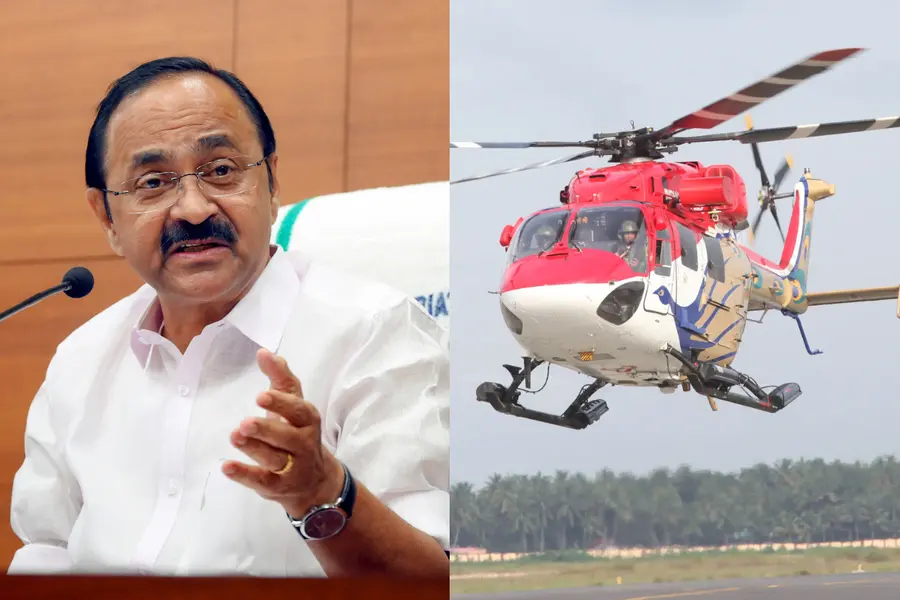
Kerala has once again stumbled into an argument about political morality by beginning with the wrong question, “Who paid for the ride?” V.D. Satheesan’s answer is reassuringly simple - not the government. But that is precisely where the interesting question begins, rather than ends. The Chief Minister travels to rain-hit Malappuram in a chartered aircraft arranged by a private individual. Journalists ask who paid for it, and V.D. Satheesan declines to reveal the sponsor’s identity. And then comes the defence that has become something of a universal solvent in Indian politics, “not a rupee came from the government treasury!” One is tempted to ask whether the treasury is really the only thing that belongs to the public.
Satheesan’s argument would seem pretty straightforward. The helicopter arrangement had expired, six people had died in Malappuram and he needed to reach the disaster site quickly. An acquaintance arranged an aircraft. And why, he asks, should there be anything objectionable about accepting such help? He went a step further and said that he would use such private arrangements again if necessary. He also defended ministers accepting sponsored foreign travel and his colleague K.M. Shaji travelling in a friend’s Range Rover.
Also Read

The problem is that “the government didn’t pay” answers only one question. It does not tell us who paid or why that person paid, nor does it tell us whether he/she has business before the government. It does not tell us whether the recipient of the favour might subsequently be in a position to influence matters affecting the benefactor. And, most importantly, it does not tell us why the public should be asked to take all this on trust. The CPM, naturally enough, has discovered the dangers of private patronage with admirable enthusiasm. MV Govindan has attacked the sponsored flight, while P Rajeev has raised questions about the identity of the sponsor and alleged a possible connection with a company whose lease renewal is pending before the state. Those are indeed serious allegations, but they remain allegations and should be established rather than simply repeated.
Yet the Left faces an awkward difficulty; this is hardly virgin territory for the CPM. In 2017, CPM state secretary Kodiyeri Balakrishnan travelled in a Mini Cooper belonging to Karat Faisal, who had been accused in a gold-smuggling case. Kodiyeri said he did not know who owned the vehicle and that the local party leadership had hired it. The controversy did not disappear merely because Kodiyeri had not personally paid for the car. Pinarayi Vijayan’s governments have also faced the politics of privately arranged transport. In the 2017 Ockhi episode, a privately operated helicopter was hired for the Chief Minister’s travel between Thrissur and Thiruvananthapuram. The initial bill of ₹8 lakh was charged to the State Disaster Response Fund before the government cancelled that arrangement and said the General Administration Department would bear the cost. Satheesan therefore would seem quite entitled to ask why standards that are suddenly sacred to the Opposition were not always applied with equal fervour when the Left occupied the other side of the political barricade. But that does not make his own argument any better. It merely makes the hypocrisy bipartisan. A larger question remains, and Kerala ought to confront it without pretending that either the Left or the Congress has some hereditary title to moral superiority. Kerala’s political establishment and its large business houses have always had a complicated relationship.
Pinarayi Vijayan’s daughter Veena worked as CEO of RP Techsoft International, an IT venture of Ravi Pillai’s RP Group; Kodiyeri Balakrishnan’s son Bineesh had also worked with the RP Group. These documented professional relationships are not, by themselves, evidence of wrongdoing. Likewise, business magnates such as M.A. Yusuff Ali and Ravi Pillai have maintained relationships across Kerala’s political spectrum. That is hardly surprising as governments regulate business, while businessmen need governments to function. Proximity itself is not corruption, but proximity is precisely why transparency matters. And this is where the argument extends far beyond Kerala.
The most spectacular national illustration is staring us in the face. In 2014, Narendra Modi, then Prime Minister-designate, travelled from Ahmedabad to Delhi aboard an Adani Group aircraft. Modi had also used Adani aircraft during the election campaign. Contemporary reporting explicitly raised questions about the propriety and optics of a future Prime Minister travelling in an aircraft belonging to a major corporate group. That aircraft ride does not, by itself, prove a corrupt bargain, nor does the extraordinary subsequent expansion of the Adani Group establish that every government decision benefiting its companies was the result of political patronage.
But the episode illustrates the precise problem that Satheesan’s formulation obscures. A private benefit creates a question even before it creates a crime. The proper test should therefore have at least three parts. Who provided the benefit? What was the relationship between the provider and the office-holder? Was the benefit disclosed sufficiently for the public to determine whether a conflict existed? The amount drawn from the treasury is only one part of the equation. Private generosity can create obligations just as surely as public money can create expenditure.
Hospitality can create access, access can create familiarity, familiarity can create influence, and influence does not always arrive carrying an invoice. While it does not necessarily mean that every businessman expects a quid pro quo; some people help politicians because they are friends; others because they admire them; others because they want access; still others because they simply want to be useful to someone powerful. The point is precisely that without disclosure, the public cannot tell the difference.
That is why Satheesan’s refusal to identify his benefactor is more revealing than the flight itself. If the benefactor is entirely innocent, has no business pending before the government and expects nothing in return, disclosure should strengthen the Chief Minister’s defence. Instead, we are asked to accept an anonymous benefactor because the public treasury was spared. That is a remarkably narrow conception of public accountability.
Kerala does not need another round of the familiar spectacle in which the opposition cries “corruption”, the government of the day replies “you did it too”, and both sides retreat to their respective archives of hypocrisy. The more uncomfortable question is whether we have allowed private patronage to become normal in public office so long as somebody remembers not to send the bill to the government. The real currency of politics is not merely money. It is access, influence, gratitude and proximity. And sometimes the most expensive thing in politics is the thing that comes free.
(The author is a national award winner for narration and an independent political analyst)
Published: 24 Sept 2026, 01:13 pm IST
Related Topics
Disclaimer: Kindly avoid objectionable, derogatory, unlawful and lewd comments, while responding to reports. Such comments are punishable under cyber laws. Please keep away from personal attacks. The opinions expressed here are the personal opinions of readers and not that of Mathrubhumi.