

Explore the extraordinary life of K.M. Panikkar, a true "man for all seasons." Discover his multifaceted roles as a diplomat, historian, writer, and influencer in shaping modern India.
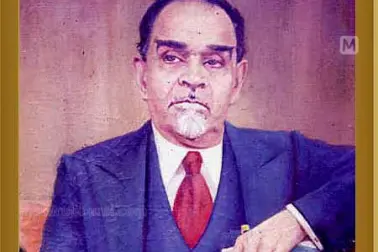
Who was the most globally recognised Malayali of the 20th century? There could be many contenders. But after reading Narayani Basu’s magisterial biography, A Man for All Seasons: The Life of K.M. Panikkar (Context, 2025), this writer is convinced about who deserves that historic distinction. It is undoubtedly Kavalam Madhava Panikkar (1895–1963), better known as Sardar Panikkar. He stands much ahead of even VK Krishna Menon, often is hailed as Kerala’s Viswapouran, the global citizen.
How many individuals can be described, without exaggeration, as a “nationalist, an anarchist, a novelist, a constitutional lawyer, an academic, a historian, a foreign policy mandarin, a journalist, a diplomat, an administrator, and a poet” — all rolled into one? How many can you think of who walked in the company of the giants of modern history, such as Gandhi, Nehru, Patel, Mao, Zhou Enlai and Nasser, had audiences with Mussolini and the Pope or angered American President Harry S Truman? He was also a man on whom history bestowed several mutually contradictory labels — a nationalist, a proud Hindu, a Zionist, a royalist, even a Communist. Though he was none of these in full measure, Panikkar had displayed shades of all of them at different moments of his long and turbulent public life. No wonder Basu calls him the “man of all seasons”.
No Indian who stood outside the arena of active politics left their imprint on so many decisive moments of the nation’s 20th century journey as Panikkar did. Born in the dying years of the 19th century in a hamlet amid the backwaters and paddy fields of Kuttanad — incidentally India’s lowest geographical point — Panikkar scaled dizzy heights in life. Imagine: the scion of a prosperous landlord family (prominent poets K. Ayyappa Panikkar and Kavalam Narayana Panikkar were his nephews) was a poor student who failed matriculation twice and even attempted suicide in sheer desperation. Yet, desperation gave way to determination as he was to emerge from Oxford as the second Indian to graduate in history with a first class. According to Basu, the first to achieve this glory was also a Malayali, Kuruvilla Zachariah, who went on to become a respected professor in the Presidency College, Calcutta. Panikkar's lifelong interests in history, politics, nationalism, and identity were kindled during his time in England, when Indian students were swept up in a nascent anti-colonial fervour that straddled the ideologies of both the Left and Right.
It was a rebirth in every sense for Panikkar, who returned to India not just figuratively but literally too — he was among the few survivors of the ship torpedoed by a German U-boat in 1918 while returning from England during World War I.
(Though Panikkar played a notable part in several key turns of India’s freedom movement after his entry into public life, the Vaikom Satyagraha was the only one in his native Kerala in which he had a leading hand. A lesser-known revelation Basu brings to light is Panikkar’s role in influencing Gandhi’s much-debated decision to keep non-Hindus away from the agitation.)
Yet the most bewildering facet of this incredible “man of all seasons” was that he was found equally indispensable by camps that were often ideologically hostile to each other. This man from an obscure Kuttanad island was the favourite of nationalist leaders — Gandhi’s trusted emissary, Nehru’s lifelong confidant, a close friend of Mohammed Ali, Sarojini Naidu and Vijaya Lakshmi Pandit— and Tagore wanted him to join Visva-Bharati. He served as the Diwan of powerful native princes and as secretary of the Chamber of Princes, who bargained for their rights under British rule and federalism. He was India’s first ambassador to both Chiang Kai-shek’s nationalist China and Mao Zedong’s communist China. Later, as ambassador to Egypt, he played a pivotal role in bringing Nasser and Nehru together in the early stirrings of the Non-Aligned Movement.
Once the trusted advocate of the native princes, Panikkar was also among the architects of the integration of their kingdoms into the Indian Union — often against their wishes — and of the linguistic reorganisation of states. His own ideological moorings were bewilderingly dialectical.
A lifelong believer in the superiority of Hindu civilisation, he nonetheless rejected the supremacist and exclusionary beliefs of fundamentalists and was instrumental in saving hundreds of Muslims during the post-Partition riots at huge personal risk. A staunch supporter of Zionism and its early leaders, Panikkar was equally admiring of Communist China and its flag-bearers such as Mao and Zhou Enlai.
It goes to Basu’s credit that even while documenting in detail the life of such an imposing figure, she never allows herself to be overawed by him. Every weakness and failure of this colossus is chronicled with clinical precision. She does not omit even his extramarital romances or the patriarchal condescension he often displayed towards his wife, despite his genuine affection for her. Among his errors of judgment, Panikkar’s admiration for Communist China -delusional and naive to critics- stands out as an infatuation that profoundly influenced Nehru’s perception of Beijing and, in hindsight, contributed to India’s disastrous misjudgments on Tibet. His esteem for China, however, had its roots in what Nehru also believed: the civilisational and anti-imperialist solidarity India shared with its neighbour. The faith that both reposed in Mao’s China eventually culminated in the 1962 war, a national humiliation that forever darkened Nehru’s legacy and cast a shadow over Panikkar’s own diplomatic record.
Owing to Panikkar’s support for China during the Korean War, the Indian diplomat became a highly disliked figure for the United States and the CIA, which suspected him of being a Communist. The US President Harry Truman referred to Panikkar as a Communist propagandist, and Dean Acheson, the Secretary of State, called him “Panicky Panikkar.” Yet it is an eloquent testament to Panikkar’s mettle that, even after his murky China innings, Prime Minister Nehru chose him as India’s ambassador to France and later to Egypt.
Often reviled as a vile, arrogant, power-hungry opportunist, the most persistent and prejudiced criticism Panikkar faced — particularly for his admiration of China — was that he was a crypto-Communist. His detractors even alleged that his recommendation to transfer the four Tamil-speaking taluks of Travancore to Tamil Nadu, as a member of the States Reorganisation Committee, was a political dowry to his son-in-law, the Communist leader M.N. Govindan Nair. The charge was that the decision indirectly helped the CPI win the first Assembly elections in 1957 after the formation of Kerala, since those taluks — traditionally Congress strongholds — were thus removed from the state’s electoral map.
Basu’s 844-page biography captures Panikkar’s extraordinary sweep of intellect and contradiction, portraying a man who, in every sense, was larger than his time. Her ability for meticulous and voluminous research was already evident in her equally ambitious biography of her illustrious great-grandfather, V.P. Menon. (V.P. Menon: The Unsung Architect of India, Simon & Schuster India 2020). Interestingly, what this writer found missing in this otherwise comprehensive tome is a more detailed account of the personal relationship between these two key Malayalis — Menon and Panikkar — who had worked closely together on the reorganisation of states.
K.M. Panikkar remains, as Basu’s title justly proclaims, truly a man for all seasons — one who defied ideological boundaries, served many masters, and yet managed to leave an indelible imprint on the making of modern India.
Published: 15 Nov 2025, 10:45 am IST
ABOUT THE AUTHOR
Related Topics
Disclaimer: Kindly avoid objectionable, derogatory, unlawful and lewd comments, while responding to reports. Such comments are punishable under cyber laws. Please keep away from personal attacks. The opinions expressed here are the personal opinions of readers and not that of Mathrubhumi.