
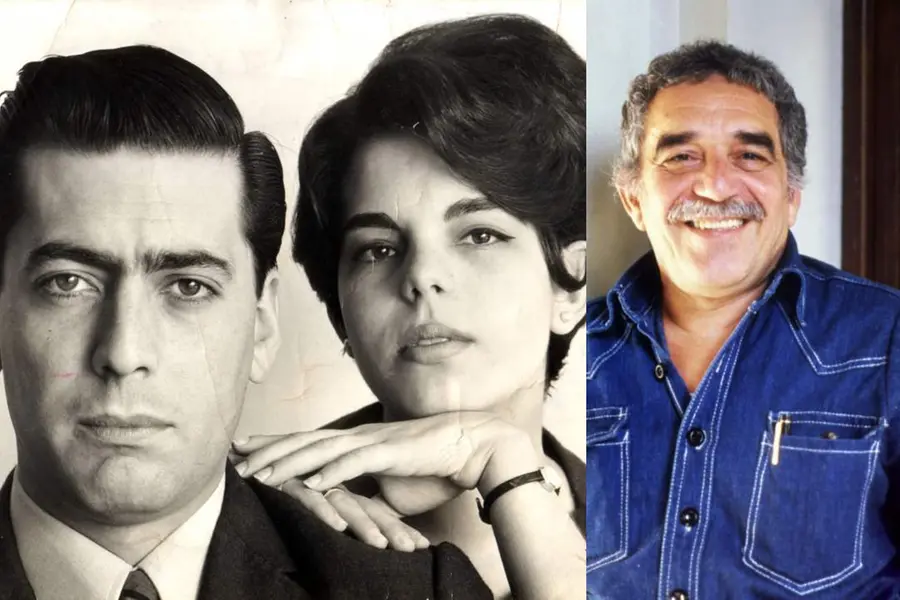
Do you know about the most famous punch in the history of world literature? It was thrown by the Peruvian Nobel laureate Mario Vargas Llosa—who died at 89 on April 13—squarely onto the face of fellow Nobel winner Gabriel García Márquez, nearly fifty years ago.
The incident took place in 1976 in full public glare at a cinema in Mexico City, where both writers, then in their forties, had come to attend a film premiere. The Peruvian and the Columbian had once been close friends—two titans of the Latin American Boom—now reunited after a long gap. Márquez, spotting Llosa, beamed and opened his arms: “Mario!” he called out, moving in for a hug. But instead of a greeting, he received a thunderous right hook. Márquez dropped to the floor, his face bloodied, his glasses shattered. As he struggled to his feet, Llosa is said to have barked, “That’s for what you did to my wife!”
Neither man ever publicly explained the rupture. But the story—kept alive through friends’ accounts—goes like this: Some time earlier, Vargas Llosa had taken a sea voyage with his wife Patricia—also his cousin—and during the trip, became infatuated with a Swedish woman on board. A longtime ladies’ man, he spent the journey with his new companion. An angry and humiliated Patricia disembarked in Chile and returned alone to their home in Barcelona.
Enter García Márquez and his wife, Mercedes. As close friends of the Llosa couple, they visited Patricia to console her. During the conversation, Márquez reportedly encouraged her to leave Vargas Llosa and promised she could always count on their friendship and company. Patricia—perhaps still reeling, perhaps needing reassurance—took this as a romantic overture.
Later, when she reconciled with Vargas Llosa, she told him about the conversation—possibly to remind him not to take her for granted. She is said to have hinted that even his closest friends found her attractive. That revelation smoldered in Vargas Llosa’s memory until the moment he saw Márquez again—and acted.
Though Márquez took the punch, it was Mercedes who landed the sharper blow. Without missing a beat, she snapped at Vargas Llosa:
“What you’re saying can’t be true—because my husband likes women, but only very good-looking women!”. Immediately after the punch, Márquez went to his photographer friend and took a picture of his face with the black eye. The photograph came to light only decades later.

The incident brought the curtains down on the long friendship of the two maestros who wrote in Spanish and were among the four pivots of the great Latin American literary Boom of the second half of the 20th century. With the passing of Llosa, all the four pivots of the Boom that brought Latin American literature universal admiration have become history. While Marquez, the superstar of the quartet, passed away in 2014, the two others, the Argentine-French novelist Julio Cortazar and the Mexican writer Carl Fuentes, left in 1985 and 2012, respectively.
All four titans had much in common. Márquez and Llosa had even more strikingly similar backgrounds. Though Márquez was nine years older than Llosa, they belonged to the same generation. Both came from fractured families with negligent fathers and were raised by their grandmothers. They were shaped by the collective crucible of Latin American culture and history. Their lives and literature were driven by deep personal and political yearnings—for freedom, and resistance against forces they saw as hostile to liberty and creativity. Both the Nobel laureates were close friends in their youth, shared similar political beliefs, and ardent admirers of William Faulkner. They were also journalists, deeply appreciative of each other’s work, and shared the same literary agent, Carmen Balcells. At one point, they even planned to co-author a novel. Llosa once taught Márquez’s works at universities, and his 1971 doctoral thesis focused on the Colombian’s magnum opus, One Hundred Years of Solitude. In 2023, the Peruvian writer Jaime Bayly published Two Geniuses, a book chronicling the lives and relationship of the two maestros.
Yet, despite their many shared traits, Márquez and Llosa sharply diverged as years went by on a crucial front: politics. Márquez was a self-declared leftist and a close comrade of the Cuban leader Fidel Castro, while Llosa identified himself as a right-leaning liberal and staunch anti-communist. This ideological divide may come as a surprise to many in Kerala, where Latin American literature is often synonymous with leftist politics. In reality, it also included outspoken anti-communists like Llosa and Jorge Luis Borges. Even radical voices such as Julio Cortázar and Carlos Fuentes—who were certainly not right-wing—stopped short of fully endorsing communism. According to Llosa, Márquez himself was initially less enthusiastic about the Cuban Revolution and was even purged by the Cuban Communist Party while working at Prensa Latina, the regime’s official news agency.
Unlike Marquez, Llosa was an active politician and even contested -unsuccessfully- in Peru’s presidential election, leading a rightwing coalition in 1990. Despite having been a Leftist during his student days, Llosa later believed that Communism was antithetical to democracy, individual freedom and economic progress. A vocal supporter of liberalism and capitalism, he admired not just rightwing philosophers like Freidrich Hayek and Carl Popper but even conservative politicians like Margaret Thatcher and Ronald Reagan. Llosa was a harsh critic of the armed resistance movements in Peru (The Shining Path) and other Latin American countries and even supported many of the region’s right-wing dictators. Even when Chile’s notorious military dictator Augusto Pinochet, who toppled Salvador Allende’s Leftwing government in 1973, was arrested in London in 1998, Llosa wrote an op-ed in the New York Times asking why leftwing dictators were not treated similarly. He called Castro, once his friend, and also Venezuela’s Hugo Chavez as tinpot dictators who trampled on human rights.
To be fair to him, one should not forget that Llosa constantly criticised not just Communism but every form of extremist ideologies- be it Nazism, nationalism or religious fundamentalism. He opposed contemporary rightwing populist leaders of Europe. Yet, he didn’t hesitate to back such leaders when they were challenged by Leftists. He endorsed Keiko Fujimori, daughter of Peru’s authoritarian president Alberto Fujimori, whom he had opposed earlier, when she contested against the Leftist Pedro Castillo. Llosa had no qualms about supporting Brazil’s racist and authoritarian leader Jair Bolsonaro for a long time because he hated the Leftist politician Lula da Silva much more. His critics questioned his double standards- holding the Left to moral absolutes but treating the Right pragmatically.
His acclaimed writings reflected Llosa’s political and philosophical evolution over the years. His powerful earliest novels, The Time of the Hero (1963), The Green House (1965) Conversation in Cathedral (1969), displayed a radical mind that slammed the military and authoritarianism. It also questioned the sexual repression, moral hypocrisy, and authoritarianism in the Peruvian society. This was followed by his period of transition and disillusionment with not just the military but the revolutionary movements that opposed it. This shift is seen in his satirical novel, Captain Pantoja and the Special Services (1973) or the “erotically humorous” Aunt Julia and The Script Writer (1977). He used to lament how difficult it was for a critic of the Left to survive in Peru during the 1970s. The arrest of the Cuban dissident poet, Herberto Padilla, by the Castro administration in 1971 brought Llosa (like many others including Fuentes) to emerge as a vocal critic of the Cuban revolution, which he supported in the beginning.
By the 1980s, Llosa’s break with “Left utopianism” was complete as demonstrated in his novels, the historical epic, The War of The End of the World (1981) and the Real Life of Alejandro Mayta (1984) which tells the story of a failed Troskyist revolutionary and says ideology blinds people. One of the most notorious chapters in Llosa’s political life took place during this period when, as head of an independent commission, he indirectly legitimised the killings of eight investigative journalists (Uchuraccay massacre) by the Peruvian military in the Uchuraccay village in 1983.
Llosa's final innings saw more explicitly political novels like The Feast of the Goat (2000) and The Way to Paradise (2003), which, even as they criticised authoritarianism, called for traditional liberalism as the right path. He continued writing until two years ago, including a memoir - Fish In Water.
Though his political views remain contentious, Llosa’s oeuvre endures as a cornerstone of world literature and a resonant voice for human rights. In 2010, he won the Nobel Prize, and in 2021, he became the first writer who never wrote in French to be inducted into the French Academy of Letters. With Llosa’s passing, curtains fell on a Latin American generation that captivated readers universally by ushering them to an entirely new world of life, letters, love and politics.
Three years after Marquez died in 2014, Llosa broke his silence over their friendship. Participating in a lecture series to celebrate the 50th anniversary of the publication of Hundred Years Of Solitude, Llosa spoke about Gabo and said he was sad that his friend died and that he was the last of that generation to which Marquez belonged. However, he continued to be silent about the punching incident.
Published: 16 Apr 2025, 10:07 am IST
Related Topics
Disclaimer: Kindly avoid objectionable, derogatory, unlawful and lewd comments, while responding to reports. Such comments are punishable under cyber laws. Please keep away from personal attacks. The opinions expressed here are the personal opinions of readers and not that of Mathrubhumi.