

Remembering PP Divakaran, a physicist and historian who shed light on Kerala`s ancient mathematicians and their contributions to calculus.
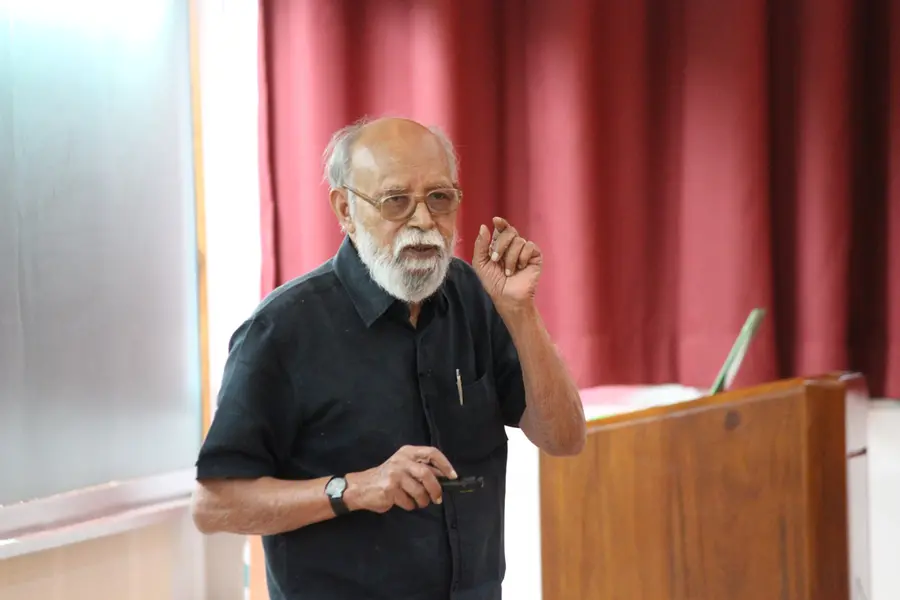
Back in April, this column mourned the untimely loss of Prof. Ranjit Nair, the second eminent physicist from Kerala to pass away within five years after Dr Thanu Padmanabhan. I never imagined that Kerala would be bereaved again so soon. With the demise of Prof. P.P. Divakaran (1936–2025) on 23 August, India and Kerala have lost not only a respected physicist but also one of the finest chroniclers of the country’s mathematical heritage. As a historian of Kerala’s ancient mathematicians—long neglected in mainstream accounts—Divakaran earned lasting credit for dispelling misconceptions and restoring their rightful place in world history.
Yet, unlike those in politics, cinema, or sport, scientists seldom receive the public or media recognition they deserve, unless they achieve something sensational. When they live outside Kerala, they become even more invisible, erased by society’s obsession with the immediate and the local. Perhaps that explains why the passing of such a distinguished scholar went almost unnoticed in his home state. Apart from a sensitive obituary in The Print, there was hardly any mention in Kerala’s mainstream media. The only official recognition Kerala ever gave him was the Kairali Global Lifetime Achievement Award in 2022–23, instituted by the state government to honour lifelong contributions to research.
Puthan Purayil Divakaran, who earned his doctorate in quantum physics at the University of Chicago, hailed from Makkoottam near Thalassery. After a long career as a professor at Mumbai’s Tata Institute of Fundamental Research (TIFR), he spent his final years in Kochi before moving to a nearby assisted living home. “Despite age-related ailments, his last years were peaceful, with his son Ashok beside him when he passed,” recalled Prof. Babu Joseph, his friend, physicist and former vice chancellor, Cochin University of Science and Technology (CUSAT).
Divakaran’s younger brother, Prof. P.P. Sudhakaran, former history professor at Government Arts College, Kozhikode, visited him a few days before his end. “He had excelled in everything he did from his student days. In studies, cultural activities, research, and teaching, he was Mr. Perfect. Hence, he had more admirers than friends,” Sudhakaran remembered. Their elder sister, Prof P.P. Gomathi, had been a well-known English teacher in Karnataka. Divakaran was separated from his French wife, Odiele, who also passed away recently. His two sons survive him: Ashok, a financial analyst in New York, and Satyan.
After completing his schooling at St. Joseph’s, Thalassery, and pre-university studies at Brennan College, Divakaran pursued a degree in Physics at Presidency College, Chennai. He briefly worked with the Atomic Energy Commission before joining TIFR. During his stint at TIFR, Divakaran received a PhD fellowship at the University of Chicago. His research also took him to Oxford for a brief period, where he met Odiele, who was researching the Medieval Temple Architecture of South India.
Divakaran retired from TIFR in 1996, but retirement sparked a second intellectual life. A chance meeting in Chennai with the Sanskrit scholar K.V. Sarma introduced him to the extraordinary legacy of Kerala’s mathematicians. Sarma urged him to read Yuktibhasha (c. 1530), Jyeshtadeva’s Malayalam prose text -the world’s first textbook on Calculus- that consolidated the discoveries of the doyens of Kerala’s ancient school of mathematics- Madhava of Sangamagrama, Nilakantha Somayaji, Parameshvara, Achyuta Pisharati and others. This pioneering school, which flourished between the 14th and 16th centuries, developed infinite series, advanced trigonometry, and made precise calculations of pi, laying the foundations for calculus, three centuries before Newton, Leibniz, or Gregory were credited with similar breakthroughs.
Although noted in the 19th century by Charles Whish and Benjamin Heyne of the East India Company, the Kerala mathematicians were largely forgotten until Indian scholars revived interest in them after Independence. (Whish’s article, published in 1832 by the Madras Literary Society and the Auxiliary Royal Asiatic Society, is accessible on the Internet Archive.) Yet, even Carl B. Boyer’s seminal books, such as “The History of the Calculus” (1939) and “History of Mathematics” (1968), considered the most comprehensive chronicles of mathematical development from ancient times to the 20th century, totally missed this great Indian chapter. However, the past fifty years saw the pioneering works of several scholars like Ramavarma Maru Thampuran, Akhileswara Iyer, CT Rajagopal, TA Sarasvati Amma (elder sister of the TA Rajalakshmi, the renowned short story writer) KV Sarma, George Geevarghese Junior (The Crest of the Peacock, 1994) and many foreign experts firmly establish the exceptional contributions of the Kerala School of Mathematics and win universal recognition as well.
Divakaran was the latest scholar to join this distinguished league with his acclaimed book, The Mathematics of India: Concepts, Methods, Connections (2018), published after years of research at Pune’s Inter-University Centre for Astronomy and Astrophysics with a Homi Bhabha fellowship. According to Divakaran, there were two schools of Kerala Mathematics. The first based in Kodungallur (Mahodayapuram) was represented by mathematical astronomers of the 7th and 9th centuries, a period known as the Second Chera era. They included scholars such as Haridatta, Govinda Swami, as well as his son, Sankaranarayanan, who ran an observatory and carried the legacy of ancient Indian mathematical astronomers like Aryabhata, Brahmagupta, and Bhaskara I and II.
The second Kerala Mathematical School was founded by Madhava of Samgamagrama in the 14th century and consisted of his descendants and disciples, who continued until the 16th century. Divakaran points out that the second school was much more modern and pure in its outlook; it grew independent of astronomical linkages. Divakaran preferred to call this the Nila School, as all its exponents belonged to villages located on the banks of the Nila River, such as Kudallur, Tirur, Trikkandiyur, and Trippangode, at a time when the region was the cradle of art, culture, and science. He dismissed the general assumption that the great Madhava’s native village, Samgamagramam, was near the present Irinjalakkuda. According to Divakaran, Madhava belonged to Kudallur (now known as MT Vasudevan Nair’s village). He pointed out that Samgamagramam was the Sanskrit name of Kudallur. Madhava called his home, “Bahuladhisthitha Vihara”, which is the Sanskrit for “Elanjippalli”, meaning the yard where the tree, Elanji, grew. Bahula is the Sanskrit word for Elanji. Therefore, in modern Malayalam, Samgamagrama Madhava should be referred to as Elanjippalli Madhavan Embran, who belonged to the Tulu Brahmin family with possible roots in the southern region of Karnataka. Most members of the Kerala School had authored brilliant works on their topics for posterity. Divakaran attributed the decline of Kerala's indigenous intellectual traditions to the country's colonial hegemony since the 15th century. However, the last notable representative of the illustrious Kerala Mathematical tradition is said to be Sankaravarman, the 19th-century prince of Kadathanadu and author of Sadratnamala (1819), a treatise in Sanskrit on astronomy and mathematics.
Historian Dr Rajan Gurukkal, who had a close association with Divakaran, recalled how he probed the “social compulsions” behind Kerala’s amazing mathematical innovations. In medieval Kerala, astronomy and mathematics were not abstract pursuits but vital to ritual calendars, eclipse predictions, and horoscopes. While Gurukkal emphasised these practical-religious needs, Divakaran pressed further, asking: how did intellectual culture itself—methods of collaboration, verification, and reasoning—shape this extraordinary flowering? “He wanted more evidence of the intellectual lineage. How exactly did the larger social needs translate into mathematical technique was his question. He sought more attention to the epistemic culture: how did these scholars of Kerala think, collaborate, record, and verify”, Gurukkal recalled. He also concurred with Divakaran that Sangamagrama Madhavan had belonged not to Irinjalakkuda but Kudallur in Palakkad district.
Despite his deep admiration for India’s intellectual heritage, Divakaran was no romantic nationalist. He firmly opposed exaggerated claims made to serve present-day politics. “He portrayed what was truly great in Indian mathematics, but also busted misplaced pride in the past,” recalled his long-time friend, Ramesh Sreekantan of Bengaluru’s Indian Statistical Institute, to The Print.
Age never dimmed his curiosity. Even in July 2024, he was at work on an unfinished paper, returning to his first love, theoretical physics—a critical review of Einstein’s hypothesis of the constancy of the speed of light.
Kerala has lost not just a physicist and historian of mathematics but also a rare mind that combined rigour with imagination, reverence with scepticism. If the great mathematicians of the Nila remain part of our living memory today, much of the credit belongs to P.P. Divakaran too.
Published: 30 Aug 2025, 11:03 am IST
ABOUT THE AUTHOR
Related Topics
Disclaimer: Kindly avoid objectionable, derogatory, unlawful and lewd comments, while responding to reports. Such comments are punishable under cyber laws. Please keep away from personal attacks. The opinions expressed here are the personal opinions of readers and not that of Mathrubhumi.