
Explore how Indian cinema portrays sporting women. Discover films like Mary Kom, Dangal, and Chak De India that showcase grit, talent, and overcoming challenges
Sports basically, is a way of life that demands a certain attitude, high moral values, focus and strict discipline. A sport is a concept and an ideology not limited to performance in the field or within the four walls of a hall such as chess. Do these carry over in films dealing with sports through entirely fictionalised narratives or through real-life representations on celluloid? Let us take a look at the representation of sporting women in Indian cinema.
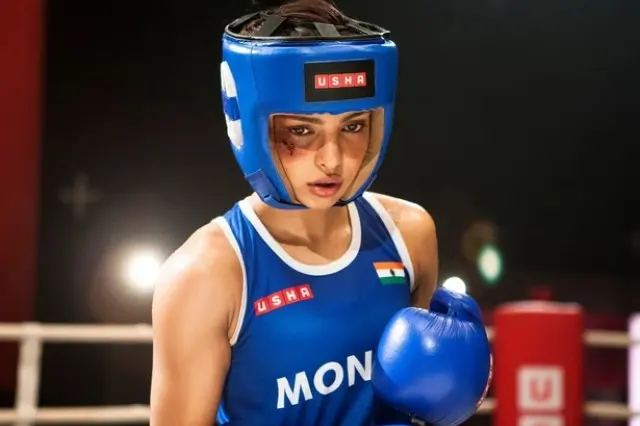
An ideal example of a good fictionalized sports film detailed in technique and training and other paraphernalia including the choice of the main cast and the actual framing and choreographing of the sports scenes is Saala Khadoos (2016). Madhavan, an intense actor who has played reasonably ‘cool’ roles, produced and acted in Saala Khadoos, a film centered on boxing which was a very big hit in the southern version but not that big a hit in the Hindi belt.
The film features two female boxers who knew boxing. Roland Barthes in Camera Luciha (1980) wrote “The power of authentication exceeds the power of representation.” For Saala Khadoos Madhavan picked a real life boxer to perform the main role of a female boxer who surprisingly turned out to be a great actress too. Saala Khadoos is the story of a failed boxer coaching a very poor girl from a fisherman’s family to boxing greatness.
For her award-worthy performance in Mary Kom (2014) fictionalised from the real life story of the rise and rise and rise of Mary Kom in competitive boxing. Olympic bronze medallist M.C. Mary Kom is also a wife and mother. Priyanka says she underwent 45 days of rigorous strength training even when she was travelling because she had her trainer travel along with her so that she did not miss out on her training. Sources state that to make some scenes look real, the director made Priyanka fight with and confront real life boxers during the fight scenes.
“A significant aspect of my training for my role in Mary Kom was to try and follow Mary’s regular routine. Besides beginning her day by running a distance of 14 kms followed by stretching exercises, Mary does shadow boxing and goes to the gym in the evenings where she does strength training and practices boxing in the ring. The vital aspect is to maintain the coordination of the brain and eye for speed and power, the most important things for any boxer. For me, Mary Kom is not just a film. It helped me grow as a person and made be cope with the loss of my father,” says Priyanka.
Performance Cinema is a term that precisely describes the kind of grueling homework, focus and determination demanded by the actor who performs the role of a serious sportsperson especially when the actor is to play a real life sportsperson.
According to Stacey Stocky of the University of Denver, performance cinema combines both cinema and performance in dynamic ways, defining a media of creative work, while also instigating the development of new, defined genres. Henry Warwick says that a performance film “sits between traditional, passive, cinematic experience and the dynamic experience of, say, a live music performance.”
One of the best examples of Performance Cinema on sports is Dangal (2016). The quality, amount, time and space Amir Khan gave himself and his girls to train in wrestling, a lesser known field in Bollywood cinema, has to be heard to be believed. When Aamir Khan had to play the part of Haryanvi wrestler Mahavir Singh Phogat, who coached his daughters Geeta Phogat (Commonwealth Games gold medal winner), and Babita Kumari (2012 bronze medal winner at the World Wrestling Championship). Khan’s preparation went far beyond putting on weight and shedding it as per the demands of the script.
The film marked the entry of then-40-year-old Kripa Shankar Bishnoi, an Indore-based wrestler, coach of the Indian women’s wrestling team, and winner of the prestigious Arjuna award (conferred for excellence in sports). Bishnoi also won a number of medals for India at international competitions, including the Commonwealth Games. (Seema Sinha, December 12, 2016.)
Bishnoi, apart from training Amir Khan, also trained Fatima Sana Sheikh and Sanya Malhotra, who play Geeta Phogat and Babita Phogat. Dangal is a path-breaking film for its strong message to encourage women to take up wrestling assumed to be a male sport. Bishnoi was readying women wrestlers for the Rio Olympics when Fatima and Sanya were sent to train under him. Bishnoi made them follow almost the same drill as the Phogat sisters. "It was important for them to acquire the explosive strength, learn wrestling tricks and adapt to an accurate mind and body coordination, important for wrestlers inside a ring,” he added. “It took Fatima six months to develop the strength required for a wrestler, whereas Sanya, a ballet dancer, was very flexible with a supple body.”
Shabash Mithu (2022) directed by Srijit Mukherjee, is a film on the struggles and rise of Mithali Raj, captain of the Indian Women’s Cricket Team, who, despite her illustrious record both as an individual batsman as well as the cricket captain, announced her retirement from all kinds of cricket on behalf of India. We do not see Mithali growing in years as a cricketer with a career span of 23 long years. She appears, in terms of build and age, to remain 16 throughout the film.
Like standard cinema, performance cinema requires a "moving picture". Like live music, it calls for an audience. The audience, just by the act of viewing, participates in the construction of the event as a meaningful experience. We have some, though not many examples in Indian cinema. Chak De India is the first film that comes to mind which extends the parameters of ‘performance cinema’ by taking in hockey at a national level with young girls chosen from across the country for the ‘National Women’s Hockey’ team taking it to a different plane. Maharaj Krishan Kaushik, who was with the team when it won the Commonwealth Games’ gold in 2002 joined force to train the girls with Mir Ranjan Negi on whose real story the film was based.
Chak de India! (2007) plays a role model for many where Kabir Khan (Shahrukh Khan) and his mother were asked to leave their ancestral house because of the anti nationalism attitude shown in the game of hockey played against Pakistan in the World Cup. Kabir Khan, on the other hand has deep love for his country and the game of hockey for which he struggles keeping aside his deeply-hurt ego even after being termed ‘betrayer’ for his past mistake. His adamant decision to train the Indian Women Hockey team for the World Cup proves his disciplined character. He constantly struggles to make them win in the end. Films like this one depicts religious bigotry, attitudes, the legacy of partition, ethnic or regional prejudice and sexism in the contemporary India through the genre of hockey.
The film is also successful in presenting two important aspects. First - that women power in India is capable of scripting miracles. This was reflected also in the London Olympic Games 2012 where two Indian woman players clinched medals for the first time in history of that particular game. With constant increase of awareness about the rights and privileges, women of modern India have realised their potential. Chak De India is a metaphor for national unity and identity defining the feminine identity to the face of the world.
Poorna – Courage has no limit (2017) unspools the story of this little girl who had to sweep the compound of the school she went to because (a) she was Dalit and (b) her father could not pay the fees. Her older cousin, Priya (S. Mariya), a gritty girl, eggs Poorna to get on with her life instead of getting trapped in an early marriage. Poorna (Aditi Inamdar), who shifts to a social welfare school, is discovered by IPS officer Pravin Kumar (Rahul Bose) who has quit the police service to look after the Social Welfare Department. On a chance rock-climbing course, Poorna’s talent for mountaineering comes to the fore and everyone backs her to try and climb Mt. Everest.
Malavath Poorna, in real life, is the youngest ever person to have conquered Mt. Everest. She is a Dalit girl from a small village in Andhra Pradesh. She peaked the summit on May 25, 2014 when she was 13. Have we ever heard of her before this film? It is a shame that we needed a socially concerned person like Rahul Bose to make a film like Poorna on this unique achievement that is a part of India’s ‘invisible’ history.
Poorna is very informative and educational without being too much in the face. We learn things about rock climbing and mountaineering including technical terms like rappelling, bouldering, etc. besides being informed about the health consequences at high altitudes with diminished oxygen. The film subtly underlines other issues such as child marriage and its tragic impact on child-bearing coupled with lack of nutrition of the pregnant girl, corruption in schools for the poor, and high incidence of drop-outs leading to closure of many of these schools. Aditi Inamdar as Poorna, picked after Bose had to zero in on her, is excellent in her naïve innocence as much as she is in her focus, her determination and her unwillingness to let go, come what may.
“We needed a girl who could convince the audience that she had the capacity to climb Mt. Everest. Can you believe that I had auditioned 500 girls for the part and she was the 110th? I saw the grit, the determination and the self-esteem I was looking for in her eyes. It was incredible because she was just 13 years old, as old as Poorna was when she achieved the feat. Then Poorna and her trainer Shekhar Babu trained Aditi and she imbibed part of the ethnic originality from Pakala, the village in Andhra Pradesh Poorna comes from. But Aditi does not come from a Dalit background,” says Rahul Bose, the director.
The word “struggle” especially in the sports field, has many more dimensions than our struggles in our ordinary lives. For women however, the struggle is much more than for men. Lack of family support, lack of infrastructural and financial backing, social taboos, gender discrimination, trolls from boys and men and hurdles in obtaining kits and wearing unconventional dresses like short skirts and pants are severe hurdles males do not have to face.
In a poor country like India where cricket is treated like the “King” and “aristocracy” is still sustained through a sport like billiards and golf, most sportsmen and women are marginalized and fall by the wayside, There have been some wonderful films like Mary Kom and Soorma. But no Indian filmmaker has ever thought of making a film on the struggles of National-level boxer Krishna Routh who has now been reduced to a sweeper in Howrah.
Published: 08 Nov 2025, 09:54 am IST
Related Topics
Disclaimer: Kindly avoid objectionable, derogatory, unlawful and lewd comments, while responding to reports. Such comments are punishable under cyber laws. Please keep away from personal attacks. The opinions expressed here are the personal opinions of readers and not that of Mathrubhumi.
