
The CPM's real problem is not that the people have stopped understanding communism. It is that the people may have started understanding the CPM rather too well, says Harikrishnan S
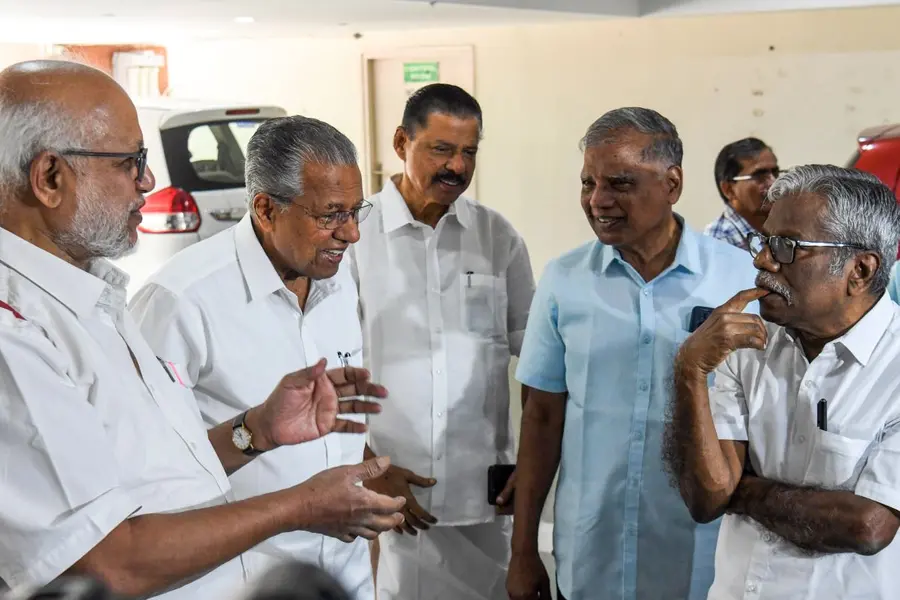
There is something almost irresistibly comic about the Communist Party of India (Marxist) sitting down in Kannur to analyse one of the most spectacular electoral repudiations in its history, with Pinarayi Vijayan presiding over the proceedings.
It is rather like asking the man who drove the car into the wall to chair the inquiry into why the building was damaged. The Kerala CPM has been handed a political thrashing so comprehensive that even its traditional fortresses have begun to resemble abandoned bunkers.
Yet, judging by some of the noises emerging from the party, the central question does not appear to be why the people rejected the party. The question seems to be why the people had the temerity to reject it. That distinction is important, because it reveals just how profoundly the party has lost the plot.
The CPM was not born as a vehicle for the glorification of an individual. It emerged from the struggles of peasants, workers and ordinary people, built its political capital through decades of agitation and claimed to represent those who had neither wealth nor privilege.
Also Read: When Rahul Gandhi takes on patriarchy, Congress’s dynasty stares back
Its ideological vocabulary was about class, exploitation, collective action and the emancipation of the common man.
And then came the Pinarayi Vijayan era. What has happened to the Kerala CPM under Pinarayi is not merely that it has become electorally vulnerable. It has undergone a rather more curious metamorphosis. A party that once prided itself on the supremacy of the organisation over the individual has increasingly come to resemble an organisation revolving around one individual, his government and, increasingly, his family.
The irony would be funny if it weren’t so thoroughly pathetic. The Communist Party, which spent decades warning us about the cult of the individual in bourgeois politics, has now spent years building one around Pinarayi Vijayan, with more than a little help from an astonishingly obedient party apparatus.
One need only look at the sheer scale of the Pinarayi brand. As Chief Minister, he was projected across Kerala with the sort of ubiquity usually associated with political leaders who believe that every bridge, road, hospital and pothole requires their photograph to establish paternity. Publicity surrounding government projects, including those associated with KIIFB, became part of an enormous political communication exercise in which the distinction between government achievement and Pinarayi Vijayan’s personal achievement became increasingly difficult to discern.
The irony was almost painful, because this was, after all, supposed to be a Marxist government Pinarayi, of course, became an extraordinarily effective political brand during the floods and the Covid pandemic. The daily briefings, the carefully cultivated image of the decisive leader and the constant television exposure created an aura of a Chief Minister personally shepherding Kerala through its darkest hours. It was politically clever and, for a time, immensely effective. But there is a price to personalising power.
When everything goes right, the leader gets the credit. When everything goes wrong, the leader gets the blame. You cannot spend years telling Kerala that Pinarayi Vijayan is the architect of everything that works and then, after an electoral catastrophe, suddenly discover that he was merely an innocent bystander. This is where the CPM’s present post mortem becomes almost farcical. The elephant in the room is not merely sitting at the table; it appears to be chairing the meeting.
Also Read: The idiot, the andhbhakt and the political fan club
The party secretary, theoretically the supreme political authority of the organisation, had increasingly come to occupy the role of political understudy to the Chief Minister, and now to the Leader of the Opposition.
Kodiyeri Balakrishnan was never seriously seen as challenging Pinarayi’s primacy, and MV Govindan has hardly established himself as an institutional counterweight. The old Kerala CPM tradition in which the organisation could exercise authority over its governments has been steadily replaced by something much more personalised.
That is why the story of VS Achuthanandan matters. The Pinarayi-Achuthanandan rivalry was not merely an internecine quarrel between two ambitious communist leaders. It represented two very different political temperaments and, arguably, two competing visions of the Kerala Left.
Achuthanandan, for all his own contradictions, retained the ability to stand apart from the party establishment and speak directly to popular sentiment. His longevity, popularity and willingness to challenge his own organisation provided a counterweight to Pinarayi’s formidable organisational authority. Once Achuthanandan's political capacity diminished, that counterweight effectively disappeared. What remained was an increasingly centralised party in which dissent could be treated less as the lifeblood of a communist organisation and more as an inconvenience to be managed.
And now the electorate has delivered its verdict. Yet some of the more enthusiastic Pinarayi loyalists seem incapable of accepting that the voters actually meant it. This is perhaps the funniest and most revealing part of the whole affair. People such as M Swaraj and others have been seen explaining the electorate to the electorate, as though the people who went into polling booths and voted had somehow suffered a collective cerebral malfunction. The voters were misled. The voters were manipulated. The voters did not understand. The voters were influenced by the opposition. The voters, apparently, were perfectly intelligent until they voted against the CPM. There is something profoundly patronising about this attitude.
The CPM has spent decades telling Kerala that its people are politically conscious, socially progressive and capable of understanding the complexities of class and power. Kerala’s electorate has long been regarded as among the most politically sophisticated in India. These are people who have switched between the LDF and UDF with a regularity that would make a political strategist dizzy. But when those same people finally deliver a comprehensive rejection of the CPM, some party loyalists suddenly discover that the electorate is a herd of easily manipulated idiots.
The party might want to consider a rather elementary proposition. If somebody succeeds in persuading your voters to abandon you, the important question is not merely who persuaded them. It is why they were willing to listen. And that question becomes even more uncomfortable when the people doing the persuading are former members of your own organisation.
Payyannur is a classic case in point. When a traditional CPM stronghold falls because a former communist rebel defeats the party’s chosen candidate, the sensible response would be to examine why the rebel’s message resonated. Instead, the tendency has been to attack the rebel and lecture the voters. But the candidate did not select himself. The party selected him. The organisation built the machinery around him, and leadership approved the political strategy. If the candidate was unsuitable, who chose him? If the voters rejected him, why did they do so? And if the answer is that the voters were simply fooled, why was a party that claims to possess such a sophisticated understanding of society incapable of understanding its own voters?
There is another problem that refuses to go away, and that is the continuing controversy surrounding Veena Vijayan and Exalogic and the transactions involving CMRL. Whether the allegations ultimately survive legal scrutiny is a matter for investigative agencies and courts. But politically, the episode has produced a remarkable spectacle for a party that once claimed an almost pathological commitment to collective responsibility.
Veena Vijayan is not a CPM member. Yet when the former Chief Minister’s daughter became the subject of an investigation, senior CPM leaders have repeatedly felt compelled to defend the party's political position regarding her case.
CPM General Secretary MA Baby’s appearance on the streets of Delhi in protest against investigative action created an image that would have been almost unthinkable in the old CPM. The party General Secretary taking political ownership of an issue involving the former Chief Minister’s daughter is difficult to reconcile with the old communist doctrine that the organisation comes before the individual. It becomes even more difficult when the individual happens to be the leader’s family member.
And so we arrive at the central absurdity of the CPM’s current predicament. A party founded on the proposition that ordinary people must acquire political consciousness now seems to have difficulty accepting the political consciousness of ordinary people when it produces an inconvenient result. A party that once kept its chief ministers under the watchful eye of the organisation now appears to have an organisation increasingly orbiting its (now former) chief minister. A party that denounced personality cults now seems remarkably enthusiastic about manufacturing one. And a party that once claimed to speak for the people is now asking, with barely concealed irritation, why the people did not listen.
Perhaps, the CPM’s first lesson from this election should be rather simpler than whatever elaborate diagnosis eventually emerges from Kannur. The people did not misunderstand the election. They understood it perfectly. They looked at the party, looked at the government, looked at the leadership, looked at the culture that had developed around it and then went into the polling booth and made a choice. That choice may be inconvenient, and it may even be painful. But in a democracy, the voters are not required to pass an examination set by the CPM before they are permitted to vote. The CPM’s real problem is not that the people have stopped understanding communism. It is that the people may have started understanding the CPM rather too well.
The author is a National Award winner for Best Narration and an independent political analyst. Views expressed are personal.
Published: 01 Sept 2026, 11:50 am IST
Related Topics
Disclaimer: Kindly avoid objectionable, derogatory, unlawful and lewd comments, while responding to reports. Such comments are punishable under cyber laws. Please keep away from personal attacks. The opinions expressed here are the personal opinions of readers and not that of Mathrubhumi.
