
Explore the life and work of Nemai Ghosh, Satyajit Ray`s iconic photographer. Discover his impactful contributions to Indian cinema, theatre, and documenting master artists.
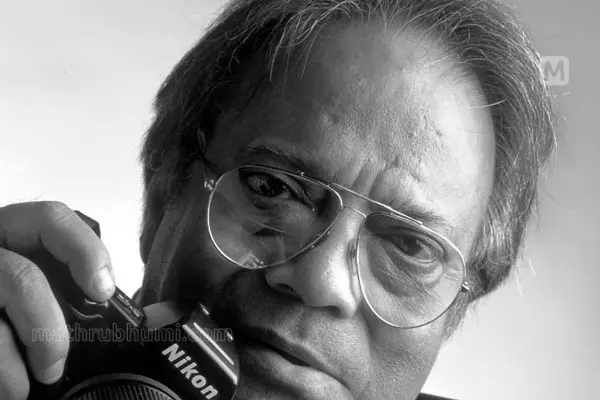
Photographers mostly choose to keep a low profile which is an extension of their always being behind the camera with one eye fixed to the camera lens. Nemai Ghosh, the ever-present photographer of Satyajit Ray from 1968 when the director was making Goopy Gyne Bagha Byne till Ray passed away in 1992, was no different. He chose to keep a low profile but the minute he chose to open up with the story of his evolution from a theatre actor to one of the most celebrated photographers in India, Ghosh shed his shyness and begin to narrate the story of his life cheerfully over a cup of tea and biscuits. He was completely grounded and never carried airs despite his first-hand relationship with some of the greatest personalities of West Bengal, his Padma Shri bestowed on him in 2010, the numerous awards bestowed on him and his exhibitions held in India and beyond.
He passed away after a long illness during Covid in March 2020 so his only son Satyaki, a brilliant photographer in his own right, could not come to perform his last rites as flights were stopped and he was in Mumbai at the time.
His photographs on Ray are exhibited at the permanent gallery of St Xavier’s College, Kolkata, and at Nord Pas-de-Calais, France. Ghosh photographed great masters Jamini Roy, Ramkinker Baij and Benodebehari Mukherjee over the years 1969 and 1970. He went back to his interest in documenting master artists from 2002, photographing more than 30 major Indian painters and sculptors at work, resulting in a massive suite of photographs of the best minds in contemporary Indian art at work.

He was still photographer for Utpalendu Chakravarty’s Chokh (Eyes), Mrinal Sen’s Interview, Calcutta ’71 and Ek Adhuri Kahani, Jukti Takko Gappo by Ritwik Ghatak, Goutam Ghosh’s Paar and M.S. Sathyu’s Kahan Kahan Se Guzar Gaya. “I am choosy about film assignments because I insist on reading the entire script of a film before accepting the work. This seems to puncture the egos of many filmmakers because after all, I am only a still photographer. But I do this because I work hard to sustain the high standards Ray helped me establish. For magazine work too, I look at the magazine myself to examine the processing and printing so that the quality of my original work does not fall because of bad printing” says Ghosh.
“The three things that have seen me through my struggles to establish myself are – tenacity of purpose, discipline and hard work. I learnt discipline from Utpal Dutt when I trained under him as part of his Little Theatre Group. The same applied to Ray and I re-learnt them from him,” he said, adding, “But my ability to catch the exact mood, the precise moment, the particular posture, the body-movement, the facial expression are all rooted back to my theatre training” he once said to this writer at his modest ancestral home in Bhawanipur.
Basically from group theatre, Ghosh chanced upon photography purely through a strange twist of fate. “One evening, as I waited to go to the rehearsals for a play and munched peanuts, a friend of mine said someone had forgotten his camera in a cab. He picked it up and was already offered Rs.600.00 for it from another friend. I don’t know what prompted me to buy the camera off him. ‘You already owe me Rs.240.00. If you give the camera to me I shall write off the loan’ He left the camera with me. I turned it around and looked into it, examining it closely. But I could hardly understand how it worked. At this point, a friend of mine who was assistant cameraman in films, offered to teach me the ropes. Actor Robi Ghosh from theatre took me to a shooting of a Ray film. The rest, as the saying goes, is history,” he reminisced.
About being captivated by the towering personality of Ray, he said “I was in a trance, such was the power of his persona. I was mesmerised by this towering persona, his ability to get sucked into his work so much that he forgot that I was always there, photographing him every minute in time. I did a lot of work to span theatre also during that time as I am originally from theatre. But that was like an off-shoot which became a subject later on. The eye of my camera and my own eyes behind the lens was focussed on Manik-da.”
Way back in 1991, a photobiography on Satyajit Ray was published under the title – Satyajit Ray at 70. It documented a collection of B & W photographs of the great master of celluloid taken by his photographer, Nemai Ghosh who, by then, had been Ray’s photographer for 25 years. It was published by Eiffel Editions of Belgium that went on to institute a travelling exhibition of these photographs with a world premiere on 20th June, 1991.
Ghosh’s creative energies sought other directions, other subjects, other worlds. One is Kolkata, the city he was born in, grew up and passed away in. Nemai Ghosh’s Kolkata is a brilliant aesthetic and creative tribute to the spirit of this city. The images reproduced in Black-and-White, are complemented with text and captions by Shankarlal Bhattacharya and Ghosh’s own quotes.
“I hear a lot about this city. Some call it a city of poverty and despair. Some find it to be one of politics and rallies. And there are many who believe in its deep root in art and culture. Whatever be the case, I find life here, and love. What draws me to Kolkata is the human element and its spontaneous expression. Every moment of the city distils a narrative of epic possibilities and I, as a flaneur, have framed all of that. From the alleys to the highways, my lens has been doing its job. It is not a comprehensive, definitive compendium of Kolkata. Neither is it meant to be one. It is my Kolkata, the way I have seen it evolve through time,” said Ghosh.
The time span is between 1967 and 2013, the earlier time-span marking out Ghosh’s ability to make the best of the moment. He shadowed Ray during the latter’s location shoots in the city as we see Ray walking tall above the rest in a rally to support flood victims, with a display board behind with an ad of Shatranj Ke Khilari. The book is neatly divided into six sections - time-line, city space, city life, city faces, city culture and reel city.
This includes a brilliant series on street performers such as fortune tellers and the monkey trick man plying their trade under the Sahid Minar, a moving series on the hand-pulled rickshaws of the city, a historic shot of Jyoti Basu addressing the First United Front rally at the Maidan, instant portrait painters who have since disappeared from Gariahat, massive crowds heading for the Gangasagar Mela from Strand Road and even Irrfan Khan and Tabu walking along the gardens between shots for Mira Nair’s film The Namesake, the weeping figure of a skeletal child sitting under the huge Howrah Bridge, a shot of a very young Ranjit Mullick crossing a street during the shooting of Mrinal This includes a brilliant series on street performers such as fortune tellers and the monkey trick man plying their trade under the Sahid Minar, a moving series Sen’s Interview and a shot of the maidan in the afternoon clicked from the top of the Shahid Minar.
One can get a glimpse of Shefali, the cabaret dancer of yesteryear caught in a pose during a performance. There are rare photographs of historical value. One shows Ray and Ghatak sitting together. Another catches Ray unawares in silhouette. A third is a priceless image of Ajoy Mukherjee, his deputy Jyoti Basu and Minister Jatin Chakraborty in a single frame. There is an architectural statement that places the Thacker Spink Mansion, the RBI Building and the UBI Building together. Painter Paresh Maity in second preference is seen looking at a forgotten idol of Kartik, the Warrior God.
Moving beyond Ray and Kolkata, Ghosh photographed the land and the people of Kutch in Gujarat (1995–97), Bastar in Chattisgarh (1998–99), Bonda Hills in Orissa (2007), the Apatani tribals in Ziro in Arunachal Pradesh (2010). “You cannot even beginning to imagine what a long struggle it was to capture the lives and habitats of these adivasis of India living in remote places inaccessible by any form of public and private transport, involving miles and hours of trekking on foot in terrible climatic conditions and all this when I was not exactly young,” reminisced Ghosh.
In January 2013, in a tribute to hundred years of Indian Cinema, The Delhi Art Gallery organized an exhibition entitled Nemai Ghosh – Satyajit Ray and Beyond launched by another famous Ray cinematographer Soumendu Roy who said, “what I could not achieve with my big camera, Nemai has done with his little camera!" Towards the end of his life, he had become very withdrawn, quiet and reclusive.
Published: 27 Sept 2025, 09:35 am IST
Related Topics
Disclaimer: Kindly avoid objectionable, derogatory, unlawful and lewd comments, while responding to reports. Such comments are punishable under cyber laws. Please keep away from personal attacks. The opinions expressed here are the personal opinions of readers and not that of Mathrubhumi.