
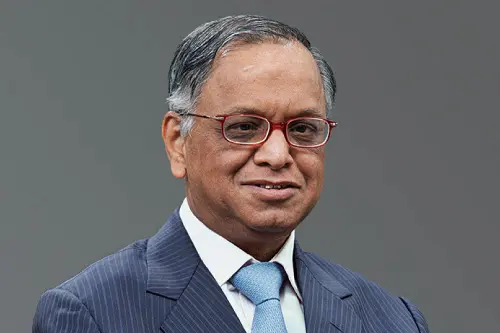
Infosys co-founder Narayana Murthy is a reasonable voice that India, especially those in the IT sector, listens to with respect. But his comment that Indian workers should adopt a 70-hour workweek to help the country reach its goal of becoming a 5 trillion-dollar economy has set off a furious debate.
Murthy referred to the rise of Germany and Japan after the Second World War and attributed it to the hard-working workforce the two countries had after the war.
He also referred to the disciplined labour force of China, where millions put in long hours on assembly lines, effectively turning China into an economic powerhouse.
As soon as Murthy's interview came out, some other CEOs like Ola's Bhavish Aggarwal hailed his call and backed the Infosys founder's opinion that the focus of some workers on work-life balance is a bad habit Indian youth is picking up from the West.

Kunal Shah, the founder of the multi-crore fintech firm CRED, went further, expressing his admiration for the 996 work culture espoused by Chinese tycoon and Alibaba founder Jack Ma, who wanted employees to work from 9 am to 9 pm, six days a week.
Predictably, such views attracted a heap of criticism, with a Reddit thread on Shah's comments attracting 1.6k views and nearly 500 comments, most of which were critical of his views.
Some noted entrepreneurs like upGrad founder Ronnie Screwvala also rejected Murthy’s vision, saying boosting productivity isn’t just about working longer hours.
In a social media post that would resonate with many workers, billionaire Harsh Mariwala, founder and chairman of Marico, called for a better environment in workplaces to boost productivity.
"It’s pivotal for organisations to cultivate a culture rooted in transparency, trust, and meritocracy, which is devoid of gossiping, backbiting, and politicking. The ultimate objective should be to make work so invigorating and rewarding that the paradigm of work-life balance seamlessly integrates.”
“When young professionals are passionate and see purpose in what they do, the need to ‘balance’ becomes a harmonious blend of personal and professional fulfillment," he wrote.
But what Murthy said touched upon a relevant issue. Work ethics of the Indian workforce need improvement as the attitude of 'sab chalega' (anything goes) permeates our outlook. The idea that once you do something, it is your creation and you are responsible for it is yet to take root here. Taking pride in what you do is what is mostly missing both in our private and public sectors.
Lack of ownership is what brings down the quality of work in India. Doing a job for job’s sake is the bane of our work ecosystem as it discourages even those who want to do quality work. Spending long hours cooped up in the workplace will hardly overcome this, and surveys have shown that Indian workers top in Asia when it comes to pretending to engage in work without doing any productive work.
Murthy's reference to Germany and Japan during the aftermath of the war is an odd one. It is but natural when faced with severe calamities like that, societies pull together to overcome such catastrophes. This was clearly demonstrated in Kerala during the disastrous 2019 flood situation.
To demand such efforts on a day-to-day basis is a bit harsh. And in any case, India currently is not facing what bombed-out Germany and Japan endured.
Even more alarming is the affinity that some industry stalwarts show for the Chinese labour model. The 996 pattern espoused by Alibaba founder and Tencent founder Pony Ma attracted severe rebuke from the Chinese government and a lot of pushback from the workers.
The continued push for such long hours of work has led to the 'lying flat' response among some youth, who say they are happy to live with what they have and do not care about symbols of personal success like an apartment or a car. They refuse to sign up for high-intensity jobs and opt for work that gives them moderate income but comes with less stress.
Even in the US and Europe, young workers are rejecting the 'hustle culture' and opting for trends like 'quiet quitting' and 'bare minimum Mondays'. Moreover, the layoffs during the Covid-19 pandemic also reinforced the perception that companies put profits over people when trouble arises.
While blaming the young workers for copying the 'not-do-desirable' habits of the West, it would be good if the corporations take the lead in showing how the better practices in those countries can be replicated here.
Successful companies, both big and small, in the US and China, spend millions in encouraging research and development in universities and schools. But in India, most universities depend on government handouts for survival.
Yet, we don’t hear much debate about how much the private sector can do to provide better research and development facilities in our universities. Just wander into the Kerala University campus in Karyavattom, which shares a wall with the Technopark in Trivandrum. There you can find many young researchers who struggle even for a few thousand rupees to carry on with their research projects.
The disciplined labour force of China is a capitalist’s dream as they work hard and are not allowed independent unions or hold protests at the workplace. Pumping patriotism into the factory work lines is a decades-old policy of the Chinese Communist Party and curtailing the rights and freedom of workers is the hallmark of authoritarian regimes.
Those who lust for a similar approach here should remember the Chinese business environment is a double-edged sword. It is not just the workers who are reined in by the government, but tycoons who step out of line also face the same fate.
Remember what happened to Jack Ma when he criticised the policies of Beijing? His high-profile presence vanished almost overnight, the IPO of Ant Financial was halted, and his company was forced to restructure.
So Indian CEOs should be careful about what they wish for.
Published: 02 Nov 2023, 08:04 am IST
Disclaimer: Kindly avoid objectionable, derogatory, unlawful and lewd comments, while responding to reports. Such comments are punishable under cyber laws. Please keep away from personal attacks. The opinions expressed here are the personal opinions of readers and not that of Mathrubhumi.