
Natural systems are capable of producing violence on scales that are difficult for the human imagination to comprehend. Sometimes one natural process triggers another. That is not an argument against climate science, but one for taking geology seriously, says Harikrishnan S
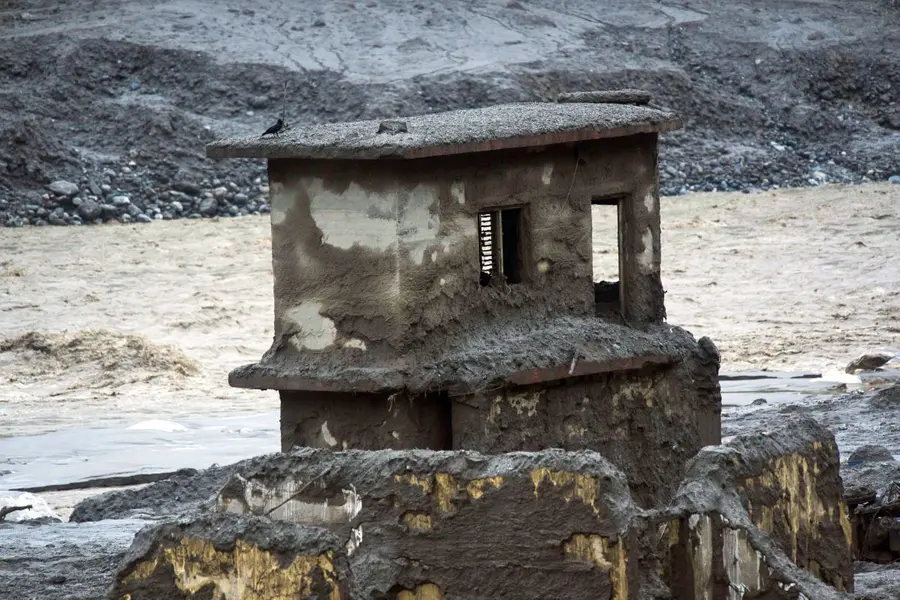
There is something deeply unsatisfactory about the speed with which a natural disaster is now converted into a climate change parable. A glacier collapses, a river rises by 9 metres in half an hour, people are killed, villages are swept away, and before the debris has even settled, the verdict is announced. Climate change did it.
It is an extraordinarily convenient explanation that has the additional advantage of being almost impossible to disprove after the event. If the glacier had not collapsed, we might have been told that climate change had made its collapse more likely. But since it did collapse, the matter is apparently settled. The investigating geologists can presumably collect their samples at leisure. The catastrophe in Nepal and Tibet on August 26 deserves better than this.
The evidence available so far points towards a spectacularly violent geological and hydrological sequence. A mass of ice and rock appears to have broken away from a glacier, fallen into the valley and interacted with the river. A temporary obstruction was apparently formed, water accumulated, and the obstruction subsequently gave way. The result was a flash flood of extraordinary violence, with the Trishuli reportedly rising by around 9 metres in 30 minutes.
Also Read: Langtang Valley before tragedy: Revisiting Nepal’s ‘valley of glaciers’ through a 2019 trek
That is hardly a metaphor for climate change, but a physical event. Something happened to an enormous quantity of ice, rock and water, and the first responsibility of science is to determine precisely what that something was.
It is perfectly legitimate to ask whether a warming climate might have altered the conditions that preceded the collapse. It is perfectly legitimate to examine glacier retreat, snowmelt, permafrost, precipitation, temperature and every other relevant variable. What is not legitimate is to substitute the question “could climate change have contributed?” with the considerably more convenient assertion “climate change caused it.” Those are not the same sentence, and they do not require the same evidence.
This distinction becomes particularly important when we remember the rather embarrassing history of the Himalayan glacier scare. In 2007, the Intergovernmental Panel on Climate Change reported that Himalayan glaciers could disappear by 2035, or perhaps sooner. The claim was subsequently withdrawn by the IPCC itself. It turned out not to be the product of some magnificent scientific breakthrough that had subsequently been overtaken by inconvenient data. It was simply an error that should never have made its way into the report in the first place.
The irony was difficult to miss. The same year, the IPCC and Al Gore were awarded the Nobel Peace Prize. Gore, of course, did not receive a Nobel Prize in Physics or Chemistry. He received the Peace Prize, jointly with the IPCC, for his efforts to disseminate knowledge about man-made climate change. The Nobel Committee praised him, in effect, for being the great communicator of the climate cause. And he certainly was. Few people have been more successful at turning a complicated scientific question into a morality play populated by innocent victims, guilty industrialists and an approaching apocalypse. His talent for advocacy is undeniable. His talent for making predictions that sound considerably more certain than the underlying evidence sometimes warranted is also difficult to overlook.
None of this means that anthropogenic climate change is imaginary. That would be an absurd conclusion. The Earth's climate is warming, and human greenhouse gas emissions are an important cause of that warming. The fact that some claims made in its name have been exaggerated or simply wrong does not make the underlying science disappear. But the reverse proposition is equally important.
The existence of climate change does not make every catastrophe a consequence of climate change. This should not be a particularly controversial proposition. Earthquakes occurred before the internal combustion engine, landslides occurred before coal-fired power stations, glaciers collapsed before the invention of the political activist, and rivers flooded long before anyone had thought of buying carbon offsets. Gravity, with its stubborn refusal to respect our ideological preferences, has been causing things to fall down for rather longer than the United Nations has been convening conferences about it.
Also Read: China's mega dam push in Tibet faces fresh scrutiny after deadly Nepal floods
The geological record is littered with events that would make even our most imaginative climate catastrophists look positively restrained. Consider Lituya Bay in Alaska in 1958. An earthquake triggered a gigantic rockslide which plunged into the narrow bay and generated what remains the highest recorded tsunami run-up in history, an astonishing 524 metres. The mountain did not require a lecture from Al Gore before deciding to fall into the sea.
Natural systems are capable of producing violence on scales that are difficult for the human imagination to comprehend. Sometimes one natural process triggers another. An earthquake causes a landslide, a landslide displaces water, and water becomes a tsunami. A glacier collapses into a river; a temporary dam forms; the dam fails; and the river becomes a wall of water. That is not an argument against climate science, but one for taking geology seriously.
There is another curious habit in the climate debate; the tendency to speak of “the Himalayan glaciers” as though they were a single enormous ice cube, which they are not. The Himalayan and Hindu Kush region contains glaciers behaving under markedly different climatic and geographical conditions. The famous Karakoram anomaly has been one of the most conspicuous reminders that the cryosphere does not always behave according to the neat narrative demanded by the political debate.
While some glaciers have lost substantial mass, some have behaved differently. Some parts of the Karakoram have exhibited periods of near equilibrium or even slight gains. The existence of these exceptions does not disprove warming, any more than the existence of melting glaciers proves that every subsequent landslide was caused by it. The correct scientific response is to measure the differences and understand them. That is considerably less exciting than announcing the end of the world, but then science has never been particularly obliged to provide exciting copy for newspapers.
The same caution should apply to the disaster in Nepal. The event happened just two days earlier; literally two days earlier. Investigators are still reconstructing the sequence of events. Satellite imagery, geological evidence, hydrological measurements and atmospheric data will have to be examined before anyone can reasonably determine whether warming played a significant causal role, a contributory role, or no meaningful role at all in the actual collapse.
There is nothing cowardly about saying we do not yet know. Indeed, there was a time when that phrase was regarded as one of the noblest sentences in science. The problem is not climate science, but climate certainty.
There is a world of difference between saying that a warmer climate can alter glacier dynamics and saying that a particular glacier fell yesterday because of climate change. There is another world of difference between saying that extreme rainfall can become more probable under certain climatic conditions and declaring that every flood is therefore a climate change event.
Causation cannot be established by temporal proximity, ideological enthusiasm or the number of people retweeting an infographic. Nor should the debate be settled by the opposite kind of intellectual laziness. Pointing to the 2007 Himalayan glacier error does not prove that climate change is a hoax; pointing to Al Gore's rhetoric does not invalidate atmospheric physics; and pointing to the Karakoram anomaly does not establish that Himalayan glaciers are gaining mass overall. What it does establish is something much less dramatic and considerably more important.
Scientists, institutions, governments, Nobel laureates, and activists can all be wrong. And sometimes the most spectacular claim in the room could simply be the least well supported. That should not be regarded as an attack on science. It is precisely the principle that makes science worth defending. So let the geologists investigate the glacier, the hydrologists reconstruct the flood, and the climatologists examine the temperature, snow and ice records. Let them determine whether the background climate made this particular failure more likely. And if, after all that, the evidence demonstrates that climate change materially contributed to the catastrophe, then say so without hesitation.
But if the evidence says that a piece of a mountain fell into a river, created a temporary dam and then released an extraordinary volume of water down a valley, perhaps we should have the intellectual honesty to say that too. The dead deserve an explanation and a slogan.
The author is a National Award winner for Best Narration and an independent political analyst. Views expressed are personal.
Published: 28 Aug 2026, 04:01 pm IST
Related Topics
Disclaimer: Kindly avoid objectionable, derogatory, unlawful and lewd comments, while responding to reports. Such comments are punishable under cyber laws. Please keep away from personal attacks. The opinions expressed here are the personal opinions of readers and not that of Mathrubhumi.
