

The Vinsmera Jewels ad featuring Mohanlal can be seen as part of this slowly shifting landscape—where mainstream male icons are beginning to explore more fluid, layered expressions of identity
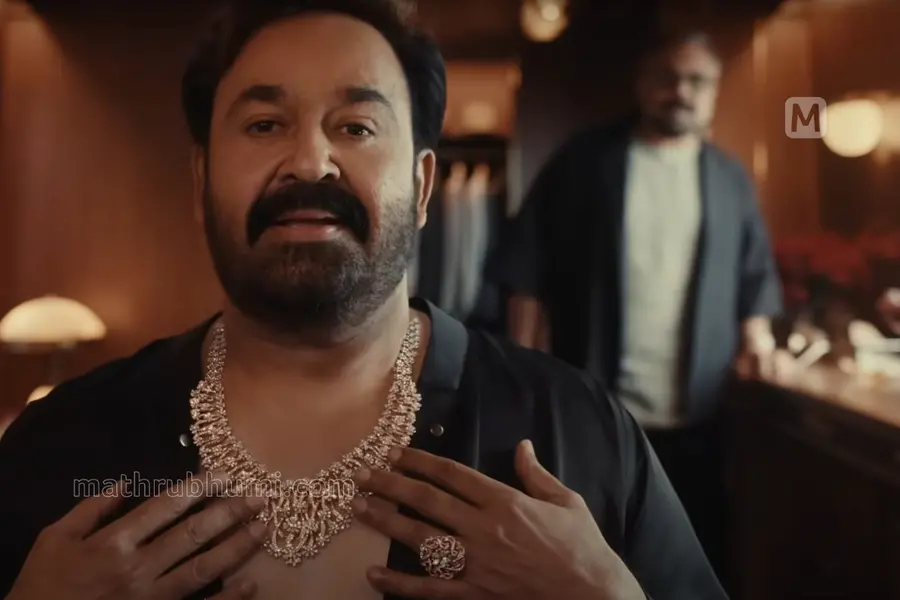
As ad filmmaker Prakash Varma runs Mohanlal through the shot breakdowns on set, the atmosphere is abuzz with quiet anticipation. Assistants scurry about, final touches are made to the lighting, and the art team adjusts the opulent backdrop for the high-end jewellery commercial. Amidst this organised chaos, a striking female model is introduced to Mohanlal. Draped in a regal ensemble, she removes her elaborate diamond necklace and places it momentarily on the makeup table beside her. Mohanlal gives it a fleeting look, nods politely at the model, and quietly makes his way to his vanity van. Moments later, confusion sets in as the crew realises that the necklace has vanished. Murmurs grow louder, eyes dart around, people begin retracing steps, checking under tables, behind props.
Cut to: Mohanlal’s van.
The inside is dimly lit. Mohanlal, now dressed in a loose-fitting black short kurta and flowy pants, stands before the mirror. The heavy diamond necklace now adorns his neck. He’s also wearing a matching bracelet and a ring—each piece gleaming under the soft vanity lights. His eyes glimmer with a childlike wonder as he slowly runs his fingers along the curve of the necklace. He tilts his head, shifts his stance gently—almost reverentially—and then, as if overtaken by a private muse, he lifts his hands in a graceful mudra. His reflection responds in kind as he slips seamlessly into a soft classical dance pose, evoking a dancer lost in a moment of abandon. Outside, the mayhem continues. But inside the van, the world has momentarily paused for Mohanlal and the diamonds. Here is a gender-conforming male superstar—an icon who has long embodied conventional masculinity—seen unabashedly embracing his feminine energy. He wears the jewellery not as costume or parody, but with a quiet reverence and grace.
The two-day-old advertisement for Vinsmera Jewels, featuring Mohanlal as the brand ambassador, has already racked up 1.8 million views on YouTube. The internet is abuzz—not just with admiration for the visual concept, but also for the superstar’s bold move in challenging gender norms. By and large, the ad has struck a chord with viewers, earning praise for both its artistic vision and cultural audacity.
That said, the ad also had its share of backlash. A section of fans took offence at seeing their long-revered masculine icon embracing what they perceived as overly feminine energies. For them, it clashed with the image they had long associated with Mohanlal—a larger-than-life figure who embodied strength, authority, and traditional masculinity. Ironically, Mohanlal has always carried an ingrained layer of femininity in his screen presence that never once stood in the way of him convincingly embodying alpha-male characters. Whether in his body language, the gentleness in his gaze, or the softness with which he often approached emotionally complex roles, there has always been a quiet subversion at play. It’s precisely this duality that has always worked in his favour. His masculinity was never one-note to begin with.
Historically gender fluid
It is when viewed through a cultural and historical lens that the association between jewellery, softness, and femininity begins to unravel. Historically, our kings, warriors, and other powerful men wore elaborate jewellery, flowing robes, and even makeup, and their masculinity was never questioned. These symbols were considered markers of power, authority, and refinement, rather than gender deviance.
So one can safely assume that the narrative perceiving a man showing interest in jewellery or showing “effeminate” traits as inherently unmanly is a relatively recent, culturally specific construct. One can perhaps blame that on colonial hangovers, rigid binary thinking, and the commodification of gender roles.
The stereotype is further fuelled by society’s—and particularly pop culture’s—tendency to conflate effeminacy with queerness, and to leap to the assumption that any man who enjoys traditionally feminine things must be gay. People are multifaceted—masculinity, like femininity, is a spectrum, not a singular mould. And masculinity doesn’t look just one way.
Why Kaathal is radical
Malayalam cinema has long been complicit in reinforcing this binary. For decades, the industry has depicted effeminate male characters as punchlines, often reducing them to exaggerated stereotypes to elicit laughs or signify queerness. Such portrayals have routinely equated softness or gender non-conformity with weakness, otherness, or ridicule.
That’s precisely why Kaathal: The Core stands tall—it dared to place a superstar, long associated with hypermasculinity, at the heart of a tender, complex queer narrative. For Mammootty, whose earlier films often glorified troubling depictions of toxic masculinity, this was more than just a bold career move—it felt like a moment of cinematic and personal redemption. By portraying a gay man with restraint, vulnerability, and quiet dignity, he gave voice and representation to a community that had for long been either caricatured or erased on screen. It wasn’t just a role—it was a reclamation of space, and a symbolic dismantling of a legacy built on narrow definitions of masculinity.
In that sense, the Vinsmera Jewels ad featuring Mohanlal can be seen as part of this slowly shifting landscape—where mainstream male icons, once considered the guardians of a certain kind of machismo, are beginning to explore more fluid, layered expressions of identity. While Mammootty’s performance was grounded in realism and narrative depth, Mohanlal’s ad takes a more stylised, symbolic route—invoking gender fluidity through gesture, costume, and performative flair. Both, however, are united by the cultural weight they carry: when a superstar bends convention, the audience notices.
And that’s significant—especially in a film industry like Malayalam cinema, which has historically been guilty of using effeminacy as a shorthand for queerness, often for ridicule. For decades, men who didn't conform to the dominant image of masculinity were pushed to the margins of the narrative, treated as comic relief, sidekicks, or worse, cautionary tales.
In that context, Mammootty and Mohanlal—two titans of that very tradition—stepping into roles and performances that challenge those binaries, is quietly radical. One did it through a character arc rooted in real-world identity, the other through a poetic visual metaphor. But both chipped away at the idea that masculinity must always look, sound, and behave a certain way.
The ad doesn’t just showcase jewellery. It nudges the audience toward a conversation about fluidity, expression, and unlearning. And in doing so, it perhaps begins to make space for a broader, kinder understanding of what it means to be a man onscreen.
The only minor glitch in the act comes when he is discovered by the ad filmmaker while adorning the jewellery—his reaction veers more towards embarrassment than ease or self-assurance. That fleeting moment of discomfort slightly undercuts the boldness of the concept, subtly contradicting the very fluidity and freedom the ad seems to celebrate. Otherwise, it’s an ad for the ages.
Published: 22 Jul 2025, 10:33 am IST
ABOUT THE AUTHOR
Related Topics
Disclaimer: Kindly avoid objectionable, derogatory, unlawful and lewd comments, while responding to reports. Such comments are punishable under cyber laws. Please keep away from personal attacks. The opinions expressed here are the personal opinions of readers and not that of Mathrubhumi.