

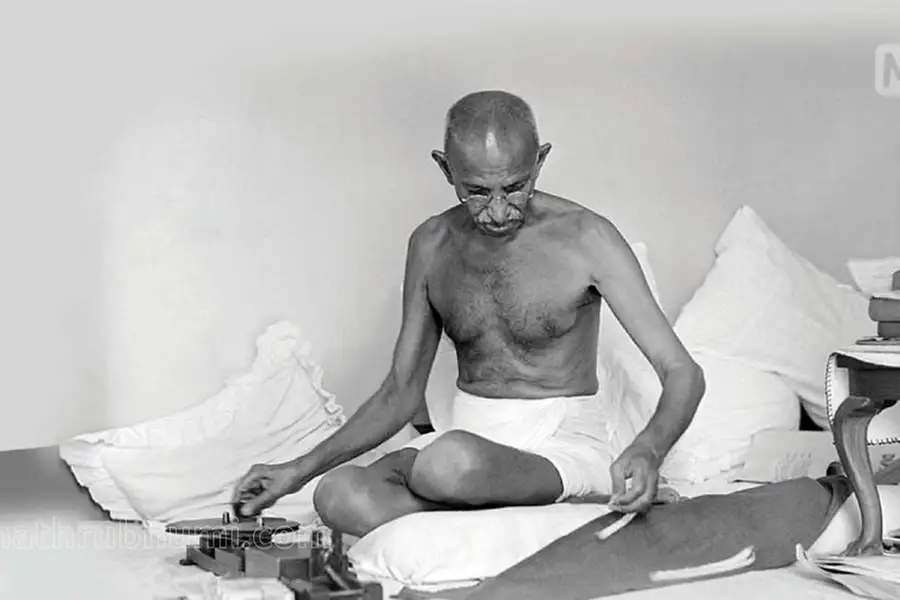
Today marks the 154th anniversary of Mahatma Gandhi’s birth, and our media will be filled with encomia for one of India’s greatest sons, the man who led us to freedom. Perhaps it is an appropriate time to look at him through the prism one of the iconic moments of his extraordinary life -- one of the most momentous events in India’s nationalist struggle, the Dandi March, which was arguably his most successful attempt at civil disobedience against the British Raj.
The British had turned salt production and distribution in India into a lucrative monopoly, prohibiting Indians from producing or selling salt independently, and instead requiring them to buy expensive, heavily taxed and often imported salt that most Indians could not afford. Indian protests against the salt tax had begun in the 19th century, but it was only with Gandhi’s decision in 1930 to demonstrate against the repressive salt tax that a real breakthrough occurred.
Gandhi started marching on foot on March 12, 1930, from his ashram at Sabarmati near Ahmedabad to the town of Dandi, near Surat, on the Arabian Sea, some 385 km away, accompanied by several dozen followers. After each day’s march the group stopped in a different village along the route, where increasingly larger crowds would gather to hear the Mahatma denounce the unfairness of the tax. Hundreds more joined the core group of followers as they made their way to the sea coast, until on April 5 the entourage reached Dandi. The next morning, on April 6, Gandhi and his followers picked up handfuls of salt along the shore, thus technically “producing” salt and breaking the law. This was a profoundly effective, highly visually compelling, act of civil disobedience.
This dramatic event seized the imagination of the nation and the world. Gandhi continued his satyagraha against the salt tax for the next two months, exhorting other Indians to break the salt laws. Thousands were arrested and imprisoned; the Mahatma himself went behind bars in early May after he informed Viceroy Lord Irwin of his intention to lead a march on the Dharasana saltworks. News of Gandhi’s detention spurred tens of thousands more to join the satyagraha. The march on the saltworks went ahead anyway on May 21, with some 2,500 peaceful satyagrahis attacked and beaten by police. By the end of the year 1930, some 60,000 people had been jailed.
The Raj had seen nothing like it, and the imperial authorities realized that continued repression and detention was clearly unsustainable. Gandhi was released from custody in January 1931 and began negotiations with Lord Irwin. A truce was formalized in the Gandhi-Irwin Pact signed on March 5, 1931, allowing Gandhi to end his satyagraha. The calming of tensions paved the way for Gandhi, representing the Indian National Congress, to attend the second session of the Round Table Conference in London. His civil disobedience campaign had succeeded; moral victory was his.
In recalling this epic moment, we echo Jawaharlal Nehru’s words at the moment of Independence, when he spoke of the Mahatma as “embodying the old spirit of India” whose message would be remembered by “succeeding generations.”
What was that message? The Mahatma was the extraordinary leader of the world's first successful non-violent movement for independence from colonial rule. At the same time he was a philosopher who was constantly seeking to live out his own ideas, whether they applied to individual self-improvement or social change: his autobiography was typically subtitled "The Story of My Experiments with Truth".
No dictionary imbues “truth” with the depth of meaning Gandhi gave it. His truth emerged from his convictions: it meant not only what was accurate, but what was just and therefore right. Truth could not be obtained by "untruthful" or unjust means, which included inflicting violence upon one's opponent.
To describe his method, Gandhi coined the expression satyagraha - literally, "holding on to truth" or, as he variously described it, truth-force, love force or soul-force. He disliked the English term "passive resistance" because satyagraha required activism, not passivity. If you believed in Truth and cared enough to obtain it, Gandhi felt, you could not afford to be passive: you had to be prepared actively to suffer for Truth.
So non-violence, like many later concepts labelled with a negation, from non-cooperation to non-alignment, meant much more than the denial of an opposite; it did not merely imply the absence of violence. Non-violence was the way to vindicate the truth not by the infliction of suffering on the opponent, but on one's self. It was essential to willingly accept punishment in order to demonstrate the strength of one's convictions.
This was the approach Gandhi brought to the movement for India's independence -- and it worked. Dandi was the epitome of it. Where sporadic terrorism and moderate constitutionalism had both proved ineffective, Gandhi took the issue of freedom to the masses as one of simple right and wrong and gave them a technique to which the British had no response. By abstaining from violence, Gandhi wrested the moral advantage. By breaking the law non-violently, he showed up the injustice of the law. By accepting the punishments imposed on him, he confronted his captors with their own brutalisation. By voluntarily imposing suffering upon himself in his hunger-strikes, he demonstrated the lengths to which he was prepared to go in defence of what he considered to be right. In the end he made the perpetuation of British rule an impossibility.
What lessons do Dandi and Gandhi offer to us in today’s India, beyond their historical resonance? One thing must be faced: Gandhi’s approach could only work against opponents vulnerable to a loss of moral authority – a government responsive to domestic and international public opinion, capable of being shamed into conceding defeat.
The power of Gandhian non-violent civil disobedience rests in being able to say, "to show you that you are wrong, I punish myself." But that has little effect on those who are not interested in whether they are wrong and are already seeking to punish you for your disagreements with them. For them your willingness to undergo punishment is the most convenient means of victory.
Gandhism without moral authority is like Marxism without a proletariat. Yet few who have tried his methods have his personal integrity or moral stature. The coercive hartal, the hypocritical “relay fast”, the theatrical misuse of dharnas, only show how far the world has fallen from Gandhi’s ideas of Truth.
None of this dilutes Gandhi's greatness, or the extraordinary resonance of his life and his message. While the world was disintegrating into fascism, violence and war, the Mahatma taught the virtues of truth, non-violence and peace. He destroyed the credibility of colonialism by opposing principle to force. And he set and attained personal standards of conviction and courage which few will ever match. He was that rare kind of leader who was not confined by the inadequacies of his followers.
Yet Gandhi's Truth was essentially his own. He formulated its unique content and determined its application in a specific historical context. Inevitably, few in today's world can measure up to his greatness or aspire to his credo. The originality of his thought and the example of his life inspires people around the world today, but we still have a lot to learn from Gandhi. One wonders if, beyond lip service, we really have.
Published: 02 Oct 2023, 07:44 am IST


ABOUT THE AUTHOR
Related Topics
Disclaimer: Kindly avoid objectionable, derogatory, unlawful and lewd comments, while responding to reports. Such comments are punishable under cyber laws. Please keep away from personal attacks. The opinions expressed here are the personal opinions of readers and not that of Mathrubhumi.