
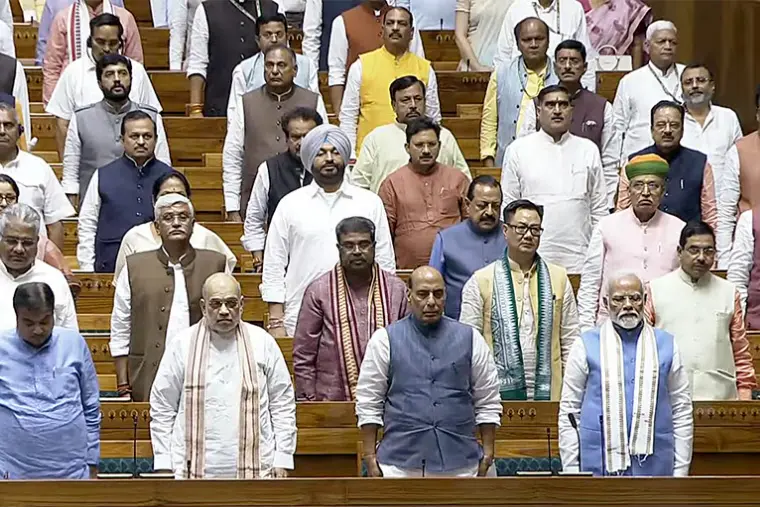
Question: When Parliament does not function or is disrupted, who is the biggest beneficiary? Answer: The government in power.
The logic is straightforward. (i) The government is accountable to Parliament (ii) Parliament is accountable to the people (iii) So when Parliament is dysfunctional, the government is not accountable to anyone!
Also Read

The total time scheduled for the upcoming session of Parliament is 190 hours. Here is how this time is divided between the government and the Opposition. About half the questions for Question Hour and half the number of notices for Zero Hour are filed by Opposition MPs. This adds up to 31 hours for members of the Opposition to raise questions and matters of public importance.
In comparison, the Union government gets 135 hours out of the total 190 for government business and other issues -- a whopping 70% of the total time.
There is a legitimate need to cut down on the hours available to the government. Re-allot some more time to the Opposition. Four hours must be reserved each week, in each House, to allow discussions on matters of urgent public importance.
Additionally, two hours should also be reserved for a Calling Attention motion (here the MP brings a matter of urgent public importance to the relevant Minister’s notice who is mandated to reply).
This will give the Opposition an added six hours each week in both Lok Sabha and Rajya Sabha to raise issues of national public importance. This would mean about 117 hours for government business and 49 hours for the Opposition. A much fairer system.
In recent years, several critical legislative decisions have been made without adequately hearing out the Opposition. For instance, during the passage of the Farm Laws, only one opposition member was permitted to speak in the Lok Sabha. Ultimately, these laws had to be repealed.
Notably, in the 17th Lok Sabha, a total of 221 bills were passed. More than one-third of these bills were hurried through with less than a 60-minute discussion. Only 1 out of 6 Bills was scrutinised by Committees. Even those bills which made it to the committees were handled casually.
The Bharatiya Nyaya Sanhita, 2023, which proposes a sweeping overhaul of the criminal justice system with 356 amendments, along with Bhartiya Nyaya Suraksha Sanhita, Bhartiya Sakshya Bill were all discussed in merely 13 sittings.
In comparison, the Criminal Procedure Code Amendment Bill, 2006, with its 41 amendments, was scrutinised by the Home Affairs Committee over 11 sittings.
Another recent issue that saw minimal participation of the Opposition was the "discussion" (sic) on the Parliament security breach. In 2001, when Parliament was attacked, both Houses of Parliament engaged in a comprehensive discussion involving the Prime Minister and the Home Minister. This inclusive dialogue demonstrated a commitment to addressing security concerns collaboratively and transparently. However, in stark contrast, in 2023, when Parliament security was breached, 146 Opposition MPs were suspended for demanding a discussion on the subject.
The Provisional Collection of Taxes Bill, was debated by only six members and passed in just 30 minutes. Similarly, the Telecommunications Bill saw participation from merely eight members and was passed within an hour.
Many other bills have met the same fate: the Jan Vishwas Bill, the Digital Personal Data Protection Bill, Government of NCT of Delhi (Amendment) Bill etc.
Between September 2020 and August 2021, 113 notices were filed by MPs in the Lok Sabha for Short Duration Discussion. Only two were accepted. Not allowing notices for a debate on matters of urgent public importance is the most lethal device to muzzle the voice of the Opposition in Parliament. The Presiding Officers, in their wisdom, would do well to address this.
The re-allotment of time in Parliament between the government and the Opposition needs to be seriously looked at. This is not merely a procedural adjustment, but a fundamental necessity to uphold the principles of accountability and representative democracy.
The writer is Member of Parliament and Leader, All India Trinamool Congress Parliamentary Party (Rajya Sabha).
Published: 20 Jul 2024, 10:05 am IST
Related Topics
Disclaimer: Kindly avoid objectionable, derogatory, unlawful and lewd comments, while responding to reports. Such comments are punishable under cyber laws. Please keep away from personal attacks. The opinions expressed here are the personal opinions of readers and not that of Mathrubhumi.