

If there is one lesson from this Asia Cup, it is that politics and sports do not make great partners on the playing field.
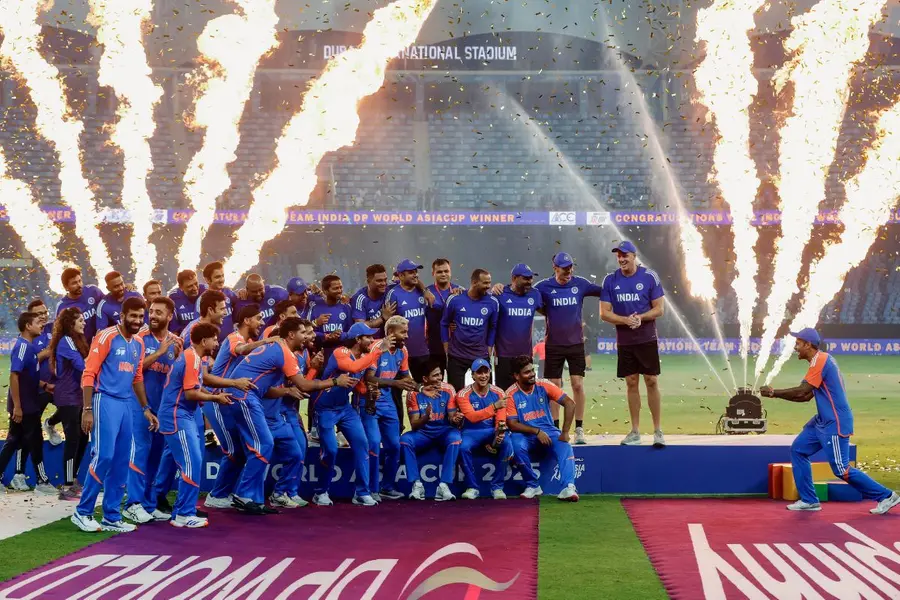
The last act in the just concluded Asia Cup cricket is still to be carried out! That may appear a strange and surprising statement but that sadly is a reflection of the kind of farcical end-script witnessed by all at the Dubai International stadium and the many on television. India had finished off on a victorious note beating Pakistan in a nail-biting finish to win the Cup for the ninth time. But, when it came to handing over the trophy the Indians did not want to receive it from the ACC chief Mr Mohsin Naqvi, who also happens to be the Interior Minister of Pakistan and the chairman of the Pakistan Cricket Board. After a long wait, Mr.
Naqvi ensured that the trophy was taken away from the stadium and perhaps to the ACC headquarters in Dubai itself. Now, when India will receive it or what further drama there will be, only time will tell. But cricket has been hit for a six, so to speak, and it’s all politics now!
None would have expected a game of cricket to end up on this note. A gentleman's game it was said has been reduced to settling scores that had nothing to do with the prowess in the sport. An India-Pakistan encounter particularly in cricket is always a much sought after engagement as far as fans are concerned and if we may so even the Cricket bodies considering the broadcasting revenues that pour in. This time not once but three successive matches, all on Sundays, featured these two teams including the final. Considering the border troubles, these two are generally described as arch rivals and the way they faced each other with the underlying fierce one-upmanship attitude made the rivalry unmatched. Dubai too brought a good crowd to witness this but the difference this time was that India’s supremacy had been well marked.
All this talk of rivalry may exist, but these days, the games are confined to tournaments like the Asia Cup or the World Cup, with the Indian government making it clear that there is no question of bilateral contests between India and Pakistan. But is there really a contest between the two countries on the cricket field? India’s supremacy has been well marked in both ODIs and T-20s for quite a while now and the fact that India won all three matches in the Asia Cup was certainly no surprise. The rankings say it all. India are No. 1 in both the ODI and T20 rankings, while Pakistan are No. 5 and No. 7 in the two formats.
But then the joy of the wins and the frenzy that followed, as it happened in Dubai, ended on a sour note. And here the Indian team’s attitude to start with did not seem convincing. Captain Suryakumar Yadav refused to shake hands with his counterpart after the toss, a routine exercise in this sport, and that started it all. The players too kept away likewise and that steamrolled. Gestures on the field and frequent sledging on the field became the order though none of them brought up anything nasty. Suryakumar was fined for his ‘political’ remarks at the post-match press conference while Pakistan’s Harris Rauf was also fined for his unseemly gestures on the field. Yet, the worst was reserved for the final day when the victorious Indian team refused to accept the trophy from Mr. Naqvi.
Even considering the ever-present tension in matches between the two countries, what happened during the Asia Cup seemed beyond acceptable limits. Perhaps recent events—the Pahalgam incident and India’s Operation Sindoor counter—only heightened the tension. In this context, it is debatable whether this was the right time for the two teams to clash on the cricket field. Once the incidents began, the on-field gestures and antics only fueled social media, generating explosive reactions. Many felt that India should have boycotted the matches. Indeed, if India had felt strongly about playing Pakistan, perhaps no matches should have been conducted. What occurred in these sensitive moments of inter-border nationalism suggests that the two teams used the sport to strain what little relationship remained.
It is sad that an event of this nature, where Indian cricket had a great time in the tournament, will now be remembered not for India’s record-extending ninth win but for all the wrong reasons. Bilateral cricket ties are already strained, and looking ahead, how the two sides perform in multi-team tournaments will be something to watch. Critics from other cricket-playing nations, as well as cricket fans in general, have already voiced their concerns that the fair name of the sport must be protected. It is a tough task ahead, but if there is one lesson from this Asia Cup, it is that politics and sports do not make great partners on the playing field.
Meanwhile, the Indian women cricketers also followed in their male counterparts’ footsteps. In Colombo, during the ICC Women’s World Cup match, Indian skipper Harmanpreet Kaur, like Suryakumar Yadav, walked away after the toss without shaking hands with Pakistan skipper Fatima Sana. The ‘no handshake’ policy has now been firmly established.
Published: 07 Oct 2025, 02:20 pm IST
ABOUT THE AUTHOR
Related Topics
Disclaimer: Kindly avoid objectionable, derogatory, unlawful and lewd comments, while responding to reports. Such comments are punishable under cyber laws. Please keep away from personal attacks. The opinions expressed here are the personal opinions of readers and not that of Mathrubhumi.