‘Let us be very clear’: Supreme Court says modified Form 6 was not approved amid SIR row
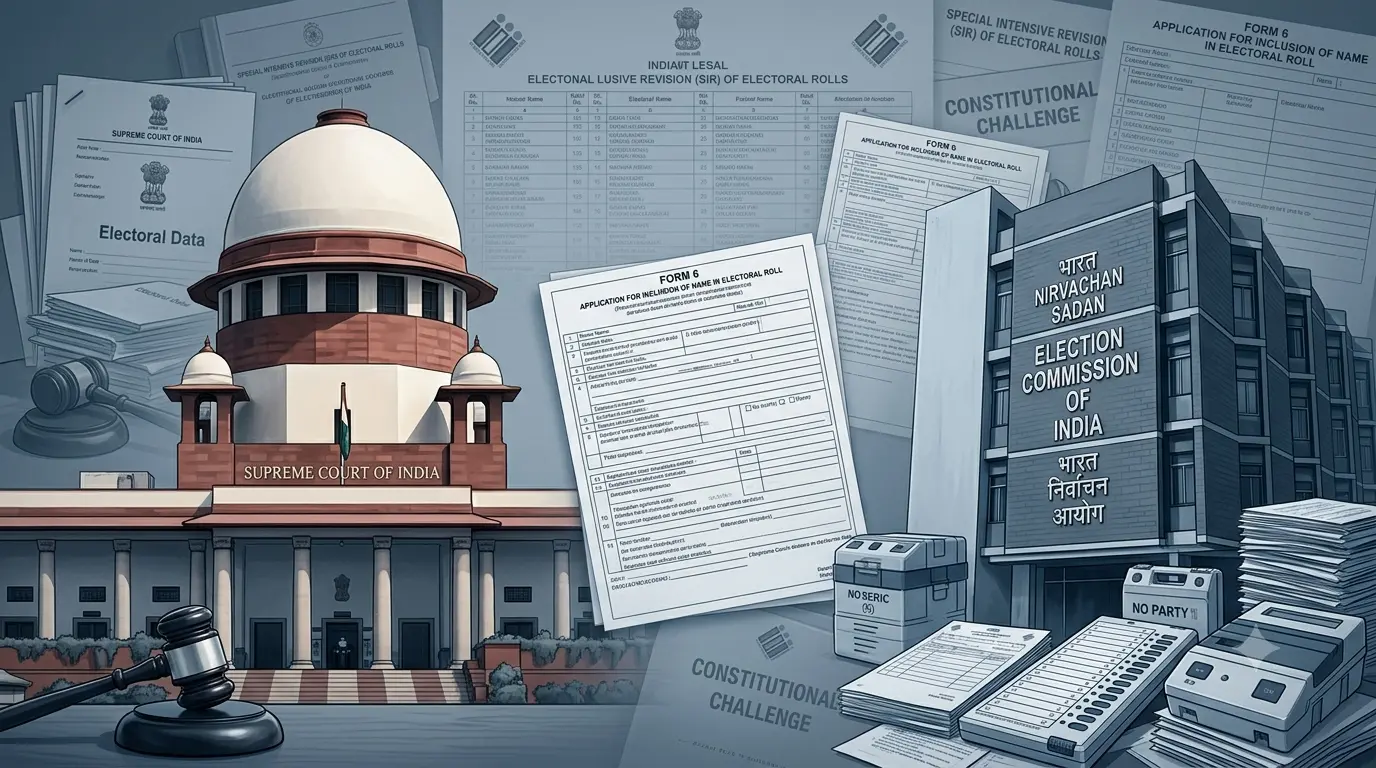
New Delhi: The Supreme Court on Monday clarified that it had not approved any modified version of Form 6, the application used for registering new voters, during the Special Intensive Revision (SIR) of electoral rolls. The observation came while the court was hearing petitions challenging the functioning of the Election Commission of India (ECI) and seeking action against Chief Election Commissioner Gyanesh Kumar.
A bench headed by Chief Justice of India Surya Kant said the court wanted to examine the official record to determine who had made the changes to Form 6. “Any modified Form 6 has not been approved by us. Let’s be clear,” the bench said. The court added that, once the record was produced, it wanted to see “who has modified” the form.
The observation is significant because the ECI had previously maintained that the additional declaration linked to Form 6 during SIR had been upheld by the Supreme Court. The poll panel had argued that Form 6 itself had not been changed and that the additional requirement was a separate declaration prescribed for the SIR exercise.
What is the Form 6 controversy?
Form 6 is the application used by eligible citizens to seek inclusion of their names in electoral rolls. The current controversy relates to an additional SIR-linked declaration that appeared alongside the form.
Under the SIR framework, applicants seeking new enrolment were required to provide information linking themselves, their parents or grandparents to earlier electoral rolls in states where the relevant previous revision had been conducted.
The dispute intensified after reports that Election Commissioners Sukhbir Singh Sandhu and Vivek Joshi had objected to the additional requirement. One of the central issues raised was whether a statutory form prescribed under the Registration of Electors Rules, 1960, could be altered or supplemented through an online process without formally amending the rules.
According to reports, Joshi objected to the change and Sandhu supported the objection, describing the alteration as unauthorised and illegal.
The ECI, however, has maintained a different position. It has said that the original Form 6 was not amended and that the SIR-related requirement was an additional declaration rather than a modification of the statutory form. The commission had pointed to its June 2025 SIR instructions, which required an additional declaration to accompany Form 6 or Form 8 during the exercise.
Why the Supreme Court's latest clarification matters
The latest observation focuses on a narrower question than whether the ECI had the general power to prescribe additional documentation during an SIR.
The Supreme Court has now made clear that it did not approve a modified Form 6. The court has also indicated that it wants to examine the underlying record before determining how the disputed version of the form came to be used.
This distinction is important because the ECI had relied on the Supreme Court's earlier judgment on the Bihar SIR while defending the additional documentation requirement. The commission's position was that the court had upheld the SIR framework and the associated declaration.
The Supreme Court's latest statement does not, by itself, amount to a finding that the ECI acted illegally. Instead, it raises the need to establish exactly what the court's earlier judgment authorised and whether the disputed online requirement falls within that authority.
What did the Supreme Court say in the Bihar SIR case?
The Supreme Court's May 27 judgment recognised the ECI's authority to conduct an SIR in Bihar and considered the documentation that could be required from voters.
The court held that Form 6 could not necessarily be applied “literally” in the context of an SIR and recognised that the ECI had a degree of residual authority to formulate an appropriate documentation framework.
However, that authority was not unlimited. The court said any departure from the statutory framework had to have a rational connection with the objective of the SIR.
The present dispute therefore centres partly on whether that recognition of the ECI's authority can be treated as judicial approval of the particular additional declaration later incorporated into the online Form 6 process.
What had the ECI said about Supreme Court approval?
The ECI issued a statement in September defending the additional declaration after questions were raised about its introduction.
The commission maintained that there had been “no change” to Form 6 itself and described the linkage requirement as an additional declaration accompanying the existing form.
The ECI also referred to its earlier SIR instructions, which provided for an additional declaration to be submitted along with Form 6 or Form 8 during the revision exercise.
The Supreme Court's Monday observation has now created a sharper distinction between the court's recognition of the ECI's power to prescribe additional documentation and approval of a particular modified or online version of Form 6.
ECI later removed the declaration in some states
The controversy also led to changes in how the declaration was used.
On September 30, the ECI removed the additional SIR-linked declaration from online Form 6 in states and Union territories where the SIR had already been completed or had not yet begun. The declaration continued to apply in areas where the SIR was under way.
The commission's position remained that the original statutory Form 6 had not been altered.
The change nevertheless became part of the wider debate over the legal basis, implementation and oversight of the SIR process.
Supreme Court also hears plea against CEC Gyanesh Kumar
Monday's hearing was not limited to the Form 6 issue. The bench was also hearing petitions seeking the suspension or prosecution of CEC Gyanesh Kumar and questioning whether decisions concerning the SIR had been taken without the required participation of the other Election Commissioners.
The court declined to grant an immediate interim order against Kumar.
Chief Justice Surya Kant said the court could not act solely on the basis of media reports and would first require a response from the Election Commission and the government.
“A news report may be 100% correct, partially correct or incorrect. We cannot pass an order on that basis today. We would definitely want their response,” the court said.
The bench also indicated that if an ECI decision was ultimately found to have been taken contrary to law, the court could intervene. It said decisions of the Election Commission have to be taken either unanimously or by majority.
What happens next?
The Supreme Court has sought the relevant records and responses before deciding the broader issues raised in the petitions.
A key question will be how the disputed Form 6 requirement was authorised and implemented, and whether it constituted a modification of the statutory form or an additional SIR-specific declaration within the ECI's existing authority.
The court's clarification also means that the May 27 judgment cannot simply be described as judicial approval of every subsequent change made to Form 6. The precise scope of the ECI's authority and the legal basis for the disputed requirement remain matters for the court to examine.
For now, the Supreme Court has not held that CEC Gyanesh Kumar personally acted illegally, nor has it ruled that the entire SIR exercise is invalid. Its latest intervention instead puts the specific Form 6 issue and the ECI's decision-making process under closer judicial scrutiny.