Inside Kerala’s temples & Theyyam traditions: Pepita Seth’s untold stories and cultural secrets
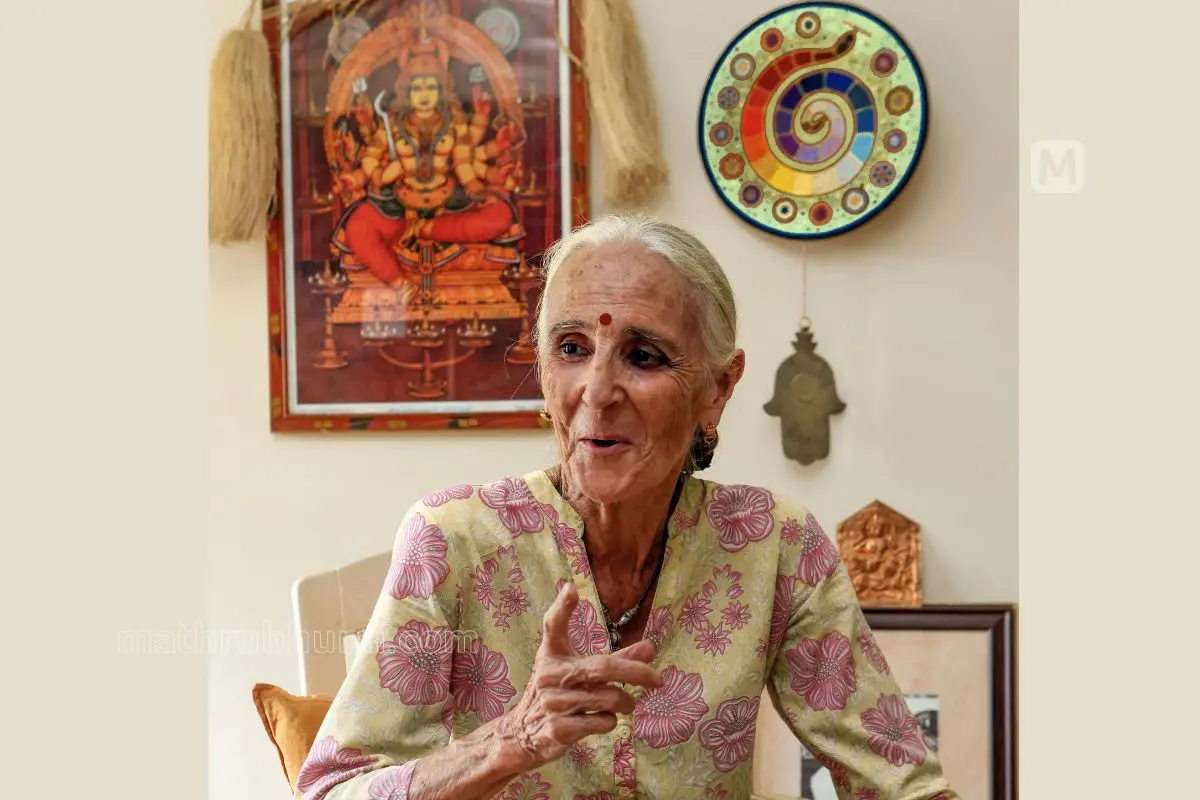
Pepita Seth, who now resides in Thrissur and is often hailed as 'Kerala’s adopted daughter', recently received Indian citizenship. Sitting in a quiet corner of Thrissur, away from the bustle of celebrations, she remarked, “People only talk about the citizenship now.”
For Mathrubhumi English, the focus was on her true contribution to the cultural fabric of Kerala. For over four decades, the Padma Shri awardee Pepita Seth has documented the state’s rituals through her photography. Her work captures the vibrancy of Theyyam from Northern Kerala and temple festivals across the state, while also portraying the subtle lives of the performers, whose traditions intertwine faith, inheritance, and survival. She reflected on the evolving nature of these rites, the ethics of preservation, and the delicate balance between performance and livelihood.
- Back then, when you began extensive travelling, it wasn’t as easy as it is today. How did you manage to come to India and explore Kerala?
I first flew to Bombay, which is now Mumbai, and from there to Kolkata. My great-grandfather, an army man, had begun his journey from Kolkata. He had originally intended to go elsewhere, but circumstances involving the Chinese altered his plans, so Kolkata became his starting point. I wanted to retrace that route.
It was also the period when the 'Beatles' had visited Banaras. That visit had drawn many foreigners to India, and Banaras in particular was full of them. Two friends travelled with me from Kolkata to Banaras, though they later went off in different directions.
In those days, there were tourist bungalows where anyone, Indian or foreigner, could stay. I checked into one in Banaras. Like many travellers then, I fell ill; the July heat was intense and unfamiliar. I remember lying under a ceiling fan that would suddenly stop, leaving the air completely still.
After two days, the manager knocked on my door. He insisted I come downstairs to eat. They seated me with them, made sure I had proper, healthy food, and included me in conversation. By that time, many Indians were understandably weary of the influx of hippie travellers. Yet, for some reason, they decided to look after me. They were kind and generous.
I had to continue to Lucknow, which was my main destination. A telegram was sent ahead announcing my arrival, and someone was waiting for me at the station. From that point onwards, I was rarely alone. There was always someone expecting me, guiding me, or seeing me off. My experience was very different from that of many other travellers.
- Was language ever a problem?
Not really. In places like tourist bungalows, there was usually someone who spoke good English. Most people did not, of course, and many were shy about speaking. But somehow, there was always someone around who could help.
When I returned to England, people assumed I would never go back to India. I said I hoped I would, and I did. I kept returning. Around 1970, I travelled south to Kerala, largely because I was fascinated by elephants. I was completely captivated by them.
- People often associate you with Guruvayur Temple and your iconic photograph of Keshavan, as well as your book 'Heaven on Earth: Universe of Kerala’s Guruvayur Temple'. Beyond Guruvayur, which temple is closest to you?
People often associate me with Guruvayur because of Guruvayur Keshavan, Guruvayurappan's elephant. The image I clicked is still in circulation. It was a rare moment as Keshavan was in musth at that time. My camera bag was with me, and I instinctively bent down at the right moment. Guruvayur Keshavan was extraordinary. Standing before him, you immediately sensed how small you were. There was a quiet awareness that you were insignificant beside such a majestic presence. That image has endured because it captured something of that scale and dignity.
But my true beginning was at Uthralikkavu in Thrissur. That was where I first encountered elephants in that setting. Kochu Gopalan, an elephant who later became known by another name, was there when I first visited. I was even challenged to ride him. I have never been afraid of animals. I respect their strength, but I am not frightened. Animals sense that. So I rode him, while others hesitated.
Uthralikkavu remains deeply personal to me. It was the starting point of everything. "And you know a secret – back then I was called 'Aana Madamma', she says, laughing loudly."
- You’ve spoken about being tested when you first began visiting temples. Could you elaborate?
Yes. For years, certain elders simply ignored me. One man in particular would sit under a tree, in Uthralikkavu, outside the temple (he was the oracle of that temple) and never acknowledge my presence. I accepted that. After several years, he finally spoke to me and took me to his home. Later, I learned his reasoning: “You knew nothing. What was the point in talking to you?” They were testing whether I would remain committed or simply disappear. They were right. Why should they waste time on someone who arrives casually and leaves just as easily? Respect must be earned.
- You mentioned observing ritual performers who remain anonymous, often covering themselves. How did you perceive that atmosphere?
There were several people like that, completely covered, their identities concealed. I did not know who they were. Yet what struck me most was their adaptability. Ritual performers adjust to circumstances with remarkable discipline.
As for the local community, they are generally accepting. Tensions often begin when outsiders intervene or impose their interpretations. Many conflicts arise not from within the tradition but from external interference.
- Many ritual art forms once confined to sacred groves or temple spaces are now performed at public venues, road shows, and commercial events. How do you view this shift?
It is comparable to opening a mobile phone. You may begin with something meaningful, but gradually it fills with advertisements and distractions. Everything becomes monetised.
Some young performers are deeply serious about their art and tradition. Others are less so. Ultimately, they must determine their own course. If a form loses its integrity entirely, perhaps it is better that it fades naturally rather than surviving in a distorted state. That may sound severe, but dilution is also a form of loss.
Sacred spaces such as Uthralikkavu, in Thrissur, have a setting that feels divinely composed — the road above, the temple below, the landscape intact. The environment itself shapes the experience. Altering that context alters the ritual.
- There are increasing complaints about vloggers and visitors obstructing rituals with cameras and mobile phones. What is your view?
It has become disruptive. Performers preparing for rituals can barely move through the crowd because of people blocking the way to film content. It was inevitable that this would cause tension.
In some places, restrictions have now been introduced — no cameras, designated press areas, and fees for coverage. Temples receive nothing from viral videos, yet bear the disruption. The quality of online commentary is often uninformed and sensationalised.
- Why do you think this tension exists between ritual and performance?
Because if it is labelled performance, it can be consumed like any other spectacle. If it is acknowledged as ritual, then one must accept limits.
Many people prefer the former. It is easier.
But for those who live within the tradition, it is not theatre. It is an obligation, an inheritance and a faith.
- It is often said that when painting a Theyyam or preparing the costume, artists deliberately leave a small imperfection. Is that true?
Yes, I think that is true. It is not unique to Theyyam; many cultures carry this idea. There is a belief that if something is made absolutely perfect, it risks inviting imbalance. Leaving a slight imperfection is a way of acknowledging that perfection belongs only to the divine.
In Theyyam too, while painting the face or preparing the costume, small variations or “flaws” are sometimes intentionally retained. It is a form of humility — an acceptance that human work cannot, and perhaps should not, claim total perfection.
- As a person who has a close association with people performing Theyyam, what is your take on the general statement, 'costumes in ritual arts have evolved. Some changes are made for visual impact in photographs or films'.
Costumes always evolve, but intention matters. If alterations are made purely for spectacle — to appear grander in reels or films — something shifts.
Lakshmanan Peruvannan, my friend, and a 'Theyyakkaran' ( who performs Theyyam) once made a piece he considered inferior and discarded it. I took it away and later asked him to repaint it. It took him eight years to complete the basic structure because he was constantly interrupted by commissions. The finished piece was exquisite.
Those who wear his work say it moves with the body in a way few others do. That is craftsmanship born of understanding, not spectacle.
- Some rituals are very strict about photography. How has that evolved?
In the early days, photography was absolutely forbidden. Completely. People were vigilant. Later, ironically, they began asking me whether I had a camera — not to stop me, but out of curiosity. Still, many rituals remain extremely guarded. There are always watchers ensuring rules are followed.
Lakshmanan, my friend, was particularly strict about intrusion. Once, when organisers insisted on using a microphone because they had paid for it, he simply threw it away. Later, when mobile phones began obstructing the ritual, performers would seize them and throw them aside. At first, they could be retrieved. Eventually, they threw them into the water so they could not be used again.
It may sound extreme, but they felt the sanctity of the ritual was being violated. When people call it “performance” or “dance”, it becomes entertainment. But if it is understood as ritual, then boundaries are essential.
- How close would performers allow you to go while photographing?
I always asked. Once, when photographing a performer portraying Vishnumoorthi theyyam, I asked how close I could come. He replied, “That is your problem. Stand where you wish.”
So I went extremely close. That is why I always asked first. Permission matters.
- You mentioned it took ten days for an artist to explain the rituals of Theyyam in general to you. Why so long?
Yes, it took ten days for him to explain how the goddess descends, the circular movement, the positioning, the sequence. Each dot, each line has significance. Nothing is arbitrary.
When he finally completed a small drawing for me, I immediately had it framed. I knew that otherwise I might lose it or damage it. Every element in that image had meaning — especially the placement of the dots, which mark stages of descent and transformation.
And even after explaining it, he said, “That is not the whole thing.” There is always more beneath the surface.
- Having known about the controversy surrounding certain fire rituals, particularly the 'Thee Chamundi Theyyam' and the accusations of child endangerment, what is your position?
I am familiar with the ritual in question. I spent hours with those who perform it, learning exactly how it is conducted. The procedures are meticulous. No one wishes harm on anyone, especially not a child.
Yet newspapers carried exaggerated claims that children were being thrown repeatedly into fire. That is simply false. If something were to go wrong, it would happen once, and they are careful precisely to prevent that. The performers are not reckless; they are highly aware of risk.
When activists attempted to stop the ritual based on misinformation, I wrote a letter explaining the facts. It was not published.
- There have been injuries among performers of Theyyam. Some activists argue for complete prohibition. Others suggest insurance and institutional protection instead. What do you think?
You cannot have it both ways. If society wishes these traditions to continue, then performers must be protected through insurance, financial support and medical care.
One of my close associates, Lakshmanan Peruvannan, suffered a stroke. He is a walking encyclopaedia of ritual knowledge. Yet there is no meaningful institutional support for someone of his stature. It is deeply troubling.
Recently, someone offered me money in appreciation of my work. I asked instead if I could give it to Lakshmanan Peruvannan. That seemed far more appropriate. He may no longer be able to perform major roles, but he still sings beautifully. Such individuals deserve protection and recognition.
- How do performers sustain themselves outside the ritual season?
The auto rickshaw has changed everything. Earlier, many worked in medical shops or small establishments, and employers would become frustrated when three employees disappeared during the Theyyam season. Now, with an auto rickshaw, they control their time.
I have known men who perform Theyyam one night and drive their auto the next morning. Some even come from the Gulf or take leave from professional positions; one senior man in Bengaluru takes annual leave specifically to perform a major ritual.
The auto rickshaw has given them economic flexibility and dignity. It has made an enormous difference.
- When you return now and see these performers, how do you feel?
It is difficult to describe. It becomes part of one’s own time and memory.
But dynamics are changing. Word spreads. Crowds grow. Infrastructure alters. Even practicalities, especially for women, shape how long one can remain in certain festival settings.
There was once a moment during a festival when I casually asked when a particular goddess would appear. Lakshmanan told me she only appears when the deity wishes to see his mother. I joked that perhaps he did not wish to see her that night. Half an hour later, Lakshmanan returned and said, “He wants to see his mother tonight.” After that, I stopped speaking lightly about such matters. One realises one must be careful.
- Many people assist in Theyyam when done in its ritualistic format. What are their lives like?
Sometimes they are training; sometimes they are assisting senior performers. It depends on their stage of life and ability.
Many of them used to drink heavily, partly because of the strain of the life they led.
- Many temples are undergoing renovation. What is your view?
Renovation once meant repair, mending what was broken. Now it often means rebuilding in a modern, sometimes garish way. That is not preservation; it is replacement.
If original murals are painted over, something irretrievable is lost. Generations of visual memory vanish. Even if new paintings are technically competent, they do not carry the same history.
There seems to be little understanding of what true conservation means. In other countries, restorers would investigate carefully how to preserve without altering. Here, sometimes things are simply covered over. And in 20 years’ time, people may call the new paintings “old” and forget what stood there before.
- What is your view on temple fireworks?
My first experience was unforgettable, running along a trench while explosions went off one after another. It was extraordinary.
These men generally know exactly what they are doing. Of course, there is risk, but competence matters. If you trust the knowledge of the person beside you, you go with them.
Once, I accompanied a group transporting fireworks for a sample display. The police stopped the vehicle, then allowed it to pass. Later, I was told, “You were sitting on the fireworks.” Technically, it was illegal to transport them that way. I had no idea at the time.
In the past, the scale was enormous. Today, there are more regulations. I prefer the morning fireworks; they feel less aggressive.
- There are also growing campaigns against the use of elephants in temples. Where do you stand?
I both agree and disagree. In earlier times, elephants were generally well cared for because they lived closely with their handlers. There was familiarity and responsibility. Now, with the increase in festivals and demand, the pressure on elephants has intensified. Overuse and improper handling are real concerns.
When Parameswaran — originally brought from the north and later associated with Uthralikkavu — was ill, I spent time with him. On one occasion, he gently traced his trunk around my face. It was a moment of extraordinary connection. When he died, there was a condolence gathering attended by nearly a thousand people. That level of collective mourning reflects genuine attachment.
The issue is not the presence of elephants alone, but how they are treated.
- Your first camera? How did you process your photographs then? Did you give the film to a studio?
I believe it was a Canon in the early days. In the beginning, it was all film. I had to send the rolls to be developed and printed, often travelling to Bombay to get them processed properly. It was complicated and time-consuming. I am not particularly interested in the mechanics of photography, though perhaps I should be.
Later, when digital photography became reliable, I shifted to it. Initially, I was cautious because I did not know how the technology would evolve. But eventually it simplified everything, once the image is taken, it is there. There is no longer the same dependence on laboratories or printing houses.
- Any advice to people into photography?
No, really, nothing at all. Feel free to take photographs, but please do so with respect.
I have a gift for the children, though. I am happy to donate my book to libraries, if they would like a copy, or to any children who wish to read my books free of charge. I want them to gain a deep understanding of the ritualistic practices, rather than relying on false stories or incorrect information.