From Bollywood to South, films caught in plagiarism controversies
“Plagiarism” is a term generally used in association with literature of all kinds – fiction, non-fiction, essays, even Ph.D. Thesis. But it also applies to other cultural and creative fields like drama, fine arts and cinema. But cinema is perhaps the biggest violator of the norms and principles of plagiarism across the world perhaps because it is easier for a filmmaker to pass off a ‘copy’ or an almost copy of any film across the world made perhaps in the 1970s and wrap it up with updated characterisations, a little switch in the plot, perhaps retaining a slight similarity in the narrative as his/her own.
It refers to the use of another’s ideas, information, language, or writing when done without proper acknowledgement of the original source. Essential to an act of plagiarism is an element of dishonesty in attempting to pass off the plagiarised work as original. Plagiarism is not necessarily the same as copyright infringement, which occurs when one violates copyright law. Like most terms from the area of intellectual property, plagiarism is a concept of the modern age and not really applicable to medieval or ancient works.
Hindi cinema is flush with plagiarized plot, character, themes and narratives “borrowed”, “inspired from”, “motivated by” or “adapted from” some earlier film, Indian or International. The first film that comes to mind is Raj Kapoor’s Sri 420 which has sometimes been attacked for taking “inspiration” of Charlie Chaplin’s films that popularized the tramp image that made Charlie Chaplin to an all-time star.
Chori Chori (1956) featuring Raj Kapoor and Nargis in the romantic lead in a non-RK production was a “copy” of the Hollywood hit It Happened One Night (1934) produced and directed by Frank Capra featuring Clark Gable and Claudia Colbert. Phir Subah Hogi (1958) also starring Raj Kapoor in the main role known mainly for its rich musical score and songs was along the lines of Dostoevsky's Crime and Punishment, a social comment. The film did not do well in commercial terms though the music remains a hot favourite till this day.
A remake of Quentin Tarantino’s Reservoir Dogs, Kaante fuses a Bollywood song and dance routine into the story of a bank robbery gone wrong. The Sunday Times in London published a report suggesting that if Kaante is really a copy, then it is time Hollywood wakes up to investigate how closely their movies are being lifted. But Kaante flopped at the box office and the noise around plagiarisation got silenced.
Flash forward to 1991 when we witnessed a very modernized and glamorous “remake” of the same film in Hindi directed by Mahesh Bhatt and starring his daughter Pooja Bhatt and Amir Khan called Dil Hai Ki Maanta Nahin. If the name of the director and/or film which is the “source” of the copy is mentioned in the credit titles, then plagiarism has not been committed. But mostly, this is never done so they are guilty of violating honesty in an ethical sense even if not in a legal sense.
The John Abraham and Nana Patekar fim Taxi number 9211 (2006) is said to have been a copy of Ben Affleck and Samuel Jackson’s Changing Lanes (2002), which saw a wealthy brat placed by circumstances at the mercy of a cab driver. The 2007 thriller Talaash, directed by Reema Kagti, starring Aamir Khan, Rani Mukerji and Kareena Kapoor will long be remembered as a good movie where glamorous superstars of our time are seen playing convincing character roles. Apart from its refreshing theme of presenting crime from an unorthodox angle, Talaashis a movie that explores a fresh treatment of the supernatural genre. Though both the writers–Reema Kagti and Zoya Akhtar– have said that Talaash was based on a real-life incident that took place near Haji Ali Road in Mumbai; it is interesting to note that the film bears certain similarities with a 2007 Macedonian film Shadows.
Some films lift from not one but more than one film and one example of this is in the film Barfi (2012) and though it was India’s official entry to the Oscars in 2013, the dying of the aged couple in each other’s arms in the end of the film is a direct lift from The Notebook (2004) while Ranbir Kapoor’s constant hide-and-seek game he plays with the police inspector (Saurabh Shukla) is borrowed generously from Charlie Chaplin’s short film The Adventurer.
Big filmmakers and big budget films are often pierced by a legal dagger of plagiarism. Several films have witnessed scrutiny for copying either scripts or scenes or songs. But foreign producers and banners remain unaware of these and even when they are aware of plagiarized stories from within the industry, the legal penalty depends entirely on the pull, influence and money power of the people directly associated with the film and the act of plagiarism remains unpunished.
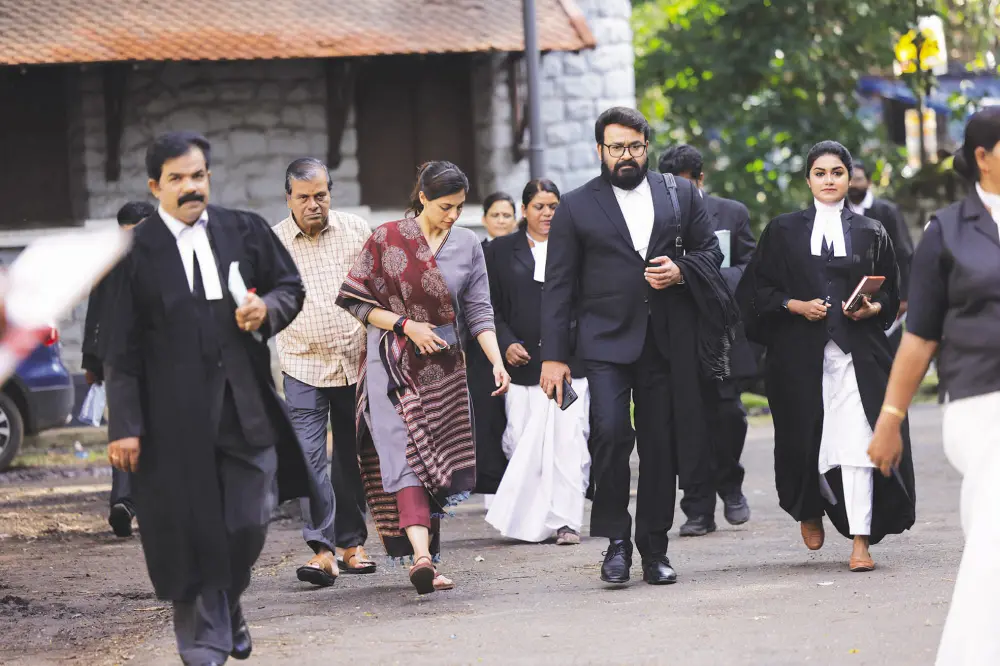
Films from the Southern states are no exception. In Neru (2023) (Malayalam), petitioner Deepak Unni approached the Kerala High Court claiming the courtroom drama by Jeethu Joseph and Mohanlal used ideas from a script he had shared with them earlier. The story is about Sara, a blind girl who is sexually harassed by an intruder. Her family seeks help from Vijaya Mohan, a lawyer who hasn't practiced for years. With her resilience and Vijaya Mohan's intelligence, they try to find justice in The Indian Legal System. Determined to seek justice, Sara who is also a talented sculptor, joins hands with a disbarred lawyer as she goes up against her aggressor, the son of a business tycoon. Kerala High Court refused to stay the release of Jeethu Joseph's directorial 'Neru'. Remember that the biggest pull in the film was Mohanlal, questions asked, accusations made but hardly any punishment.
Kamal Hassan has often been plagued with charges of plagiarized stories in some of his films. One example is Papanasam. Satheesh Paul filed a suit against the producers and director Jeethu Joseph for violating the copyrights of his novel, Oru Mazhakalathu. However, with the support of the film producers and Kamal Hassan, director Jeethu Joseph was able to fight the case victoriously.
The Tamil film Lingaa starring superstar Rajnikant with Sonakshi Sinha was charged by the Madurai-based filmmaker KV Ravi Rathnam who claimed that it was his original story. But when the director of Lingaa namely KS Ravikumar and Rajnikant himself filed a counter affidavit claiming that Lingaa was based on a story by Ponkumaran, KV Ravi Rathnam charge fell flat on its face and the film was duly released in the theatres and became a big-time hit.
The Kannada hit Byari which won the National Award faced a legal battle and finally, a compensation awarded to author Sarah Aboobacker for unauthorized adaptation of her novel. Kantara faced a temporary legal restriction on its hit track Varaha Roopam due to copyright claims of musical similarity.
Bogan, a film directed by Lakshman which won the National Award and starred Jayam Ravi and Arvind Swami, got embroiled in a plagiarism controversy in 2017. An upcoming director, Antony, accused Lakshman of plagiarism and claimed that the story of Bogan belonged to him. He filed cases against the director, producers Isari Ganesh and Prabhudheva. But somehow, the film saw the light of the day and turned out to be a decent hit.
According to noted Indian film scholar MK Raghavendra’s paper, ‘Plagiarizing’ for Bollywood, “Popular Indian cinema was held to be imitative of Hollywood until fairly recently when its method became the subject of deeper scrutiny. Bombay filmmakers emphasize that their films differ in content and format from Western films and there is a definite method involved in making films for Indian audiences. Most people are aware that Hollywood or Western cinema frequently provides Bollywood with its models but no successful Bombay film simply 'copies' Hollywood. Most films, even when they 'borrow' from non-Indian models, need to integrate the borrowed motifs within Indian filmmaking conventions if the film must be successful.”
Today, so far as Indian cinema goes, the Hollywood influence is almost entirely absent though some traces of its influence remain such as the cabaret numbers which were almost compulsory in every mainstream film be it in Hindi or in the Southern films till recently. While there are softwares like Turnitin for catching plagiarisation in written material, I do not think that similar softwares are available for films. One of the most widely distributed educational applications in the world, Turnitin is used by more than 10,000 institutions in 135 countries to manage the submission, tracking and evaluation of student work online.
This writer however, is ideologically not against being “inspired” by ideas and concepts and in giving these a personal take through language, cultural facets and total Indianisation and making a film keeping these in mind.