
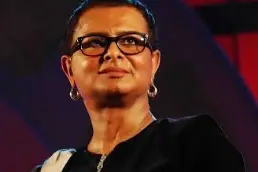
What makes Rituparno Ghosh, till this day, the most talented and bold director in the tinsel town of Tollygunje in the post-Ray-Sen-Ghatak era? Was it his ability to the draw out the best performances from his actors, actresses? Or, was it his command over the language of cinema that made him the most sought-after filmmaker by producers ranging from NRIs to successful banners from the Bengali mainstream like Shri Venkatesh Films and later, even Subhash Ghai from Bollywood? Perhaps, it could be his tightly-knit screenplays, his lucid dialogue and his grasp over the chutzpah of production design, music and other technical details? Incidentally, he was also one of the most prolific filmmakers in Bengali cinema during his time and would have made many more films if he hadn’t passed away at a comparatively young age in 2013.
His skills were honed in making advertising films, and he made not less than 400 during his tenure as ad film maker. His first film as director came with Hirer Angti based on a short story by Sirsendu Mukhopadhyay and was produced by the CFSI. Though it won an international award, it failed to get a theatrical release.
“It was Satyajit Ray’s Jalsaghar (The Music Room) that led to the gem of an idea for what shaped into Unishe April. I told myself, if I were to make a film exploring the loneliness of a celebrity, how would I do it. As I worked on the script, I felt the story needed more fleshing out because I was making a feature film. So, I introduced the daughter and the story finally evolved into a confrontation between the celebrity mother and her anonymous daughter. Interestingly, the daughter’s character turned out to be more author-backed than the mother’s. That was never my intention!” Ghosh said in an interview.
Women in his films
His second film Unishe April (the 19th of April) bagged the top award at the National Film Awards in 1995. Debasree Roy was also bestowed the Best Actress Award for her role in the film. This was perhaps for the first time in the history of Indian cinema for the director using the narrative (conceived, scripted and written by Ghosh) to diagnose a mother-daughter schism in ideological terms. He did it with a certain amount of objective distance perhaps because he was still having teething troubles. But this proved to be an asset that added quality to his work.

His woman-centric films showed how deeply a filmmaker could probe into the depths of the psyche of a woman. Through all his feature films since Unishe April, the loneliness of a woman had been his forte. However varied in their manifestations his women might have been, never mind the differences in their relationships with others, or even the sociological backdrop they belong to, the bottom line is the same – they are lonely souls who find loneliness unavoidable against the backdrop of patriarchy. It is as if he has ‘naturalised’ loneliness as an integral part of the woman’s mindset. He once said, “Women are important to me because of their combination of vulnerability and strength. Binodini, the woman around whom Chokher Bali centres, is the ideal woman in this context. She is vulnerable because of her reduced status, yet, because of her persona, beauty and education,, she is powerful too.”
Rituparno Ghosh’s ‘Family’
The family as portrayed in the directorial films of Rituparno Ghosh counters the most perceptions of conventional and traditional forms of this social institution. Through his films, beginning with the contemporary and post-modernist Unishe April to his period classic Antarmahal, one discovers that instead of worrying about the composition and structure of the family, he studied what families do and what his characters themselves consider to be 'family.' He steered clear of the abundance of what literature and popular cinema have showered on the family as an institution of society. At the same time, his films define in minute detail, the everyday activities of family life. This includes the ordinary ways in which families eat together (Asookh, Utsab, Titli), enjoy leisure activities (Titli, Bariwalli, Chokher Bali), and care for each other (Asookh, Dahan, Shubho Muhurt), which are not trivial but things that really matter to families.
Rituparno's celluloid family could be defined as a radical family in emotional and psychological terms, even where the family apparently seems to be quite conventional in its structure and its composition. The inner spaces of the house/apartment/mansion that the member/s of the family inhabit in each film, evolves into a character unto itself, and does not remain confined merely as the physical framework within which the human characters negotiate their terms of interaction. The celluloid 'family' presented by Rituparno Ghosh in six films – Unishe April, Dahan, Asookh, Bariwalli Utsab and Titli are worth exploring.
Literature and Rituparno
Rituparno’s adaptations of literature other than his Tagore interpretation Chokher Bali covers a wide span of literature in terms of language, history, authorial representation and content. The seed was sowed with Shirsendu Mukhopadhay two of whose stories Rituparno chose to present on celluloid. His first film Hirer Angti was one and Dosar was the other. He made Raincoat in Hindi loosely adapted from O’Henry’s famous short story The Gift of the Magii.
Antarmahal was a very loose and distorted adaptation of Tarasankar Bandopadhyay’s short story Protima. Shubho Muhurat was an Indianised and contemporary relocation of Agatha Christie’s The Mirror Crack’d From Side to Side. The Last Lear does not have direct links to William Shakespeare’s King Lear except in the title and in its protagonist being a famous Shakespearan actor who has fallen on bad days. Rituparno had generously dotted the screenplay with direct references to the Shakespearean original and the protagonist’s obsession with King Lear and his performance in the title role. Dahan is a celluloid interpretation of a literary piece of work by Suchitra Bhattacharjee said to bebased on a true incident that lends itself to a strongly feminist reading.
A unique element in a Rituparno Ghosh script is its distinct structure, which changes with every film he directs. Unishe April opened with the shocking scene of an untimely and sudden death. Whispers and hushed tones underscored the grief of a little girl in shock, till we were surprised to discover that the entire unfolding was in flashback. The narrative of Dahan is sandwiched between letters penned by one of the two main female characters to her sister away in Canada. Asookh explores the cinematographic space with a structured narrative that moves in and out of film shoots, the make-up room of the film-star heroine, and the dark, brooding ambience of her bedroom as the camera closes in again and again on her loneliness, her deep emotional insecurity, and her sense of alienation.
In Bariwalli, he brings Bonolota down to repair a fuse gone wrong. Dipankar, the film director steps in to help her out. The film closes on the same note. The film team has left, the fuse has gone kaput once again and Bonolota clambers downstairs to repair it herself, having come to terms with her loneliness. In Dosor, it begins with a car crash, a traumatic accident that is out of the frame but is expressed through the sound track and from the faces of the crowd gathered to watch. It ends rather tamely, with the estranged husband and wife coming to terms for a new beginning.
Dahan (Crossfire) opens with a voice-over of one of the two women who form the centre of the narrative. This female voice, used as a framing device in this circularly structured film, destabilizes, the popular practice of using a male voice-over and thus registering the authority of the male. The female voice functions here, unlike in dominant cinema, in relationship to one of the major visible characters on screen. The voice-over is a letter Ronita is writing to her older sister in Canada. The film closes with the same voice-over, with Ronita’s letter being read out against the visual of an aircraft in flight, taking her to distant Canada.
In Utsab, Ghosh opens the narrative through the video camera of a strapping young man, Joy, grandson of the matriarch, who has come for Durga Pooja in a sprawling mansion. Joy uses his camera to make observations on the house, the family and the festival. The Durga Pooja is the ‘peg’ on which the film hangs. Joy wants to become a filmmaker, but has surrendered to his father's wishes to do an MBA abroad. His comments on the trivialities around the house are allegories that bring alive his passion for films and filmmaking. "I have heard these pooja vessels were used by Satyajit Ray in Debi," he says. "My mother told me this though she was very small then."
Abohomaan is rooted in the fragmenting of a ‘happy family’ situation comprised of Aniket (Dipankar Dey), a famous director of ‘art films,’ wife Deepti (Mamata Shankar), growing son Apratim (Jisshu Sengupta) and Aniket’s old mother (Sova Sen.) The family falls apart from inside though to outward appearances, everything remains as it was. Shikha (Ananya Chatterjee), gatecrashes into their lives with a self-scripted, self-styled audition that is as arrogant and self-indulgent as it is defiant. Though Aniket does not care for her brash ways, Deepti feels she is just right for the role of Binodini for the film Aniket is planning to make. Her grooming of the unsophisticated, loud and crude Shikha prepares the younger girl to step into this difficult ‘period’ role based on the true story of Nati Binodini, a famous theatre actress of the Bengali stage, whose relationship with her mentor and director Natasamrat Girish Chandra Ghosh is legendary. The film-within-the-film spills over, in some way or the other, into a real life relationship between Aniket and Shikha. Deepti feels betrayed both by her husband and the young actress. Aniket shrugs off everything and does not once confirm the scandal making the rounds of the gossip mills even as he moves from the dining table into the rest room to talk for hours to her on his cell phone. He does not stop the editor of a film glossy from publishing a lead story on the scandal authored by his own son.
His unconventional structure within the narrative of Abohomaan works well with critics and serious film buffs but not with the mass audience left to grope with cinematic markers between and among the time-zones. Lastly, audiovisual references to texts and cultural performances of bygone eras the audience might not be familiar with, leads to a lack of understanding the links and therefore, a failure to draw parallels with the main story. It is difficult to invest a story that revolves around an adulterous scandal with dignity. It is nearly impossible to let it go without being judgmental. Abohomaan succeeds on both counts.
Rituparno was the youngest director among the pillars of Indian cinema who carved a niche in Indian cinema consistently through his directorial films and a few films as actor. He made award-winning films, with around a dozen National Awards.
He transcended the barriers of regional cinema firstly, by bringing in actors and actresses from national cinema to star in Bengali films, such as Mithun Chakraborty in Titli, Sharmila Tagore, Nandita Das and Raakhee in Shubho Muhurt, Kiron Kher in Bariwali, Aishwarya Rai in Chokher Bali, Soha Ali Khan, Abhishek Bachchan and Jackie Shroff in Antarmahal, Moneesha Koirala in Khela, Bipasha Basu in Shob Charitro Kalponik, Amitabh Bachchan, Preity Zinta, Divya Dutt and Shefali Chhaya in The Last Lear, Madhavan and Jaya Bachchan in Taank Jhaank (Sunglass) and secondly, by stepping directly into Hindi territory with Raincoat, starring Ajay Devgun and Aishwarya Rai.
Filmmaking, for Rituparno, was an experiment in discovering new ways of story-telling through the language of cinema. It was a learning experience. He journeyed through the 21 years exploring different dimensions of human life, love, relationships, loneliness, solitude, gender in different ways. “If I were to go on making Unishe April and Dahan, I would have had to commit suicide,” he once said. His cinema itself was a question of making choices – which film to make next, how to make it, on what story, and when. But so it is with many filmmakers with a passion for cinema and for filmmaking.
Published: 20 Apr 2025, 08:07 am IST
Related Topics
Disclaimer: Kindly avoid objectionable, derogatory, unlawful and lewd comments, while responding to reports. Such comments are punishable under cyber laws. Please keep away from personal attacks. The opinions expressed here are the personal opinions of readers and not that of Mathrubhumi.