
Vikramaditya Vedic Clock, a unique timekeeping system based on ancient Indian astronomy. Divides the day into 30 Muhurtas.
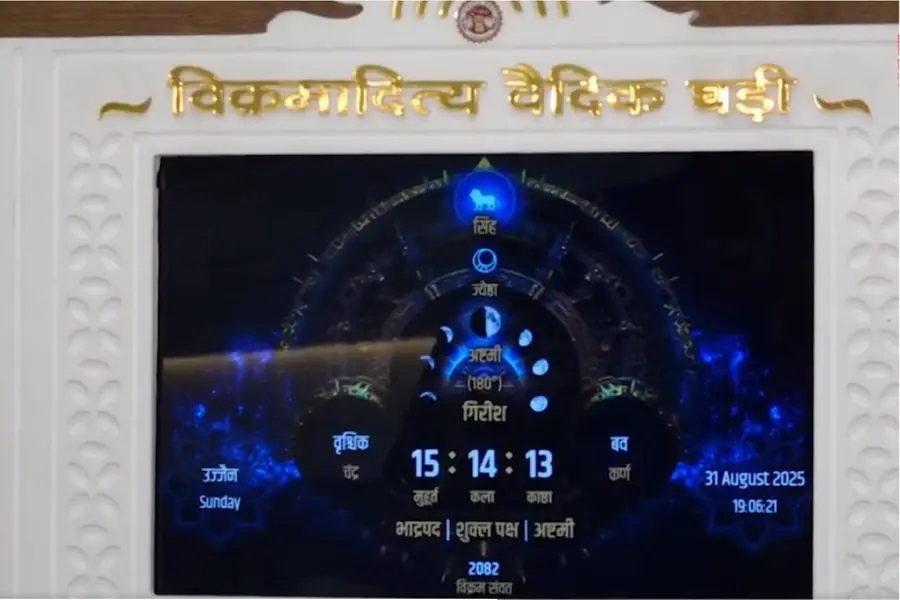
Ujjain: Madhya Pradesh Chief Minister Dr. Mohan Yadav will inaugurate the world’s first Vikramaditya Vedic Clock in Ujjain, a unique timekeeping system based on ancient Indian astronomical principles. The initiative, developed by Arohan Sanstha under the Maharaja Vikramaditya Research Centre, aims to revive traditional Indian time calculation methods and integrate them with modern digital platforms.
The Vedic clock does not follow the conventional 24-hour format. Instead, it divides the day into 30 muhurtas, with sunrise marked as zero and sunset at 15, adjusting dynamically with local solar movement.
Key features of the Vikramaditya Vedic clock and app:
Sunrise-based timekeeping: The clock begins its count from sunrise, unlike modern clocks that reset at midnight.
30 muhurtas per day: A traditional Indian division of time replaces the standard 24-hour format.
In-depth Hindu calendar (panchāngam) information: Users can access data on Nakshatra, Tithi, Yoga, Karana, planetary positions, and more.
Festival & eclipse alerts: Dates and timings for Hindu festivals, fasts, and solar/lunar eclipses.
Multilingual app: A companion mobile application is available in 189 languages, providing personalized Vedic calendar data and astronomical information.
Integrated time display: Shows Vedic time alongside Indian Standard Time (IST) and Greenwich Mean Time (GMT).
How the clock was conceptualised by Arohan Srivastava
The clock has been developed by engineer Arohan Srivastava, who first envisioned the idea in 2013 after a visit to the Greenwich Museum in the UK. There, he recognised how Western time systems, especially the Prime Meridian, had been globally imposed, overshadowing India’s own scientific traditions.
The project gained momentum after Srivastava met Dr. Mohan Yadav, then the Higher Education Minister, during a bicycle pilgrimage to India’s 12 Jyotirlingas. Their shared interest in Vedic sciences led to institutional support for the clock's development.
The Vikramaditya Vedic Clock is calibrated using astronomical data from the Dongla Observatory and aligns with calculations rooted in Jyotish Shastra and traditional Indian almanacs. It is designed to function with real-time solar movement, making it location-specific.
A prototype of the clock was earlier installed at Jantar Mantar in Ujjain, which was inaugurated by Prime Minister Narendra Modi on February 29, 2024.
Published: 01 Sept 2025, 09:51 am IST
Related Topics
Disclaimer: Kindly avoid objectionable, derogatory, unlawful and lewd comments, while responding to reports. Such comments are punishable under cyber laws. Please keep away from personal attacks. The opinions expressed here are the personal opinions of readers and not that of Mathrubhumi.
