
A NASA satellite blazes through Earth's atmosphere during re-entry, breaking apart as it burns, with fiery debris trailing against the backdrop of the planet below
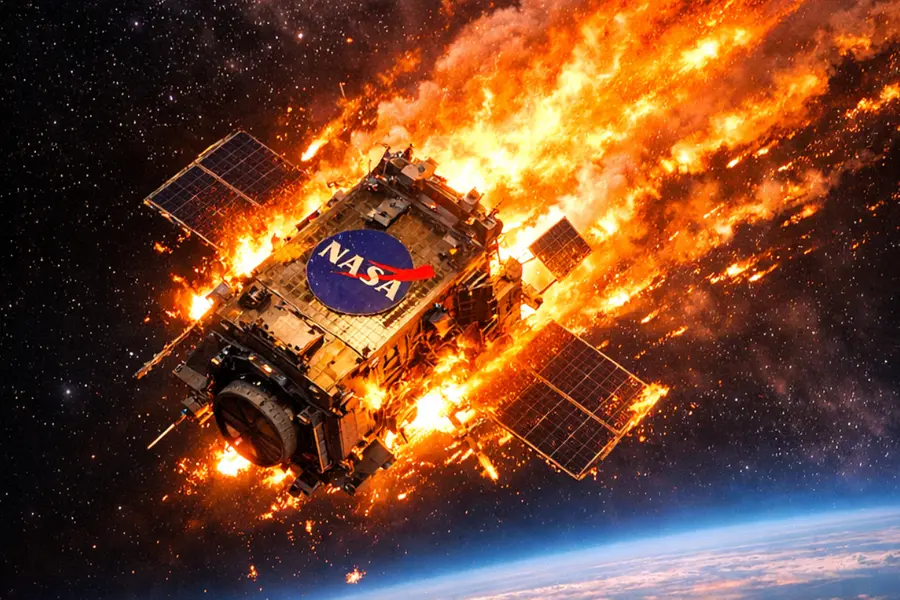
Washington: NASA’s Van Allen Probe A is expected to re-enter Earth’s atmosphere on March 10, nearly 14 years after its launch, according to predictions from the U.S. Space Force. The spacecraft, which weighs approximately 1,323 pounds, was part of a twin-probe mission alongside Van Allen Probe B to study the radiation belts surrounding Earth.
From 2012 to 2019, the Van Allen Probes flew through the Van Allen belts, rings of charged particles trapped by Earth’s magnetic field, to understand how these particles are gained and lost. The belts serve as a protective shield against cosmic radiation, solar storms, and the solar wind, which can damage technology and pose risks to astronauts.
As of March 9, 2026, the U.S. Space Force projected that Van Allen Probe A would re-enter at around 7:45 p.m. EDT on March 10 (5:15 am IST on March 11), with a margin of error of plus or minus 24 hours. NASA expects that most of the spacecraft will burn up during re-entry, though some components may survive. The agency emphasised that the risk of harm to people on Earth is very low, approximately 1 in 4,200. NASA and the Space Force will continue monitoring the satellite closely and provide updated predictions.
Originally intended for a two-year mission, the Van Allen Probes launched on August 30, 2012. For nearly seven years, they collected unprecedented data on Earth’s two permanent radiation belts, named after physicist James Van Allen. NASA concluded the mission in 2019 after both spacecraft ran out of fuel and could no longer orient toward the Sun.
The mission marked a milestone as the first spacecraft designed to operate for extended periods inside the harsh radiation belts, a region most missions usually avoid. During its lifetime, Van Allen Probe A made several significant discoveries, including the identification of a transient third radiation belt that forms during intense solar activity.
Earlier forecasts had predicted that the spacecraft would re-enter in 2034. However, the current solar cycle has proven much more active than expected, with the Sun reaching its solar maximum in 2024. Increased solar activity caused higher atmospheric drag on the satellite, accelerating its descent and leading to the earlier-than-expected re-entry.
Data collected by the Van Allen Probes continues to be invaluable for understanding space weather and its effects on satellites, astronauts, and terrestrial systems like communications, navigation, and power grids. Scientists are reviewing the archived data to improve predictions of solar activity and potential hazards.
Van Allen Probe B, the twin spacecraft, is not expected to re-enter before 2030.
Published: 10 Mar 2026, 06:43 pm IST
Disclaimer: Kindly avoid objectionable, derogatory, unlawful and lewd comments, while responding to reports. Such comments are punishable under cyber laws. Please keep away from personal attacks. The opinions expressed here are the personal opinions of readers and not that of Mathrubhumi.
